Stock Market Week Ahead (August 10-14): CPI Wednesday, Cisco, Super Micro, CoreWeave and Applied Materials
Week ahead August 10-14: July CPI lands Wednesday 8:30am ET and decides the September hike. Sea Limited, CoreWeave and Super Micro Tuesday, Cisco Wednesday, Applied Materials Thursday.
TL;DR
- Wednesday at 8:30am ET is the whole week. July CPI lands, and after Friday's payrolls miss it is the number that decides whether the Fed hikes in September. CME FedWatch odds of a September hold jumped to about 60% on Friday, from 45% Thursday and roughly one in three a week earlier; Kalshi's contract puts hold odds even higher, near 65%.
- The week starts from a record. The S&P 500 closed Friday at 7,757.64, up 0.62%, capping a week in which it gained about 3.6% and the Nasdaq gained about 5.2%, because a bad jobs report is now good news for rates.
- The Fed walks in split and without a safety net. July's hold drew three dissents in favour of a hike, the most since September 2016, and Chair Kevin Warsh has stripped forward guidance out of the post-meeting statements, so the data carries the whole load.
- The Cleveland Fed nowcast wants 3.42% headline and 2.52% core, a headline that barely moves against a core that keeps easing.
- Tuesday is the AI infrastructure audit: CoreWeave and Super Micro both report after the close, with Sea Limited before the open carrying a 19% implied move, one of the largest of the season.
- Cisco closes the loop on networking Wednesday, and Applied Materials reports Thursday into a memory cycle that has whipsawed the stock 40% in both directions this summer.
- Thursday adds July PPI at 8:30am ahead of Applied Materials that evening, and Friday brings July retail sales at 8:30am, the first read on the consumer since payrolls went negative.
More on $SPY: Stock Market Week Ahead (August 24-28): Nvidia, July PCE, and Warsh at Jackson Hole →
What to Expect From the Stock Market This Week
Last week was the busiest earnings week of the quarter and it delivered a genuine surprise: the feared SpaceX unlock produced a rally rather than a crash, and the market ended at a record despite the economy shedding jobs.
This week the argument narrows to one question, and it is a macro question rather than an earnings one. Does inflation give the Fed permission to stay put? Friday's payrolls print did half the work. Wednesday's CPI does the other half, and everything else on the calendar, including two of the most volatile stocks in the AI complex, trades in its shadow. Use the sector heatmap to see where the rate repricing actually lands rather than guessing from the index level.
The Board
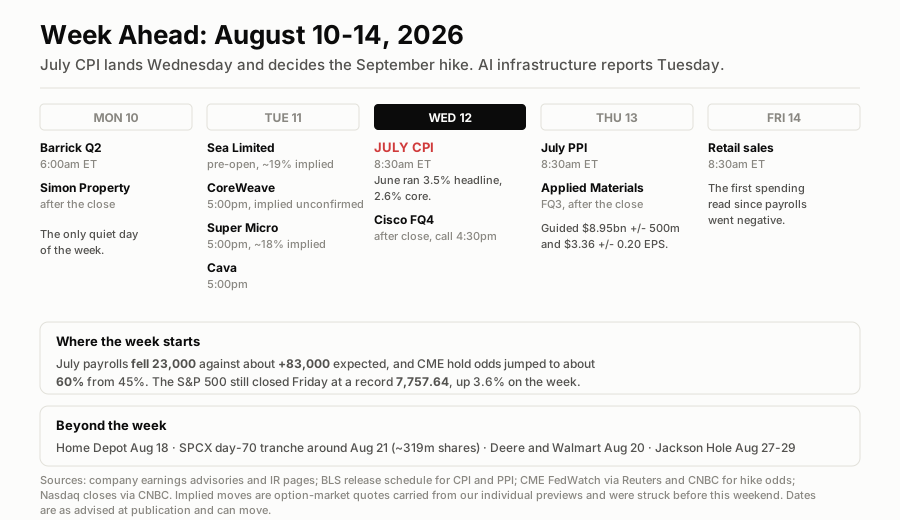
One macro print, four volatile reporters, and a market starting from a record high.
Why Friday's Jobs Report Changed This Week
Start here, because it reset every expectation on the calendar.
July payrolls fell by 23,000, against a consensus that wanted roughly +83,000. The composition is what makes it argumentative: government payrolls dropped 53,000 while private payrolls rose 30,000, so the headline is partly a public-sector story. May and June were revised down by a combined 103,000.
The unemployment rate actually fell to 4.1%, which sounds reassuring and is not, because it fell for the wrong reason: labour force participation dropped to 61.4%, a level not seen in over five years. People left the count rather than found work. Average hourly earnings growth slipped to 3.2% year over year, the slowest since May 2021.
Markets read all of that as one thing: the Fed does not need to hike. On CME's FedWatch tool, the odds of a hold at the current 3.50-3.75% target jumped to about 60%, from 45% on Thursday and roughly one in three a week earlier. The prediction market Kalshi shows hold odds running even higher, near 65%, up from close to a coin flip before the report; hike odds had sat at almost 58% just after the July 29 FOMC meeting, so the whole move happened in twelve days. The two sources do not agree on the exact split, but they agree completely on the direction: a September hike is now the minority case. Stocks rallied to a record on it. For context, CME's tool still prices a 55% chance of a hike in October and almost 75% by December, so the market is not calling off the tightening cycle, only pausing it one meeting.
Two things make Wednesday heavier than a normal CPI. The committee is already split: at the July 29 meeting it held at 3.50-3.75% with three dissents in favour of a hike, from Beth Hammack of Cleveland, Neel Kashkari of Minneapolis and Lorie Logan of Dallas, the most dissents since September 2016. And there is no verbal cushion, because Chair Kevin Warsh has removed forward guidance from the post-meeting statements. With nothing to steer expectations between meetings, the data carries the whole load.
That is the setup Wednesday walks into. A soft CPI confirms the pause and the record close gets extended. A hot CPI puts the Fed back in play with a labour market that is already deteriorating, which is the genuinely uncomfortable outcome and the one nothing is priced for.
Monday, August 10: The Only Quiet Day
monday.com opens the week before the US open. Consensus wants $355.5 million of revenue against a $354-356 million guide, and options price a 23.4% move against a $93.13 close, the widest single-name implied move on the board. The company has already guided growth down from 24% to 18-19%.
Barrick reports Q2 at 6:00am ET, with the webcast at 11:00am. Gold has been the quarter's quiet winner, and Newmont's record $2.2 billion free cash flow quarter sets the comparison: strong trailing profits against forward numbers that move with the gold price rather than with anything management does.
Updated August 10, at the close. monday.com beat every line and the market only half-believed it: revenue of $364.6 million, up 22%, past both the guide and consensus, non-GAAP EPS of $1.48 against $1.11, and then the full-year revenue range held at $1,466-1,474 million with Q3 guided below the street. The stock opened down about 9% pre-market and closed down 4.84% at $88.62, clawing back more than half the early decline, well inside the 23.4% the options were charging. Barrick beat its production guide and missed on cash: 796,000 ounces against a 730,000-770,000 guide, adjusted EPS of $0.82 against $0.84, and attributable free cash flow of $141 million against $1.21 billion in Q1, as the realised gold price fell to $4,417 an ounce and capex rose to $978 million. It closed down 6.41% at $40.88, worse than the 5.9% pre-market print, past its own straddle's breakeven.
Rumble, now RUM Group, reported after the close, call at 5:00pm ET. Revenue of $40.4 million, up 61%, cleared the single-analyst $30.7 million placeholder this site flagged as unreliable going in, split between $30.3 million of Rumble video and $10.1 million of Quake AI for a partial quarter of Northern Data. The net loss widened to $79.1 million on acquisition costs, and management issued its first-ever guide: Q3 revenue of $87-93 million. The stock was quoted around $6.19 in thin after-hours trading, a snapshot minutes after the print.
Simon Property Group reported after the close, with the street looking for FFO near $3.21 on revenue of about $1.61 billion. Results were not out in time for this update; check the earnings calendar for the release.
Tuesday, August 11: The AI Infrastructure Doubleheader
Four reporters, and three of them carry double-digit implied moves. This is the day with the most single-stock risk in the week.
Sea Limited reports before the open, with the call at 7:30am ET. Consensus wants $0.86 of adjusted EPS on $7.09 billion of revenue, but only five analysts sit in that average and the spread runs $0.74 to $1.00. Options price a 19.1% move struck against the $114.91 close on August 6, one of the biggest implied swings of the entire season. Sea has missed EPS in a typical quarter (a median surprise of -4.9% over the last four) while the revenue machine keeps beating, so which line the market grades decides the day. The real test is whether management holds the full-year guide of Shopee GMV up about 25%.
CoreWeave reports after the close, call at 5:00pm ET. Consensus is $2.56 billion of revenue, up about 112% from $1.21 billion, inside the guided $2.45-2.6 billion, with an adjusted loss near $1.27 per share. The argument is the ledger: a backlog approaching $100 billion, fattened by Meta's expansion to $35 billion of total commitments, against $31-35 billion of capital expenditure. The stock round-tripped violently in July, from the low $90s to a July 29 low near $60 and back to the mid-$80s.
Super Micro reports fiscal Q4 the same evening. Most of the headline is already public from a July 21 preannouncement claiming more than $60 billion of new orders, which sent the stock up as much as 20%. Tuesday is the cross-examination of the margin story behind it. Revenue near $11 billion would be about +91%, and note the trap: EPS consensus exists in two irreconcilable flavours, $0.59 and $0.92 on different adjustment bases, so ignore any single beat-or-miss headline. Options price about 18% against a $28.40 close on July 31.
Cava reports at about 4:10pm with the call at 5:00pm. Consensus wants revenue near $353 million, up 26-27%, with adjusted EPS of about $0.17. The setup is momentum against valuation: Q1 comps ran +9.7% and the year-ago Q2 comp was just +2.1%, the easiest lap on the calendar. At north of 120x earnings, beats are the baseline and the question is whether a second full-year guidance raise arrives.
Updated August 11, after the close. Tuesday delivered. Sea Limited grew revenue 48% to $7.8 billion, past the $7.09 billion consensus, and opened up about 9%, well inside its 19.1% implied move; GAAP EPS of $0.70 landed below the adjusted-basis estimates, the exact consensus split flagged in the preview. CoreWeave beat on revenue, adjusted EBITDA and operating income, with revenue of $2.58 billion, up 112%, a 59% adjusted EBITDA margin and a backlog of $104.2 billion at June 30, and traded up 12-14% after hours when the call put the backlog at $129.2 billion as of August 11. Super Micro missed revenue by 4% at $11.12 billion and rose 8-9% after hours anyway, on a 17.5% gross margin, adjusted EPS of $1.70 and a fiscal 2027 guide of $65-72 billion against a street at $52.5 billion. What the doubleheader means for the record chase is in the hero piece.
Three more report before the open Tuesday. Cardinal Health closes fiscal 2026 with the tightest consensus band of the week, $2.39-2.46, against a computed whisper of $2.73; the event is the first fiscal 2027 guide. eToro reports with the webcast at 8:30am ET, where net contribution rather than the gross crypto revenue line is the number that matters. Tencent Music reports at 7:00am ET carrying a 10% implied move and a freshly consolidated Ximalaya acquisition.
Wednesday, August 12: July CPI at 8:30am, Then Cisco
The full hour-by-hour timetable for the day is here, covering CPI, Tencent, Brinker, Cisco and Coherent in sequence.
This is the print of the week and possibly the month. The timetable, the firmed-up forecast and the scenarios are in the CPI piece.
Here is where the forecast actually stands, because it matters more than usual. June CPI came in at 3.5% headline and 2.6% core, both well below expectations, against 4.2% in May. The whole of that drop was energy: the energy index fell 5.7% on the month, its largest one-month decline since April 2020, and headline CPI fell 0.4% month over month while core was flat.
For July, the Cleveland Fed's inflation nowcast, updated August 7, puts headline CPI at 3.42% and core at 2.52%. That model runs on daily oil and weekly gasoline prices, which makes it the most defensible published forecast going into this print. Prediction-market pricing has clustered near 3.5-3.6%, close enough to agree. A widely syndicated economist consensus of 2.8% is also circulating and sits nearly a full point below both; two of the three cluster and that one does not, so our read is that it is the outlier rather than the insight.
Take the nowcast at face value and Wednesday looks dull on the front page: 3.5% to 3.42% on the headline, 2.6% to 2.52% on core. Core is the number the Fed reacts to, so a dull-looking print can still settle September.
Now look at what the same model says about August: 3.45% headline, but a monthly jump of 0.38% against July's 0.09%. Brent settled at $83.55 on Friday, having dipped below $80 earlier in the week on hopes of a deal to reopen the Strait of Hormuz. It rose back above $84 on Monday after Iran's foreign minister said the waterway stays shut until Washington eases sanctions and pays reparations. The energy shock lands in the August print, reported in September. Wednesday is the calm month.
That June was measured before the ceasefire collapsed is a point we made in the June CPI preview, and the 5.7% energy drop confirmed it. We expected the war premium to show up in July; the nowcast says it mostly does not, and lands in August instead. The risk to Wednesday is therefore the other way round from the obvious one: the outcome that keeps September genuinely live is a firm core, not a hot headline, and it is the one a reader watching only the front-page number will misread.
Updated August 12, after the print. July CPI landed dead on the nowcast: 3.4% headline, 2.5% core, +0.1% on the month, with the energy index falling 1.5% instead of spiking. The calm-month call above held, September pricing stayed near a coin flip, and the report that can actually settle the meeting is now the August CPI on September 11.
Cisco reports fiscal Q4 after the close, with the call at 4:30pm ET, covering the period ended July 25. Consensus of $1.17 on $16.83 billion sits dead on the guide, so the event is the first formal fiscal 2027 AI revenue guidance. It is the last big networking read of the season and the cleanest test of whether AI data-centre spending is reaching the switching and optics layer or stopping at the accelerator.
Coherent reports the same evening, call at 4:30pm ET, and it is the sharper version of that test. Consensus of $1.62 sits at the midpoint of a $1.52-1.72 guide, so the quarter is close to pre-agreed, while the stock has run about 44% off its July 29 low on an August 4 report of drafted US restrictions on Chinese optical transceivers. Options price 14.8%.
Tencent reported after the Hong Kong close: revenue beat at RMB 204.8 billion, up 11%, but capex nearly tripled year on year and profit missed. Brinker reports before the open, call at 10:00am ET, where three quarters are already banked and the first fiscal 2027 guide is the whole print.
Updated August 12, after the close. All three evening reporters beat and sold off, the same pattern in three different corners of the AI trade. Cisco beat on every line and guided FY27 AI revenue to $7.5 billion, clear of its own $6 billion floor, then fell roughly 2% after hours on a sell-the-news reaction. Coherent's non-GAAP EPS of $1.74 cleared the top of its own $1.52-1.72 guide, and the stock still gave back about 3.6% after hours from an already-elevated close. Cerebras beat both the core revenue and margin guides it had cut seven weeks earlier, raised full-year guidance, and fell roughly 16% after hours, the sharpest of the three reactions. None of the three misses were about the numbers; all three stocks had already run hard into the print.
Thursday, August 13: July PPI, Then Applied Materials
The full hour-by-hour timetable for the day is here, covering PPI, jobless claims, the four 8:00am calls and Applied Materials in sequence.
July PPI lands at 8:30am ET, one day after CPI rather than alongside retail sales. It is the producer-side check on whatever Wednesday says, and on goods it usually leads consumer prices by a quarter or two. If CPI runs hot on energy and PPI does not confirm it, the inflation scare is a pass-through story rather than a broad one.
Applied Materials reports fiscal Q3 after the close, with the call at 4:30pm ET. The guide is the consensus: management guided revenue of $8.95 billion plus or minus $500 million, up about 23%, and adjusted EPS of $3.36 plus or minus $0.20, up about 36% from $2.48, and the street has settled on those numbers. When consensus equals the guide, the quarter is close to pre-agreed and the reaction lives entirely in the outlook.
The backdrop got louder while the stock fell. Samsung says the memory shortage lasts into 2028, TSMC raised 2026 capital expenditure to $60-64 billion, and the tape has been brutal in both directions: a June record, a roughly 40% drawdown into the late-July chip selloff, then a 15% single-day rebound on July 30. The known cost is new US export restrictions that AMAT expects to remove $600-710 million of fiscal 2026 revenue, with China now roughly a quarter of sales against about 40% in 2023.
Four more report before the open Thursday. JD.com laps the peak of the delivery-subsidy war, when its new-business segment lost RMB 14.8 billion in a single quarter. Tapestry closes fiscal 2026 with Coach now roughly 89% of group revenue and the stock within about 2% of its high. Birkenstock reports a quarter where constant-currency and reported growth differ by six points. Nu Holdings reports after the close, the one name on the week whose computed whisper sits below consensus.
Friday, August 14: Retail Sales
July retail sales lands at 8:30am ET, which makes Friday a third macro day rather than a wind-down. The hour-by-hour timetable for Friday is here.
This is the first spending read since payrolls turned negative. Put it next to Friday's participation rate of 61.4%, Wednesday's inflation print and Thursday's PPI and you have the entire argument about whether this is a soft landing or the front edge of something worse.
What to Look Out For Beyond the Calendar
The SpaceX day-70 tranche lands around August 21. Roughly 319 million shares, our own derived figure against an approximate date, become eligible. The first unlock produced a 6.1% rally rather than a crash, which cuts both ways for the next one: the fear has been discharged, and the supply is still scheduled. The full staircase runs to December 8, and the lock-up calendar tool tracks the dates.
The following week is the retail week: Home Depot on August 18, Target and Lowe's on August 19, then Walmart and Deere on August 20; the full retail-week board is here. If Friday's retail sales print is soft, those names become the confirmation or the refutation. Dates for the whole slate are in the earnings calendar.
Jackson Hole runs August 27-29, with this year's topic "Financial Innovation: Implications for Payments and Policy". In a year where the debate is whether to hike rather than cut, the symposium matters more than a topic about payments suggests.
The Playbook
- Tuesday is a four-name pileup with no way to manage in between. Sea Limited, CoreWeave, Super Micro and Cava all report within about ten hours of each other. Sea and Super Micro are already pricing turbulence honestly, at 19.1% and about 18% respectively. CoreWeave is the outlier: the ~12.5% implied move still circulating predates this setup and trades at a different share price, so it is the one name on the board to size smaller against rather than lean on.
- A wide implied move is not by itself a reason to sell it. The house lesson from July was that realised moves ran well above implied all season: Roblox fell 29%, SanDisk rose 26%, Reddit fell 21%, all against single-digit implied moves. Applied Materials has already whipsawed 40% in both directions this summer, which argues for buying volatility into Thursday over fading it.
- CPI is a macro gap, not an earnings move, and it does not respect a strike. Selling premium into Wednesday's 8:30am print the way a seller prices a single stock's earnings call is a different risk than that seller usually accounts for. A defined-risk iron condor with real wings survives a surprise that a naked strangle does not.
- Applied Materials into Thursday is a hold-the-guide trade, not a beat-the-number trade. Management's own range already equals the Street's consensus, so the entire reaction lives in the fiscal Q4 outlook and the China revenue hit, not in the print itself.
- Cash through Wednesday morning is a legitimate position. CPI is the only event on this calendar that can move every other name on the board at once, and it is also the one nothing on this list can be hedged around.
The One-Line Read
A week that starts from a record high and a shrinking labour force comes down to one number on Wednesday morning: if July CPI confirms the cooling June showed, the September hike comes off the table and the rally has room, and if the oil spike that June was too early to capture shows up in the headline instead, the market has to price a Fed that may still hike into a jobs market already losing 23,000 a month, which is the one outcome nothing on this calendar is positioned for.
Next up:GDP, Wednesday at 8:30am ET →
More on $SPY
Updated Every Saturday
The Week Ahead
Every earnings date, Fed event and setup for the current trading week, on one page.
Refreshed Weekly
Earnings Calendar
Who reports next, when, and what consensus and the whisper expect.
The Week-Ahead Brief
Don’t miss next week’s setups. Get the Saturday brief.
Latest issue, Aug 17“The consumer cracked on Friday. Six retailers answer for it this week.”
Every Saturday: next week’s earnings dates, Fed days and the trades worth watching, from the same desk that writes the week-ahead hub. Free, built for retail investors.