Tencent Music Earnings Preview (August 11): A 10% Implied Move, And A Growth Rate Being Cut
Tencent Music reported Q2 2026 revenue of RMB8.93bn ($1.32bn), up 5.8%, decelerating from Q1's 7.3%. Shares fell 9.95% to $8.91 as the growth-rate-cut fear this preview flagged played out.
Updated August 11 with reported results. The preview asked whether the drag from social entertainment was finally small enough to stop mattering; group growth decelerating for a second straight quarter says it is not, yet.
TL;DR
- Tencent Music reported Q2 2026 total revenue of RMB8.93 billion ($1.32 billion), up 5.8% year over year, decelerating from Q1's 7.3% and landing between the roughly 9% pre-cut estimate and the roughly 4% bearish house call this preview flagged.
- Music-related services grew 11.0% to RMB7.61 billion ($1.12 billion), a step down from Q1's 12.2%. Membership services grew 8.1% to RMB4.79 billion ($706 million), decelerating from the 13% pace disclosed in the prior quarter's subscription line.
- The now-completed Ximalaya acquisition is consolidated into these numbers, and this preview's stated test, an organic, ex-Ximalaya growth figure, was not clearly supplied in the release; without it, the 5.8% headline cannot be cleanly split between bought and earned growth.
- Options had priced a 10% move against a $9.53 spot. Shares fell $0.98, or 9.95%, to $8.91, a session move that landed just inside the implied band rather than blowing through it.
- Analyst commentary around the print cited elevated competition risk and slower revenue trends, consistent with the May 52-week-low narrative this preview described rather than a resolution of it.
More on Earnings: Options Scorecard: The Week of August 10, Graded (35 Calls, 51% Right) →
When Does Tencent Music Report Earnings?
Tuesday, August 11, before the US market opens, with the call at 7:00am ET. Tencent Music's parent, Tencent itself, reports the following day; the full week is in the earnings calendar.
The Board
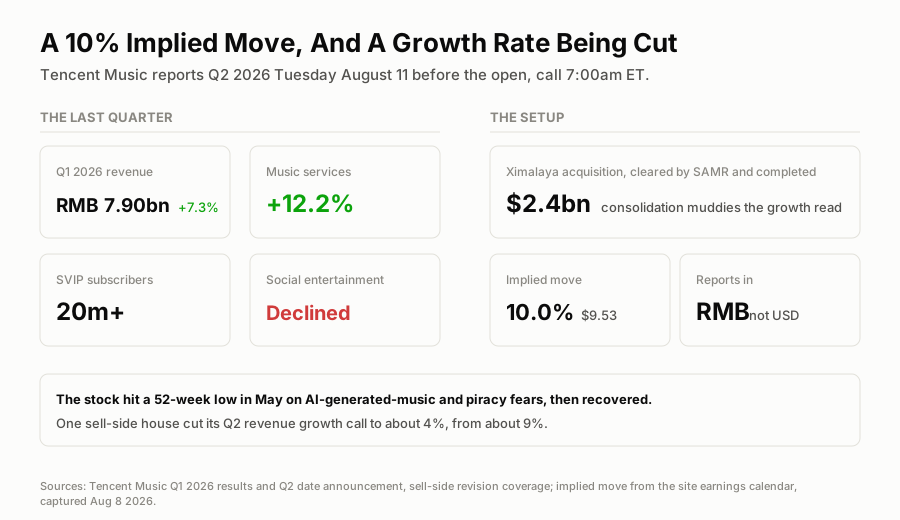
A subscription business that grew 12% last quarter grew 11% this one, inside a group that decelerated from 7.3% to 5.8%. The acquisition arrived and did not reverse the trend.
Two Businesses, Moving In Opposite Directions
Tencent Music has spent three years converting itself from a live-streaming company into a subscription company, and Q1 is the cleanest picture of how far that has got.
Music-related services grew 12.2%, driven by uptake of the premium SVIP tier, which has passed 20 million subscribers, by fan-club memberships, and by a very strong live-concert business. As of the end of 2025 the company had 127.4 million paying online music users and music subscription revenue of RMB 4.6 billion in that quarter, up 13%.
Social entertainment declined again. That is the legacy live-streaming and karaoke business, the one that regulators leaned on and that user behaviour has moved past.
Group revenue of RMB 7.90 billion, up 7.3%, is the average of those two. The market pays for the first business and discounts for the second, and the useful question on Tuesday is whether the drag from social entertainment is finally small enough to stop mattering.
What The May Sell-Off Was About
The ADR made a 52-week low in May, and the argument attached to it was AI: that generative music tools flood streaming catalogues with cheap content, that royalty economics get harder to police, and that piracy gets easier. One house cut its Q2 revenue growth forecast to roughly 4% from roughly 9% on the back of intensifying competition and industry headwinds.
My read is that this is a real risk being applied at the wrong point in the value chain. Tencent Music's moat is not scarcity of recordings, it is distribution and payment inside a Chinese ecosystem where music consumption is bundled with social identity, fan communities and live events. SVIP works because it sells status and access, not because it sells audio files. AI-generated catalogue is a genuine threat to the economics of the label side; it is a much slower threat to a subscription platform that has just proven it can charge more.
That is an opinion, and Tuesday gives it a test: paying-user count and ARPU. If subscribers keep growing and the price per user keeps rising, the AI-disruption thesis has not shown up in the numbers yet.
The Ximalaya Problem
The completed $2.4 billion acquisition of Ximalaya, a major Chinese online audio and podcast platform, is strategically coherent: more listening time, more subscription surface, a second content category that AI-generated music does not obviously commoditise.
It is also an accounting complication arriving at the worst possible moment. Consolidating an acquisition into a quarter where investors are trying to judge organic growth means the headline growth rate stops being comparable. If Tencent Music prints revenue growth well above the 4-7% range, the first question is how much of it was bought rather than earned.
What to demand from the release: an organic, ex-Ximalaya growth figure. Companies that supply it are usually confident; companies that do not usually are not. That single disclosure decides how the print should be read.
Update, August 11: the release did not cleanly supply that figure. The reported 5.8% group growth and 11.0% music-services growth are consolidated numbers, Ximalaya included, and the deceleration from Q1's 7.3% and 12.2% happened anyway, with the acquisition presumably adding to rather than subtracting from the headline. That is the less confident outcome this preview warned about: growth decelerated even with an acquisition helping the topline, and the stock's 9.95% drop reads as the market drawing the same conclusion.
Why There Is No Dollar Consensus Here
Our earnings calendar shows an implied move for Tencent Music but no consensus EPS or revenue, and that is deliberate. The company reports in renminbi. Estimate feeds routinely carry local-currency figures that get rendered with a dollar sign somewhere downstream, and a RMB 7.9 billion revenue line republished as "$7.9 billion" is a seven-fold error that no amount of good writing recovers from. Where the currency cannot be verified, the figure does not get published, and the options-implied move (which is priced in dollars on the ADR) does.
The Options Angle
The 10% implied move against the $9.53 spot set breakevens at $8.58 and $10.48. The stock closed the day at $8.91, a decline of 9.95% from the prior close, inside that band on the logged spot.
- The straddle pass was correct. Measured against the $9.53 reference spot, the move to $8.91 (about -6.5%) did not clear the 10% breakeven; a straddle buyer loses on this print.
- The short-premium pass foregoes a win, not a loss. A seller of the 10% would have collected, since the realized move from the logged spot stayed under the breakeven, though the point is close enough that it should not be read as a wide margin.
- The conditional did not clearly trigger. The release did not supply the ex-Ximalaya organic figure this preview asked for, and analyst commentary around the print leaned toward competition risk rather than confirmation of the SVIP-ARPU thesis. No post-print long was struck.
Trade log
| # | Stance | Structure | Strikes and expiry | Cost or credit | Spot at writing | Implied move | Result |
|---|---|---|---|---|---|---|---|
| 1 | Pass | Long straddle | $10 straddle, Aug 21 | ~10% of spot; live price not sourced | $9.53, Aug 7 close | ±10.0% | Win. Move from the logged spot (~6.5%) fell short of the 10% breakeven. |
| 2 | Pass | Short premium of any kind | Aug 21 expiry | Not sourced | $9.53, Aug 7 close | ±10.0% | Opportunity cost, not a loss. A seller would have collected on the ~6.5% move; margin was narrow. |
| 3 | Conditional | Post-print long (shares) if paying users and ARPU both rise ex-Ximalaya | Struck off the Aug 11 close | Struck off the Aug 11 close | To be struck Aug 11 | n/a | Not triggered. No ex-Ximalaya organic figure was disclosed; condition unmet. |
The One-Line Read
Tencent Music's group growth decelerated for a second straight quarter even with Ximalaya now consolidated into the numbers, the release never supplied the organic figure this preview said would decide the read, and a near-10% drop is the market's answer to a question the company chose not to help it answer.
Next up:GDP, Wednesday at 8:30am ET →
More on Earnings
Updated Every Saturday
The Week Ahead
Every earnings date, Fed event and setup for the current trading week, on one page.
Refreshed Weekly
Earnings Calendar
Who reports next, when, and what consensus and the whisper expect.
The Week-Ahead Brief
Don’t miss next week’s setups. Get the Saturday brief.
Latest issue, Aug 17“The consumer cracked on Friday. Six retailers answer for it this week.”
Every Saturday: next week’s earnings dates, Fed days and the trades worth watching, from the same desk that writes the week-ahead hub. Free, built for retail investors.