Coherent Q4 Results: A Beat Above Its Own Guide, Sold In After-Hours Trade
Coherent posted fiscal Q4 non-GAAP EPS of $1.74, above its own $1.52-1.72 guide, on revenue of $2.05 billion, and shares still fell about 3.6% after hours from an already-elevated close.
Updated August 12 after the close with reported fiscal Q4 results. The preview below this update said the guide, not the quarter, was the real event; the guide came in above the top of the company's own range and the stock sold off anyway.
TL;DR
- Coherent reported fiscal Q4 2026 non-GAAP EPS of $1.74 on revenue of $2.0455 billion, up 33.8% year over year. Both cleared Street consensus ($1.65 EPS, roughly $2.03 billion revenue), and the EPS print landed above the top of the company's own $1.52-$1.72 guide.
- Non-GAAP gross margin came in at 40.2%, up 215 basis points from a year ago. GAAP EPS was $1.19, GAAP gross margin 38.5%.
- Q1 FY2027 guidance: revenue of $2.2-$2.4 billion, non-GAAP EPS of $1.85-$2.05, non-GAAP gross margin of 39.5-41.5%. The floor of that revenue range is 7.6% above the quarter Coherent just reported.
- Full fiscal 2026: revenue of $7.12 billion, up 22.5%, non-GAAP EPS of $5.61, GAAP diluted EPS of $4.12 versus a $0.52 loss the year before.
- The stock closed the regular session up 8.24% at $355.64, extending its pre-print run, then traded down to $343.00, off 3.55%, in after-hours trade shortly after the print (a 5:47pm ET snapshot, not a close). A beat above guidance still sold off, because the stock had already run 44% into the print on a drafted China-transceiver policy the earnings release does not resolve.
More on Earnings: Options Scorecard: The Week of August 10, Graded (35 Calls, 51% Right) →
Did Coherent Beat Earnings?
Yes, on every headline line. Non-GAAP EPS of $1.74 beat the $1.65 consensus and cleared the top of management's own $1.52-$1.72 guide by two cents. Revenue of $2.0455 billion beat a roughly $2.03 billion consensus and landed just inside the top of the $1.91-2.05 billion guide. Non-GAAP gross margin was 40.2%, up 215 basis points year over year.
None of that stopped the stock from falling. Shares closed the regular session at $355.64, up 8.24%, extending the run this piece flagged as already stretched, then traded at $343.00, down 3.55%, in after-hours activity at 5:47pm ET, shortly after the print and call. A beat above the top of guidance selling off is not a contradiction: it is what happens when a stock has already priced the good outcome and the actual number, however clean, does not add a new reason to pay more.
The Whisper Number Called It Exactly
Before the print, this piece flagged a stray consensus figure near $1.43 circulating online as almost certainly wrong, because it sat below the bottom of management's own $1.52-$1.72 guide. The number that reconciled with guidance was $1.62, and the computed whisper, based on Coherent's habitual roughly 8% surprise, was $1.74.
Coherent reported non-GAAP EPS of $1.74. The whisper was not close, it was exact. The bar was the whisper, not the consensus, and the stale $1.43 figure would have made a real beat look like a blowout that never happened.
The Board
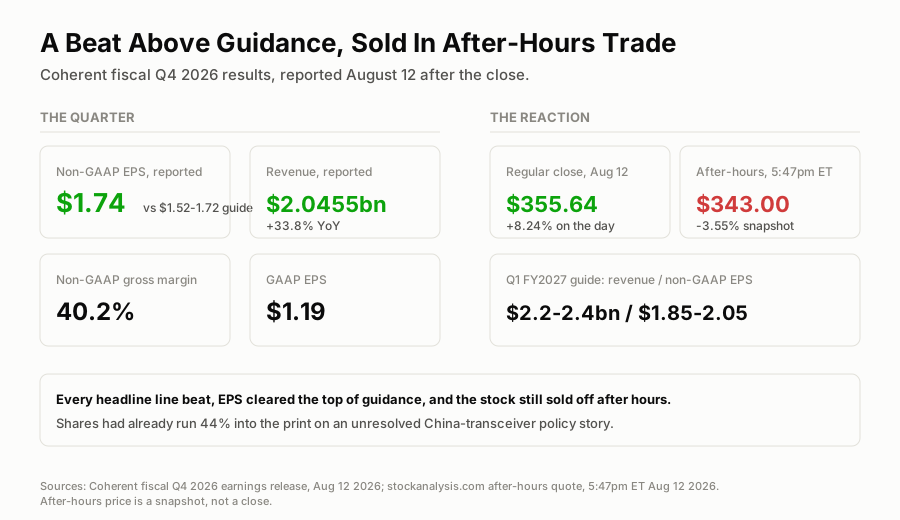
A beat above the top of guidance, and the stock still sold off after hours. The quarter was never the argument for the 44% run.
What The Business Actually Did
Fiscal Q3, reported in the spring, was the strongest evidence yet that Coherent has stopped being a diversified photonics conglomerate and become an AI-datacenter supplier with a legacy industrial business attached.
- Revenue $1.81 billion, up 21%.
- Datacenter and communications: 75% of total sales.
- Datacenter revenue up 37% year on year.
- Non-GAAP EPS $1.41, up 55%, which is operating leverage rather than one-off help.
- Record backlog, with optical transceiver capacity described as filled through at least 2028 and some long-term agreements running to 2030.
Capacity sold out three to four years forward is the single most valuable disclosure a component supplier can make, because it converts a cyclical business into something closer to a contracted one. It is also the reason the fiscal Q4 print carries limited information: when the order book is that long, one quarter's revenue is a scheduling question.
The Policy Trade Is Running The Stock
On August 4, reporting indicated that US officials had drafted restrictions on new Chinese-made optical transceivers used in data centres. Chinese suppliers ship the majority of the world's transceivers, and Coherent is one of a small group of Western manufacturers with competitive technology at scale, alongside Lumentum and Applied Optoelectronics. The stock rose about 13% on August 7 and has run roughly 44% off its July 29 low, which was itself close to a 48% drawdown.
Be precise about what has and has not happened. A drafted rule is not a rule. It has no effective date in the public reporting, no scope that can be modelled, and no schedule for the multi-year requalification that swapping transceiver suppliers actually requires in a hyperscale network. What the market has repriced is the option on a policy outcome, not a change in Coherent's revenue.
That was the setup going into Wednesday, and it resolved cleanly: no new restriction was announced with the earnings, and management's Q1 FY2027 guide of $2.2-2.4 billion in revenue reads as an operating plan built on the AI-datacenter demand already in the backlog, not a bet on the policy outcome. The policy option is still unpriced by anything in this release. Applied Materials reports fiscal Q3 2026 on Thursday, the next read on AI-supply-chain demand this week.
Why The Beat Still Sold Off
Options had priced a 14.8% move against a $379.13 reference close, before Monday's 14% pullback reset the starting point to $328.57. What actually happened was smaller and in the wrong direction for the bulls: the stock rallied into the print on its own, closing the regular session at $355.64, and then gave back 3.55% after hours once the print landed.
That is the shape of a stock that had already spent its good news. Coherent is trading at a forward multiple above 40x earnings, by one estimate, after a run that has more than doubled the stock off its July low. A guide that beats the top of the prior range by a couple of percentage points does not reset a valuation that rich; it just removes the one clean reason left to keep bidding it up into a print that was always going to be judged against an already-elevated bar, not against last quarter. Selling premium into a name whose realised moves have been running this hot all season is the reflex that has scored worst in our implied versus realised move database, and this print did not change that lesson.
The Options Angle
The print is done, and the read is: the business executed, the stock did not need it to.
- Passing on long shares into the print was the right call. The $379.13 entry this piece flagged as a poor one is now above both the after-hours print ($343.00) and the Aug 12 regular close ($355.64). A 44% run into a beat-and-raise still cost a buyer money on the open, which is exactly the risk the pass was written to avoid.
- The $420/$470 call spread is close to a total loss with two trading days to Friday's expiry. The stock needs to rally roughly 22% from the after-hours print just to reach the lower strike. That is not the market's read on this release.
- The short $380 straddle, which this piece also passed on, is currently sitting inside its profit zone ($323.02 to $435.24) at the after-hours print. That is not a vindication of selling premium here in general, the July calibration record still argues against the reflex, but on this specific structure and this specific print, the premium seller is ahead right now. Both trades were passes, so neither is logged as booked capital either way; the pass on the straddle looks less clean than the pass on the call spread as of this snapshot.
Trade log
| # | Stance | Structure | Strikes and expiry | Cost or credit | Spot at writing | Implied move | Result so far |
|---|---|---|---|---|---|---|---|
| 1 | Pass | Long shares into the print | n/a | n/a | $379.13, Aug 7 close | ±14.8% | Correct: stock is below $379.13 at the $343.00 after-hours print |
| 2 | Bullish, defined risk | Call spread | $420C / $470C, Aug 14 | Live prices not sourced; quoted against the implied move | $379.13, Aug 7 close | ±14.8% | Tracking toward a near-total loss; needs +22% by Friday's close |
| 3 | Pass | Short straddle / premium sale | $380 straddle, Aug 14 | ~14.8% of spot collected | $379.13, Aug 7 close | ±14.8% | Currently inside the $323.02-$435.24 profit zone; the pass looks costly so far |
Row 2 is logged without a live debit because option prices for the August 14 expiry could not be sourced at writing; it is scored against the realised move and the $420 level. All three rows are snapshots against the 5:47pm ET after-hours print, not Friday's expiry close, which is when this log gets its final score.
The One-Line Read
Coherent beat its own guidance on every headline line and the stock sold off anyway, because the quarter was never what a 44% rally into a drafted China-transceiver policy was pricing, and a clean execution report does not answer the one question, whether that policy becomes real, that the stock has spent two weeks betting on. Cerebras reported the same evening with the same pattern, a beat that sold off, on a different corner of the AI-infrastructure trade; the rest of the week is in the earnings calendar.
Next up:GDP, Wednesday at 8:30am ET →
More on Earnings
Updated Every Saturday
The Week Ahead
Every earnings date, Fed event and setup for the current trading week, on one page.
Refreshed Weekly
Earnings Calendar
Who reports next, when, and what consensus and the whisper expect.
The Week-Ahead Brief
Don’t miss next week’s setups. Get the Saturday brief.
Latest issue, Aug 17“The consumer cracked on Friday. Six retailers answer for it this week.”
Every Saturday: next week’s earnings dates, Fed days and the trades worth watching, from the same desk that writes the week-ahead hub. Free, built for retail investors.