SPCX Lock-Up Calendar: August 20's 319 Million Shares, and Every Unlock Still Ahead
The full SpaceX lock-up calendar: about 319 million more shares unlock around August 20, after the 911.5 million August 6 release produced a 6.1% rally instead of a crash. Every date to December 8.
UPDATE (August 17, 2026): the next tranche lands around Thursday, August 20. The day-70 release frees roughly 319 million shares, our derived count against a restricted pool of about 4.6 billion. One date correction with it: the prospectus counts the fixed-day tranches from its own June 11 date, which puts day-70 on August 20, the date CNBC reads off the filing; this page previously counted from the June 12 first trade and said August 21, one day later. The whole staircase below is restated on the prospectus basis, still marked approximate.
The stock arrives at this one from strength. SPCX closed Friday, August 14 at $140, about 29% above the $108.27 low it set the day before the first unlock, and back over its $135 IPO price. August 6 was a test of fear that had already been pre-sold; August 20 tests a squeeze. Whether that makes it a buy is a separate question, and my answer is still not yet.
UPDATE (August 7, 2026): the unlock happened, and the stock went up. SPCX closed August 6 at $114.92, up 6.1%, the day the shares became eligible, after closing at an all-time low of $108.27 the session before. The feared wave of selling did not arrive on the day. The calendar below is unchanged and the remaining tranches still release through December 8. One correction to the arithmetic in this piece: the float increase is 143%, not 164%, because the correct denominator is the 638.9 million shares actually sold including the greenshoe, not the 555.6 million base offering. Full outcome, what we got wrong, and why September's index rebalance matters: why SPCX rose after the lock-up expired.
TL;DR
- Next unlock: around August 20, the day-70 tranche, roughly 319 million shares on this site's derived count. Against the post-August float of about 1.55 billion shares, that is another 21% of supply in one day.
- The first unlock already happened and did not crash the stock. Roughly 911.5 million shares became eligible on August 6 and SPCX closed up 6.1% at $114.92. The full account of why is here.
- The staircase continues on a fixed day count from the June 11 prospectus: 7% tranches around August 20, September 9, September 24, October 9 and October 24, then a roughly 28% release tied to Q3 earnings, and all remaining 180-day shares on December 8, 2026.
- Musk and a select group of insiders stay locked until mid-2027. That is the one piece of good news in the calendar.
- SPCX priced at $135 in the largest IPO ever, $86 billion raised, bottomed at $108.27 on August 5, and closed Friday, August 14 at $140. The supply schedule has not slowed; the fear of it has.
More on $SPCX: SPCX Is Above Its IPO Price Again. 319 Million Shares Land Next Week, and I'm Still Not Buying →
The Full Unlock Calendar
This is a schedule, not an opinion. Put these dates in a calendar. Fixed-day dates count from the June 11 prospectus and stay approximate; this page counted them from the June 12 first trade until August 17, one day later.
| Date | Event | Approximate release |
|---|---|---|
| August 4 | Q2 2026 earnings, first as a public company (done) | Triggered the first tranche |
| August 6 | First shares became eligible (done) | ~911.5m shares; the stock rose 6.1% |
| ~Aug 20 | Day-70 tranche, the next one | ~7%, about 319m shares |
| ~Sep 9 | Day-90 tranche | ~7% |
| ~Sep 24 | Day-105 tranche | ~7% |
| ~Oct 9 | Day-120 tranche | ~7% |
| ~Oct 24 | Day-135 tranche | ~7% |
| Q3 earnings | Earnings-triggered release | ~28% |
| December 8 | All remaining 180-day shares | Balance |
| Mid-2027 | Musk and select insiders | Locked until then |
Two features of that table deserve emphasis.
The first tranche is bigger than the IPO. SpaceX offered 555,555,555 Class A shares at $135, and underwriters exercised their option in full for a further 83,333,333, so 638,888,888 shares were sold in total to raise a record $86 billion. The August 6 eligibility covers roughly 911.5 million shares. More stock becomes sellable in one day than the entire offering that created the public float.
And that is the number that matters, because the float is tiny. SpaceX has roughly 13.1 billion shares outstanding, so the 638.9 million share public float is about 4.9% of the company. Against that base, the August 6 tranche is an increase of about 143%: the tradeable float goes to roughly 2.4 times its current size in a single day, reaching about 11.8% of shares outstanding.
Hold that next to the other way of measuring the same event. Those 911.5 million shares are only about 7% of shares outstanding. So the correct reading is not that a large slice of SpaceX becomes sellable, because it does not. It is that a small company's worth of stock lands on a float that was deliberately kept scarce, and scarcity was doing a great deal of work in the valuation. A conditional tranche of 455.8 million further shares needed SPCX to close at or above $175.50 on five of the ten sessions running into Q2 earnings; the stock never came near it, so those shares failed the trigger and roll into the December 8 release, making the final step of the staircase larger.
The August 20 Tranche: Will This One Be Different?
About 319 million shares become eligible on or around Thursday, August 20, roughly 7% of the restricted pool and about 21% of the current float in a single release. No filing states that count; it is derived: 7% of a restricted pool of roughly 4.6 billion shares, itself backed out of the first tranche being 20% of it.
The reason the last unlock produced a rally is worth restating, because it is the question everyone searching this date is really asking. August 6 arrived with the stock at an all-time low of $108.27, down 20% from the IPO, with the fear fully pre-sold. Eligibility created no obligation to sell, and at a 20% loss to the IPO price almost nobody used it. The feared flood never showed, the shorts covered, and the stock ran 35% off the low inside a week, to $146.15 by August 12.
August 20 inverts that setup. The stock comes into it at $140, above the IPO price, after the squeeze. The sellers with a 2008-era cost basis are exactly as willing at $140 as they were at $110; the difference is that this time they are selling into strength instead of into a hole. I would not read the August 6 outcome as proof the calendar does not matter. It is proof that positioning matters more than eligibility on any single date, and positioning now leans the other way. The buy-or-wait verdict lives in the decision piece, and it is still wait.
One more mechanical point: Forbes noted on August 14 that most of the August 6 shares have not actually traded yet. Eligible supply that has not sold is not absorbed supply; it is an overhang that moved from a legal restriction to a personal decision.
Who Actually Owns the Shares, and Will They Sell?
The supply numbers are meaningless without knowing whose stock it is, because different holders behave in completely different ways. The register splits cleanly into three groups.
Group one: cannot sell. Elon Musk holds about 42% of the equity and more than 80% of the voting power through Class B super-voting shares, and he is locked until mid-2027. The single largest holder is mechanically absent from every date on this calendar. That is the most underweighted fact in the whole discussion.
Group two: will not sell. Alphabet owns close to 7%, from a $900 million investment made alongside Fidelity in January 2015, and has held it for eleven years without trimming. EchoStar is strategic. Nvidia and the Qatar Investment Authority arrived through the February 2026 xAI merger and have owned the position for months, not years. Sovereign wealth funds have no fund life and no redeeming investors. None of these holders has a reason to hit a bid in August.
Group three: the actual sellers. Two populations, and they are the ones that matter.
The early venture funds. Founders Fund wrote a $20 million cheque into the 2008 Series C, and that stake is now worth roughly $50 billion. That is about 2,500 times the money, held for eighteen years. Sequoia, Andreessen Horowitz and Valor Equity Partners each hold around 2% or below. Venture funds have finite lives and investors who have been waiting since the last financial crisis, and distributing a position that has become this concentrated is not greed, it is the job.
The employees. SpaceX pays its workforce in restricted stock and options, and the company does not break out the collective total in its filings, which makes it the least visible part of the register. This staggered schedule is the first genuine liquidity most of them have ever had.
The part that breaks the "they will wait for a better price" argument
Going into August 6, the intuitive hope was that holders would not sell into a stock 19% below its IPO price and near its all-time low. For the strategics, that was right. For the group most likely to sell, the logic never applied in either direction, at $110 or at $140, and the reason is cost basis.
A 2008 Series C position has a cost basis of effectively nothing. At roughly 2,500 times money, the difference between selling at $135 and selling at $110 is the difference between a 2,500x and a 2,030x return. Neither number changes any decision. The seller with an eighteen-year hold and a near-zero basis is the most price-insensitive participant in the market, which is exactly what makes lock-up supply relentless rather than opportunistic.
The scale is real, too. If 20% of the restricted pool is 911.5 million shares, that pool is roughly 4.6 billion shares, and each 7% tranche is about 319 million shares, worth roughly $35 billion at $110. Set against an original float of 638.9 million, one 7% tranche is another 50% of the stock that existed before August.
Against that, one genuine mitigant: at the pre-unlock price near $110, Founders Fund's first 20% slice alone was around $10 billion, against a float then worth about $70 billion, and both figures move with the stock. A holder that large cannot exit through the open market without destroying its own price. Positions of this size get distributed to limited partners in kind, or placed in blocks at a negotiated discount, and both routes spread the impact over months rather than dumping it into a Thursday.
This is a staircase, not a cliff. Standard lock-ups end on one date and the market braces for one bad session. SpaceX staggered it: 20% after Q2 earnings, then five 7% tranches at days 70, 90, 105, 120 and 135, roughly fortnightly through October, then a large earnings-triggered slug at Q3, then the remainder on December 8. That design reduces the size of any single shock and replaces it with something arguably worse for a stock already falling: four months of continuous, scheduled, known supply.
The Board
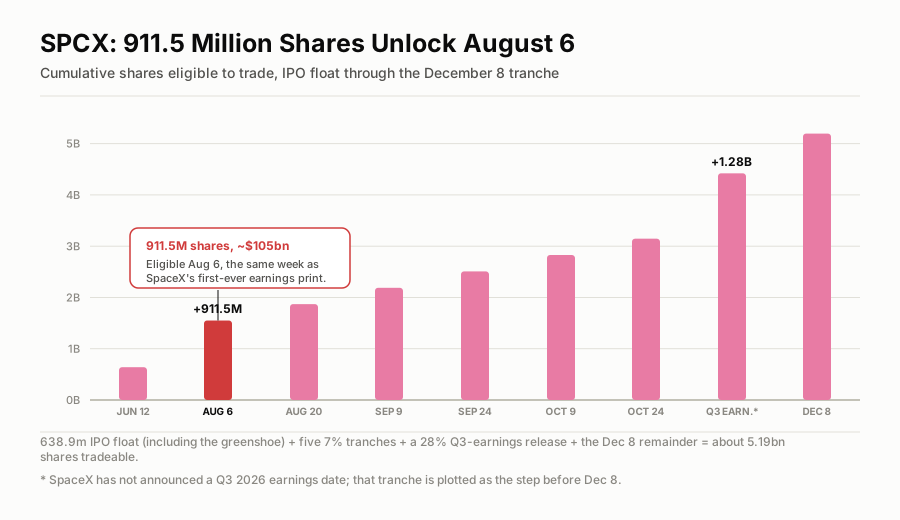
Not a cliff. A staircase, running from August to December.
Cumulative Shares Eligible to Trade
Running total of the public float plus unlocked restricted shares. Hover or tab through a bar for the exact date and share count.
* SpaceX has not announced a Q3 2026 earnings date. That tranche is plotted as the step before Dec 8, not on a confirmed calendar date. Every other date and share count above comes from the unlock calendar earlier in this piece.
View exact figures
| Date | Event | Added | Cumulative | % of total |
|---|---|---|---|---|
| Jun 12, 2026 | IPO float begins trading | +555.6M | 555.6M | 11% |
| Aug 6, 2026 | ~20% tranche eligible (Q2 earnings trigger, Aug 4) | +911.5M | 1,467.1M | 29% |
| ~Aug 21, 2026 | Day-70 tranche, ~7% | +319.0M | 1,786.1M | 35% |
| ~Sep 10, 2026 | Day-90 tranche, ~7% | +319.0M | 2,105.2M | 41% |
| ~Sep 25, 2026 | Day-105 tranche, ~7% | +319.0M | 2,424.2M | 47% |
| ~Oct 10, 2026 | Day-120 tranche, ~7% | +319.0M | 2,743.2M | 54% |
| ~Oct 25, 2026 | Day-135 tranche, ~7% | +319.0M | 3,062.2M | 60% |
| Q3 earnings (date TBD) | ~28% tranche (Q3 earnings trigger) | +1,276.1M | 4,338.3M | 85% |
| Dec 8, 2026 | Remaining 180-day shares clear | +774.8M | 5,113.1M | 100% |
Why August 4 Was the Date That Mattered Most
Because it did two jobs at once, and most coverage only mentioned one.
Job one: it was the first earnings report SpaceX ever filed as a public company. The losses on record going in were large: a $4.9 billion net loss in 2025 and another $4.28 billion in Q1 2026, driven largely by Starship development and AI infrastructure spending. The Q2 print landed on August 4 and gave the market its first real disclosure to model against.
Job two: the report triggered the unlock. The first roughly 20% tranche was tied to Q2 earnings, with shares eligible from August 6. A bad print would not just have repriced the stock, it would have released supply into the reprice two days later.
That was an unusual and unkind structure: the event with the most uncertainty wired directly to the event with the most supply. It resolved better than this piece expected.
What the Valuation Can Absorb
Here is the arithmetic our existing view comes from.
When our piece on SPCX below its IPO price ran the numbers in late July, the market capitalisation was around $1.54 trillion: roughly 90x trailing sales and about 46x forward revenue, against Rocket Lab near 63x and legacy aerospace near 2x. At Friday's $140 close, roughly 13.1 billion shares put the market cap near $1.8 trillion, which stretches those same multiples about a fifth higher. The forward multiple only makes sense if revenue roughly doubles toward $36 billion.
One correction to our own earlier work while we are here. That piece described the lock-up as a single early-December expiry and built a December put spread around the idea of one flush. The staged schedule above supersedes that framing: the first and largest tranche arrives in August, and December is the tail rather than the event.
Now layer the share price path on it. The stock priced at $135, reached about $225 at its high, gave the whole gain back to a $108.27 low on August 5, and closed Friday, August 14 at $140. The round trip happened with only the first tranche eligible and, per the coverage above, most of it still unsold.
A 90x sales multiple is a promise about the future. Four months of scheduled selling is a fact about the present. Multiples that high need scarcity of stock to hold, and scarcity is precisely what this calendar removes.
What Actually Happens on an Unlock
Worth being clear, because the popular version is wrong.
"Eligible to trade" is not "will be sold." The 911.5 million figure is what becomes permitted, not what hits the tape. Employees hold for tax reasons, conviction, or because they cannot sell into weakness without crystallising a loss. Historically, actual selling into a large unlock is a fraction of the eligible amount.
But the price reacts before the selling, not after. Markets front-run known supply. The typical pattern is weakness in the days before an unlock date as traders position for it, then a relief bounce if the feared selling does not materialise. That means the tradeable event is the anticipation, not the event.
And repeated tranches train the market. Because this schedule repeats every two to four weeks, each date becomes a smaller, more predictable version of the same setup. By October the market will have learned how much supply actually arrives per tranche, and the reaction should compress.
The Playbook
- The dates to watch are the two or three days before each tranche, not the tranche itself. That is when positioning pressure shows up. The next window runs into August 20.
- Musk being locked until mid-2027 is genuinely important. The largest holder cannot sell, which removes the worst-case supply scenario for eighteen months. Weigh that against everything above.
- If you want the space theme without the calendar, own something else. Rocket Lab trades at a lower multiple with no unlock overhang. Owning SPCX specifically through August to December is choosing to fight a known supply schedule.
- For options, this is the rare case where a defined-risk bearish structure has a genuine edge in the timing, because the supply dates are published. But implied volatility already reflects them, so you are not getting the calendar for free. Read calls and puts explained before expressing this with anything short-dated.
- The bull case against all this: SpaceX is the most strategically important private company of the era, Starlink revenue compounds, and the market absorbing tranches without a flood would reframe the calendar as noise. August 6 was the first test of that path and the bulls won it. The next tests arrive roughly fortnightly through October.
The One-Line Read
The biggest tranche came free on August 6 and the stock rallied; about 319 million more shares arrive around August 20, with the staircase running to December 8, and this time the sellers get to work at $140 instead of $108.
Next up:GDP, Wednesday at 8:30am ET →
More on $SPCX
$SPCX · 2026-08-13
SPCX Is Above Its IPO Price Again. 319 Million Shares Land Next Week, and I'm Still Not Buying
$SPCX · 2026-08-10
Is SPCX About to Rocket, or Is the August 20 Unlock About to Land on It?
$SPCX · 2026-08-07
Why Is SpaceX Stock Up After the Lock-Up? 911.5 Million Shares Came Free and the Selling Never Came
Updated Every Saturday
The Week Ahead
Every earnings date, Fed event and setup for the current trading week, on one page.
Refreshed Weekly
Earnings Calendar
Who reports next, when, and what consensus and the whisper expect.
The Week-Ahead Brief
Don’t miss next week’s setups. Get the Saturday brief.
Latest issue, Aug 17“The consumer cracked on Friday. Six retailers answer for it this week.”
Every Saturday: next week’s earnings dates, Fed days and the trades worth watching, from the same desk that writes the week-ahead hub. Free, built for retail investors.