Nu Holdings Earnings Preview (August 13): The One Name This Week Where The Whisper Sits Below Consensus
Nu Holdings reports Q2 2026 on August 13 after the close. Consensus is $0.19 on $5.48bn, the computed whisper is $0.18, and Q1's risk-adjusted net interest margin fell 100bp to 9.5%.
Final scoring, August 14 close: all three rows lost
NU closed at $15.23, up 9.33% from Thursday's $13.93, per stockanalysis.com. Against the $13.84 August 7 close every row was struck on, that is a realised move of 10.04% against the 7.8% implied this piece logged. All three calls are graded losses, and they are now rows on the Track Record ledger, which the preview never had.
Row 1, the pass on the straddle, is the expensive one. The piece argued that a company with a 0.4% median surprise would land inside its implied move, so paying 7.8% for the print was paying for a distribution that had not shown up. It showed up. $15.23 clears the $14.92 upper breakeven stated in the piece, and it also clears the $15.08 breakeven a $14 strike at roughly $1.08 of premium would imply, so the straddle pays whichever construction you use. Thesis wrong, call wrong.
Row 2, the pass on long shares, cost 10.04%. The reasoning was that consensus was being cut while risk-adjusted net interest margin fell 100bp to 9.5%, so the growth headline was not worth buying into the print. The margin went the other way by 290bp to 12.4%, net income crossed $1bn at a 33% return on equity, and the stock did the rest.
Row 3, the put spread, expired worthless. It was logged as defined-risk downside protection paying below $13, on a stock that closed $2.23 above that strike. Small loss, full premium, no protection needed.
Where the stock goes from here is a separate question, and it gets its own piece: is Nu Holdings a buy after the $1 billion quarter, which takes apart the 290 basis points and the FX-neutral growth rates.
What I got wrong, and it is the same error the July audit named. This piece reasoned from a company's habit of landing on consensus to a conclusion about its share price, and those are different questions. Nu did land near the EPS line; the stock still moved 10% because the credit disclosure underneath it moved 290 basis points. The implied move was pricing the disclosure, and I read it as pricing the EPS. Realised has now beaten implied often enough this season that "the expected move looks wide" needs to stop being a reason on its own.
More on $NU: Is Nu Holdings (NU) a Buy? 49% Growth Was 67% in Dollars →
Updated August 14, 1:30pm ET: management will not call 12.4% a floor, and the 90-day bucket is the same cohort
NU is at $15.18, up 8.94%, at about 1:05pm ET against Thursday's $13.93 close, per stockanalysis.com. Options had priced a 7.8% move; the cash session has now cleared it, so row 1's straddle is through its $14.92 upper breakeven with hours left on the August 14 expiry. Final scoring on all three rows still goes on tonight's close, per the terms each row was written on.
The 290 basis points came with a caveat the company supplied itself. Nu attributes most of the 16bp improvement in the 15-90 day NPL ratio to seasonality, and the 35bp rise in the 90+ ratio to first-quarter early delinquencies migrating through. Those are one cohort measured at two points, not two independent readings, which makes a record risk-adjusted NIM and a deteriorating 90+ bucket entirely compatible. Management said it expects the margin to stay in the region of 12.4% but explicitly declined to treat that level as a floor.
The beat went past the bull case too. JPMorgan noted that even optimistic models had risk-adjusted NIM near 11%, so 12.4% cleared the high end rather than the middle. Cost of credit fell 9% quarter over quarter to $1.7 billion, while the expected credit loss provision for the quarter was $1.483 billion against $1.012 billion a year earlier.
Refining yesterday's read. The update below took the 290bp reversal as evidence for the "mix and seasoning" explanation over the "worse marginal borrower" one. With the company's own seasonality attribution on the record, that is weaker than it looked at 6pm: seasonality explains the improvement in the early bucket, and the late bucket got worse. My read now is that the quarter is not yet evidence either way, and the thing to watch is whether the 90+ ratio rolls back down in Q3 once the Q1 cohort has fully seasoned.
Updated August 13, after the close: the margin question this piece asked got answered, and the bulls got the answer
Net income crossed $1 billion for the first time: $1.06 billion, up 49% year over year and 17% quarter over quarter, at a 33% return on equity, up from 29% in Q1. Managerial revenue was $5.9 billion, up 39%, ahead of the $5.48bn consensus this piece cited. Nu did not publish a GAAP EPS figure in its release; consensus ran $0.19-0.20 depending on the aggregator, and I am not backing into a precise reported number the company itself did not state. Source: Nu Holdings' Q2 2026 press release.
The risk-adjusted net interest margin, the number this whole preview was built around, reversed instead of extending its slide. It rose 290 basis points to 12.4%, against the 100bp drop to 9.5% that worried this piece a week ago. Headline NIM also rose, 180bp to 22.9%. The 15-90 day NPL ratio improved 16bp to 4.8%; the 90+ day ratio ticked up 35bp to 6.9%, so credit quality is not uniformly better, but the margin line that mattered most here moved the bull way.
That is evidence for the "mix and seasoning" explanation this piece flagged over the "worse marginal borrower" one. A genuinely deteriorating book does not usually hand back 290bp of margin in one quarter. It is one data point, not a trend, and the 90+ NPL uptick is the thing to keep watching.
The credit portfolio kept growing: $39.4 billion, up 37% year over year and 5% quarter over quarter from $37.2bn, in line with the growth rate this piece described. Customers reached 139 million, with Mexico at 15.8 million and now Nu's largest digital bank by its own count in that market. Deposits rose to $45.3 billion, up 18% year over year.
The stock closed the regular session at $13.93, up 2.73%, before the release, then traded at $15.01 in after-hours, up 7.75% as of 6:42pm ET. Options had priced a 7.8% move. The after-hours print landed almost exactly on that number, on the high side.
How the logged plays stand. Row 1's straddle needed a move past $12.76 or $14.92; the $15.01 after-hours quote sits above the upper breakeven, so the play is provisionally paying, not yet final since it was struck against the Aug 14 expiry and after-hours quotes move before Friday's session does. Row 2's pass on long shares is behind on this print: the stock is up 7.75% after hours against a flat pass. Row 3's bearish put spread does not pay on a stock moving up into new highs; that hedge did its job of costing little and protecting nothing, which is what a hedge against the wrong direction is supposed to do. Final scoring on all three rows goes on the Friday, August 14 close, per the terms each row was written on.
TL;DR
- Nu Holdings, the parent of Nubank, reports Q2 2026 on Thursday, August 13, after the US close.
- Consensus is $0.19 of EPS on about $5.48 billion of revenue, from seven analysts spread $0.16 to $0.21. Estimates have drifted down a cent over 30 days.
- The computed whisper is $0.18, below consensus. That makes Nu the only name on this week's calendar where the priced-in expectation sits under the published one, and it is a direct consequence of a habitual surprise of just 0.4%: this company lands almost exactly where the sell side puts it.
- Q1 was a growth quarter with a cost attached. Revenue passed $5 billion for the first time, net income was $871 million at a 29% return on equity, and the customer base grew by about 4 million to over 135 million.
- Underneath it, the credit book grew 7% in the quarter and 40% year on year to $37.2 billion, provisions rose 33% to $1.79 billion, and the risk-adjusted net interest margin fell 100 basis points in a single quarter to 9.5%. Options price a 7.8% move against a $13.84 close.
When Does Nu Holdings Report Earnings?
Thursday, August 13, after the US market closes. It rounds off a week that starts with monday.com and runs through July CPI on Wednesday; the full slate is in the earnings calendar.
The Board
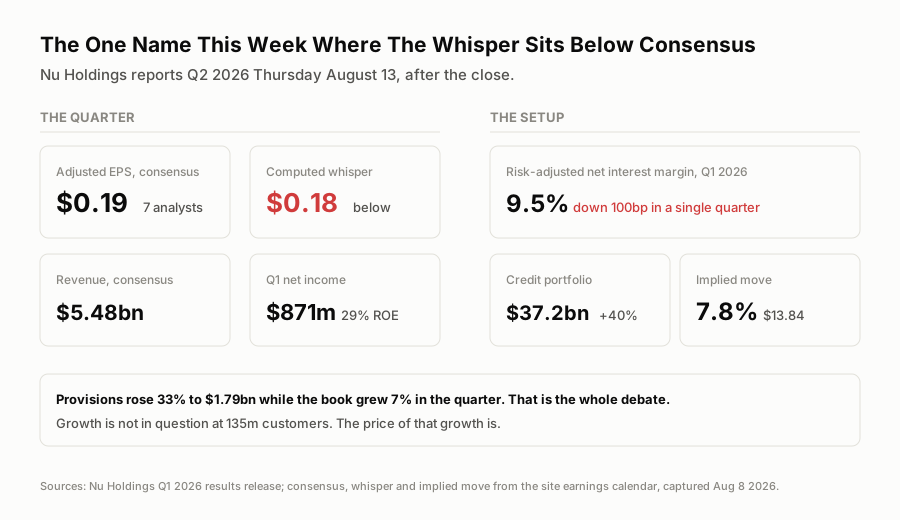
Growth is not the question at 135 million customers. The price of the growth is.
A Whisper Below Consensus Is Rare, And It Means Something
Across this week's calendar the pattern is uniform: computed whispers sit above consensus, because most companies habitually beat and the market prices the habit. Cardinal Health's whisper is 13% above; Tapestry's is 16% above.
Nu breaks the pattern for two compounding reasons.
It does not beat. The median surprise across its last four prints is 0.4%, which is another way of saying the company lands on the number. A bank that reports where the models put it is a bank whose disclosure is good and whose earnings are mechanical, and that removes the upside tail that the whisper formula adds elsewhere.
Estimates are being cut. Analyst EPS drifted down a cent over the past 30 days. Revisions lead the published average, so a falling revision trend pulls the whisper below a consensus that has not finished adjusting.
Put together: $0.19 published, $0.18 priced. The practical implication is that a small beat on Thursday is not automatically good news, because the direction of estimates is the thing the market is watching.
The Growth Is Real. So Is What It Costs.
Q1 2026 was, on the headline lines, excellent. Revenue above $5 billion for the first time. Net income $871 million. Return on equity of 29%, which is a number almost no incumbent bank in the Americas can match. Roughly 4 million customers added, taking the total above 135 million.
Now the credit lines from the same quarter:
- Credit portfolio $37.2 billion, up 7% quarter on quarter and 40% year on year.
- Credit-loss provisions up 33% to $1.79 billion.
- Risk-adjusted net interest margin down 100 basis points to 9.5%.
That third line is the one to sit with. Risk-adjusted NIM is what a lender actually keeps after expected losses, and losing a full percentage point of it in three months is a large move for a bank of any size. The bull explanation is mix and seasoning: a book growing 40% a year is always full of young loans, and young loans carry front-loaded provisions under expected-loss accounting even when they eventually perform. The bear explanation is simpler: the marginal borrower is worse than the average one, and a 40% growth rate is only available at a price.
Both explanations produce identical numbers for several quarters. The way to tell them apart is the vintage data and the NPL formation rate, which is exactly what Thursday's supplementary disclosure should contain and what the headline EPS will not.
Two Countries That Change The Model
Mexico. Nu has been converting its Mexican operation into a licensed banking entity, which is a step up in regulatory obligation, capital requirement and cost base. Executed well it is the unlock: deposits fund the loan book at a lower cost than wholesale money, and the Brazilian playbook repeats in a market with far worse incumbent service. Executed badly it is a multi-year drag on the group's return on equity while the Brazilian business subsidises it.
The United States. A US launch is a different proposition entirely: a market with abundant capital, sophisticated incumbents and no obvious underbanked wedge of the kind that made Nubank in Brazil. My read is that the market currently ascribes close to zero value to a US entry and would rather see the capital deployed in Mexico, which means announcements here are as likely to be taken as a cost as an opportunity.
The Options Angle
7.8% on a $13.84 share is about $1.08 of expected range. For a lender that lands on consensus almost every quarter, that is a meaningful move, and it tells you the market's uncertainty is about credit disclosure rather than about EPS.
- The straddle is a pass. When a company's habitual surprise is 0.4%, the earnings line is close to known; paying 7.8% for a print that reliably comes in on the number is paying for a distribution that has not historically shown up.
- Long shares into the print is also a pass, on the estimate direction. Buying a bank while its consensus is being cut and its risk-adjusted margin is compressing is buying the growth headline and ignoring the funding of it.
- This is the setup where defined-risk downside protection on an existing holding earns its keep: a put spread costs a fraction of the straddle and pays if the credit disclosure disappoints, without requiring a view on the EPS line at all.
Trade log
| # | Stance | Structure | Strikes and expiry | Cost or credit | Spot at writing | Implied move | Breakeven |
|---|---|---|---|---|---|---|---|
| 1 | Pass | Long straddle | $14 straddle, Aug 14 | ~7.8% of spot; live price not sourced | $13.84, Aug 7 close | ±7.8% | Needs a move beyond $12.76 or $14.92 |
| 2 | Pass | Long shares into the print | n/a | n/a | $13.84, Aug 7 close | ±7.8% | Scored against the Aug 14 close |
| 3 | Bearish hedge, defined risk | Put spread against an existing holding | $13P / $12P, Aug 14 | Live prices not sourced; quoted against the implied move | $13.84, Aug 7 close | ±7.8% | Pays below $13, inside the implied range |
Row 3 is logged without a live debit because option prices for the August 14 expiry could not be sourced at writing; it is scored against the realised move and the $13 level.
The One-Line Read
Nu is compounding customers, revenue and return on equity at rates no incumbent bank can match, and it is doing it while its risk-adjusted margin drops a hundred basis points in a single quarter and its consensus gets cut, which is why it is the one name this week where the market is braced for less rather than more.
Next up:GDP, Wednesday at 8:30am ET →
More on $NU
Updated Every Saturday
The Week Ahead
Every earnings date, Fed event and setup for the current trading week, on one page.
Refreshed Weekly
Earnings Calendar
Who reports next, when, and what consensus and the whisper expect.
The Week-Ahead Brief
Don’t miss next week’s setups. Get the Saturday brief.
Latest issue, Aug 17“The consumer cracked on Friday. Six retailers answer for it this week.”
Every Saturday: next week’s earnings dates, Fed days and the trades worth watching, from the same desk that writes the week-ahead hub. Free, built for retail investors.