Cardinal Health Earnings Preview (August 11): The Tightest Consensus Of The Week, And A Whisper 13% Above It
Cardinal Health reported non-GAAP EPS of $2.91, above the $2.42 consensus but boosted $0.31 by a one-time tariff refund. Shares hit a 52-week high near $253 on a raised FY27 guide.
Updated August 11 with reported results. The preview said the seven-cent consensus band was a bad bar and the whisper of $2.73 was the more honest one; the actual print beat even the whisper, though a one-time item did a meaningful share of that work.
TL;DR
- Cardinal Health reported fiscal Q4 non-GAAP EPS of $2.91, up 40%, clearing both the $2.42 consensus (+20.2%) and this preview's own $2.73 whisper. GAAP diluted EPS was $1.70, up 70%.
- The beat is not entirely organic: a one-time $100 million IEEPA tariff refund in the GMPD segment added $0.31 per share to non-GAAP EPS. Ex-refund, EPS was closer to $2.60, still a real beat of consensus but short of the whisper.
- Revenue was $63.7 billion, up 6%, below this preview's $65.1 billion consensus and a deceleration from Q3's 11% growth. Segment detail was more mixed than the headline: Pharmaceutical and Specialty Solutions profit grew 21%, just under the 22-23% full-year guided range, and GMPD's $150 million of segment profit was "primarily" the tariff refund rather than organic growth.
- Full fiscal 2026 non-GAAP EPS came in at $11.26, up 37%, above the top of the raised $10.70-$10.80 guide, roughly $0.15-0.25 above it even stripping out the one-time refund. Fiscal 2027 guidance is $12.40-$12.60, 13-15% growth, alongside a fresh $5 billion buyback authorization ($6.4 billion total remaining).
- Shares traded up as much as 6.9% intraday to a 52-week high near $253.47, against the $236.40 spot this preview logged; that clears the 6.2% implied move this preview's straddle pass was measured against.
More on Earnings: Options Scorecard: The Week of August 10, Graded (35 Calls, 51% Right) →
When Does Cardinal Health Report Earnings?
Tuesday, August 11, before the market opens. Tuesday is the densest day of the week, sharing the tape with Sea Limited, CoreWeave and Super Micro; the whole slate is in the earnings calendar.
The Board
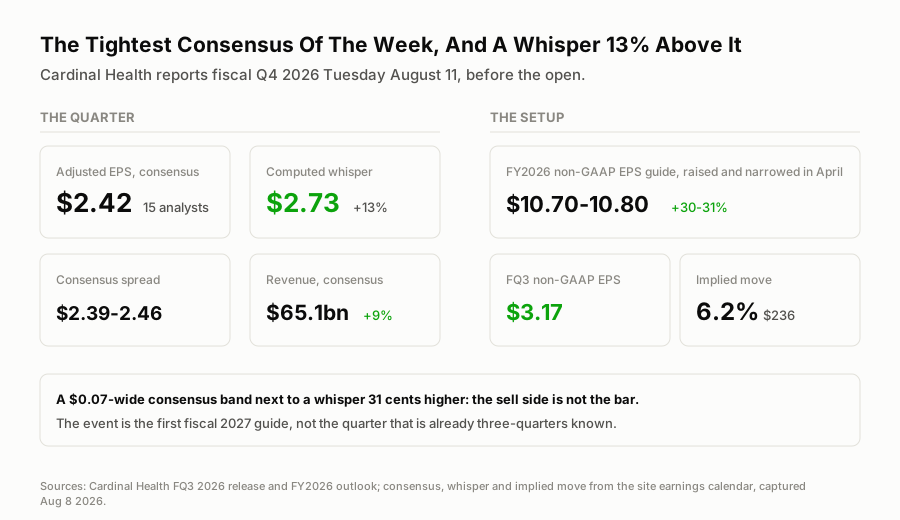
The consensus band was too tight by design. The print cleared even the whisper, with an asterisk on how much of it was a one-time refund.
A $0.07 Consensus Is A Statement About Analysts, Not About The Business
Fifteen sell-side models, all within seven cents of each other. That is not fifteen independent forecasts, that is fifteen models anchored to the same company guidance and to each other. It happens in distribution because the gross margin is thin and stable and the revenue line is close to mechanical: $65 billion of drugs move, a fraction of a point sticks.
The problem is that the same tightness makes the published number a bad bar. Cardinal's median surprise across its last four prints is about 12.4%, and estimates drifted up a cent over the past 30 days. Compound those and the whisper lands at $2.73. The stock does not trade against $2.42; it trades against something closer to the whisper, which is exactly the mechanism that produces the "beat and fall" reaction our earnings calendar exists to make visible.
Anyone reading a headline on Tuesday morning that says Cardinal beat by nine cents should note that nine cents is a 3.7% beat against a company that has been running at 12%.
Update, August 11: the whisper was still too low. Non-GAAP EPS of $2.91 beat the $2.73 whisper by about 6.6%, on top of clearing the $2.42 consensus by more than 20%. But $0.31 of that beat came from a one-time tariff refund; strip it out and EPS was closer to $2.60, a real beat of consensus and roughly in line with, not meaningfully above, the whisper. The headline number overstates the underlying quarter.
The Quarter Is Already Three-Quarters Known
This is what makes the print low-variance. Work forward from disclosure:
- FY2026 non-GAAP EPS guidance: $10.70-$10.80, raised and narrowed on April 30, representing 30-31% growth.
- Fiscal Q3 delivered $3.17 of non-GAAP EPS, up 35%, on $60.9 billion of revenue, up 11%.
- Segment guidance behind the raise: Pharmaceutical and Specialty Solutions segment profit up 22-23% (from 20-22%), Other segment profit up 36-38% (from 33-35%).
- Subtract the consensus fourth quarter of $2.42 from the full-year range and the first nine months implied are $8.28-$8.38. That reconciles with what has been reported, which is the internal-arithmetic check clearing.
The GAAP line will look worse and it should be read carefully rather than reacted to. Fiscal Q3 GAAP operating earnings fell 30% to $509 million and GAAP diluted EPS fell 20% to $1.69, because of a $184 million pre-tax goodwill impairment in the Navista and ION reporting unit. The stock fell about 5.8% on that release even as guidance went up, which is a fair summary of how this name trades: the market does not fully trust the adjustments.
Where The Growth Is Actually Coming From
Drug distribution is a scale business with a 1%-ish operating margin, and nobody re-rates it. What has re-rated Cardinal is the second engine: specialty. The Solaris integration and the Specialty Alliance physician network push the company up the value chain from moving boxes to servicing oncology and other high-cost therapeutic areas, where the fee pools are larger and stickier.
That is the bull case, and the bear case is attached to the same assets. The $184 million goodwill impairment landed in Navista and ION, which are exactly the specialty-adjacent assets the growth story rests on. Management's read is that segment profit is compounding in the low twenties; the impairment says at least one acquired piece has not performed to the plan it was bought on. Both statements can be true, and Tuesday's segment detail is where the market decides which one dominates.
Fiscal 2027 Guidance Delivered, With A Real Asterisk
The first FY27 guide answered what this preview asked to watch, in each case with a caveat:
- Double-digit EPS growth was guided, at $12.40-$12.60, 13-15% growth. That is real deceleration from the 30%-plus pace of the last two years, exactly the lapping difficulty this preview flagged, but it is not a collapse.
- Specialty segment profit growth undershot its own run rate. Pharmaceutical and Specialty Solutions profit grew 21% in the quarter, just under the 22-23% range management had guided to. Not a broken thesis, but not the acceleration a clean beat would suggest either.
- Buyback cadence stepped up, not down. FY26 repurchases reached $1.4 billion, above the $1.0 billion this preview cited mid-year, and the board approved a fresh $5 billion authorization, $6.4 billion total remaining. That is the one unambiguous positive in the segment detail.
The Options Angle
The 6.2% implied move set breakevens at $221.74 and $251.06 against the $236.40 spot. Shares traded as high as $253.47 intraday, above the upper breakeven.
- The straddle pass left money on the table. This was a genuinely mispriced print: a modest 6.2% implied move on a low-beta name got a guidance-driven gap large enough to clear it. A straddle bought at that price would have paid off.
- The long-shares position is a clean win, up roughly 7% against the $236.40 entry, exactly the "grind, not gap" case this preview argued for, except the grind arrived all at once.
- The covered call caps the win right around the strike. With shares testing $253 against strikes written above $250, the position captures most of the move up to the strike and then gives back the rest; call it a partial win, better than flat, worse than the uncapped shares.
Trade log
| # | Stance | Structure | Strikes and expiry | Cost or credit | Spot at writing | Implied move | Result |
|---|---|---|---|---|---|---|---|
| 1 | Bullish | Long shares into the print | n/a | n/a | $236.40, Aug 7 close | ±6.2% | Win, roughly +7%. Shares traded to $253.47 intraday. |
| 2 | Neutral to bullish | Covered call | Aug 14 strikes above $250 | Live premium not sourced | $236.40, Aug 7 close | ±6.2% | Partial win. Gains capped near the written strike as shares tested $253; better than flat, worse than uncapped shares. |
| 3 | Pass | Long straddle | $237.50 straddle, Aug 14 | ~6.2% of spot | $236.40, Aug 7 close | ±6.2% | Loss (foregone). Shares cleared the $251.06 upper breakeven; a straddle buyer would have profited. |
The One-Line Read
Cardinal Health's headline non-GAAP beat leaned on a one-time tariff refund worth 31 cents a share, but the fiscal 2027 guide, the buyback increase and a 52-week high were real enough that the modest 6.2% implied move turned out to be the cheapest mistake the options market made in this week's slate.
Next up:GDP, Wednesday at 8:30am ET →
More on Earnings
Updated Every Saturday
The Week Ahead
Every earnings date, Fed event and setup for the current trading week, on one page.
Refreshed Weekly
Earnings Calendar
Who reports next, when, and what consensus and the whisper expect.
The Week-Ahead Brief
Don’t miss next week’s setups. Get the Saturday brief.
Latest issue, Aug 17“The consumer cracked on Friday. Six retailers answer for it this week.”
Every Saturday: next week’s earnings dates, Fed days and the trades worth watching, from the same desk that writes the week-ahead hub. Free, built for retail investors.