JD.com Q2: Revenue Went Backwards, Profit Swung Positive, Delivery Halved
JD.com Q2 2026 results: net revenues fell 2.9% to RMB 346.4bn, operating income swung to RMB 4.5bn from a RMB 0.9bn loss, and new-business revenue halved to RMB 7.3bn. The ADR fell premarket.
The Print Landed. Revenue Fell 2.9%.
UPDATE (August 13, 2026, 7:10am ET): JD has reported Q2 2026. Net revenues of RMB 346.4 billion (US$51.1 billion), down 2.9% from RMB 356.7 billion. Income from operations swung to RMB 4.5 billion from a RMB 0.9 billion loss a year ago. Non-GAAP net income attributable to ordinary shareholders reached RMB 8.9 billion (US$1.3 billion) against RMB 7.4 billion, and non-GAAP diluted earnings per ADS came in at RMB 6.29 (US$0.93) against a street near US$0.86. The ADR traded $30.94 at 6:48am ET, down 2.12% on Wednesday's $31.61 close.
Of the two questions this page set up in advance, the loss did narrow, from RMB 14.8 billion to RMB 9.9 billion in new businesses. Nothing grew. Product revenue fell 5.4% and new-business revenue halved to RMB 7.3 billion. The full teardown is the first three sections below; the pre-print preview follows it unchanged.
More on Earnings: Options Scorecard: The Week of August 10, Graded (35 Calls, 51% Right) →
TL;DR
- Updated August 13: JD reported net revenues of RMB 346.4 billion (US$51.1 billion), down 2.9%, its first year-on-year revenue decline in this run, against a US dollar street somewhere in the US$50.5-51.6 billion band depending on the feed.
- The profit inflection is real and it came out of the marketing line. Group income from operations went from negative RMB 0.9 billion to positive RMB 4.5 billion, a swing of RMB 5.4 billion, while marketing expenses fell 24.8% to RMB 20.3 billion.
- New businesses shrank faster than the loss did. Revenue RMB 7.3 billion against RMB 13.9 billion; operating loss RMB 9.9 billion against RMB 14.8 billion. The segment now loses more per renminbi of revenue than it did at the peak of the subsidy war.
- JD Retail did the heavy lifting: RMB 295.4 billion of revenue at a 4.6% operating margin, up from 4.5%, which CFO Ian Su Shan called a record margin for a peak promotional quarter.
- Cash is not the problem. Free cash flow of RMB 31.8 billion (US$4.7 billion) in the quarter, RMB 235.1 billion (US$34.6 billion) of cash and equivalents, and US$1.0 billion of buybacks in the first half retiring roughly 2.5% of the shares outstanding.
- The pre-print options view (both passes) is graded in the trade log at the bottom. Options priced a 5.9% move against a $32.97 August 7 close.
What JD Actually Reported
Revenue fell. That is the first line of the release and it has not happened here in a while: RMB 346.4 billion against RMB 356.7 billion, which the company attributes to a high base effect. Split by type, product revenues fell 5.4% and service revenues rose 6.8%.
Everything below the revenue line improved.
| Line | Q2 2026 | Q2 2025 |
|---|---|---|
| Net revenues | RMB 346.4bn (US$51.1bn) | RMB 356.7bn |
| Income from operations | RMB 4.5bn, 1.3% margin | RMB (0.9)bn, -0.2% |
| Non-GAAP operating income | RMB 5.5bn, 1.6% | RMB 0.9bn, 0.3% |
| Net income to shareholders | RMB 7.1bn (US$1.1bn), 2.1% | RMB 6.2bn, 1.7% |
| Non-GAAP net income | RMB 8.9bn (US$1.3bn), 2.6% | RMB 7.4bn, 2.1% |
| Non-GAAP diluted per ADS | RMB 6.29 (US$0.93) | RMB 4.97 |
| Free cash flow | RMB 31.8bn (US$4.7bn) | RMB 22.0bn |
Source: JD.com Q2 and interim 2026 results release, August 13, 2026. Dollar figures are the company's own convenience translations.
For scale on how low the bar was: JD's income from operations for the whole of 2025 was RMB 2.8 billion. This single quarter did RMB 4.5 billion. That is what CEO Sandy Xu means by "a clear inflection in our profit trajectory", and on the group P&L she is right.
Where the Profit Came From
Marketing.
Marketing expenses came in at RMB 20.3 billion, down 24.8% and 5.9% of net revenues. Work back from the reported level and the reported percentage and the year-ago figure was close to RMB 27 billion, so roughly RMB 6.7 billion of spending left the P&L. Group operating income improved by RMB 5.4 billion. My read is that the entire profit swing is that one line coming off, with a little given back elsewhere: fulfillment expenses rose 10.4% and R&D rose 37.7% to RMB 7.3 billion.
Retail held its end up. JD Retail booked RMB 295.4 billion at a 4.6% operating margin, against RMB 310.1 billion at 4.5%. Ten basis points of margin on a smaller base is not much of a story on its own, though the CFO's framing (a record margin for a peak promotional season) is a fair claim about mix discipline through the 618 period.
The cash statement is the strongest part of the release and nobody will lead with it. RMB 31.8 billion of free cash flow in the quarter against RMB 22.0 billion, RMB 235.1 billion of cash on the balance sheet, and buybacks of 69.9 million Class A shares (34.9 million ADSs) for US$1.0 billion in the first half. That retired about 2.5% of the ordinary shares outstanding at the end of December, with US$1.0 billion left on the authorisation that runs to August 2027.
The Delivery Segment Got Smaller and Less Efficient
RMB 9.9 billion of operating loss on RMB 7.3 billion of revenue.
A year ago the same segment lost RMB 14.8 billion on RMB 13.9 billion of revenue. So the absolute loss narrowed by a third while the revenue base fell by nearly half, and the ratio moved the wrong way: roughly RMB 1.06 of loss per RMB 1 of revenue then, RMB 1.36 now. Management describes the food-delivery investment as narrowing significantly on improved operational efficiency and revenue diversification. Both things can be measured against that ratio, and the ratio does not show it yet.
I would be careful with the segment revenue line, because it collects more than food delivery and JD does not break the pieces out. What the number does establish is direction. JD spent 2025 buying orders and spent this quarter not buying them, and the revenue that the subsidies were generating went with them. Full-year 2025 new-business revenue was RMB 49.3 billion against an operating loss of RMB 46.6 billion; annualise this quarter and both halves of that are much smaller.
The disclosure this page asked for in advance, a stated cap or end date on the investment, is still absent from the release. The call is at 8:00am ET and that is where it would come, if it comes at all.
When Did JD.com Report Earnings?
Thursday, August 13, before the US market opened, with the call at 8:00am ET. It shared the morning with Tapestry's fiscal Q4, July PPI at 8:30am and Applied Materials that evening; the rest of the day is in the hour-by-hour timetable and the week is in the earnings calendar.
The Board
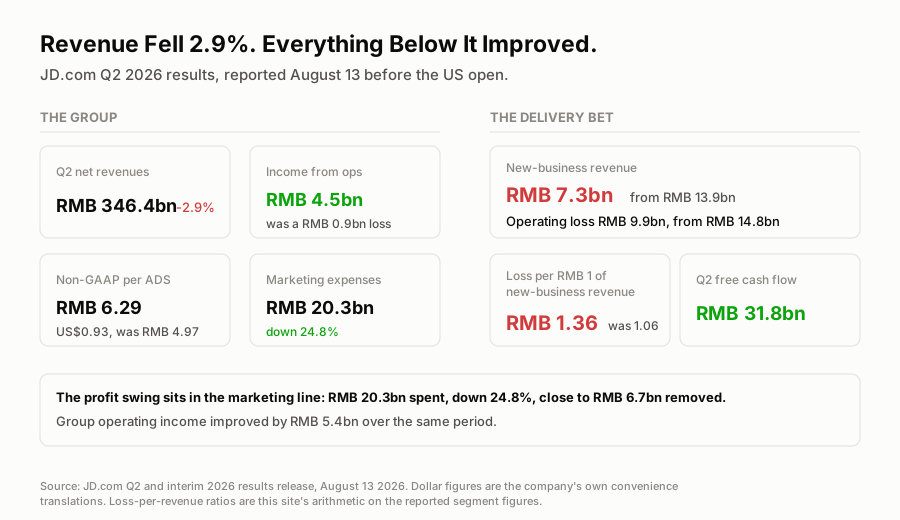
Every line below revenue improved. Revenue fell, and so did the business that the spending was supposed to build.
The Preview, As Published August 9
Everything from here down was written before the print and is left as filed.
The Easiest Comparison JD Has Had In Two Years
Everything about Thursday turns on what happened a year ago.
JD entered food delivery in early 2025 and spent the middle of that year in an open subsidy fight with Meituan and Alibaba. The cost of it is visible in one line: new-business segment operating losses went from RMB 0.7 billion in the June quarter of 2024 to RMB 14.8 billion in the June quarter of 2025. Reporting at the time put JD's food-delivery investment loss for that quarter near RMB 13 billion, above what sell-side houses had modelled, and described the group as posting its first quarterly loss in nearly four years.
That is the base. Anything short of RMB 14.8 billion of new-business loss this quarter is a year-on-year improvement in the group's profit, without a single thing changing in the core retail business.
The May update pointed the same way. JD said food-delivery unit economics per order continued to improve and that total investment in the business narrowed significantly quarter on quarter. Regulators have since intervened to restrict subsidy-led competition in delivery, which is bad for market-share ambitions and good for everyone's P&L.
But The Core Business Is Growing At 4.9%
Here is the part the "easy comp" story does not fix. Net revenues grew 4.9% in Q1 on RMB 315.7 billion. For a company whose historical identity is share-taking growth in Chinese e-commerce, mid-single digits is a maturity signal, and it arrives at the same time as a domestic consumption backdrop nobody would describe as strong.
Meanwhile non-GAAP net income fell to RMB 7.4 billion from RMB 12.8 billion in Q1, a decline of roughly 42%, because the delivery investment and international logistics buildout sit on top of a thin-margin retail business. JD's core operating margin has never had much room in it; the model is scale, first-party inventory and logistics control, not fat unit economics.
So Thursday comes down to two questions that point in opposite directions:
- Does the loss narrow? Almost certainly, against a RMB 14.8 billion base and a regulatory cap on subsidies.
- Does anything grow? A 4.9% top line with a falling profit line is a company treading water while it pays for an option on a new category.
What Would Actually Change The Stock
A stated end to the subsidy investment. Sell-side work through the war argued JD would be the first of the three to step back, on financial-pressure grounds, while Alibaba had strategic reasons to keep spending. If management puts a ceiling or an end date on food-delivery investment on Thursday, that is the re-rating catalyst, because it converts an open-ended loss into a bounded one.
A margin number for food delivery. Not "unit economics improved", which is a direction. A contribution margin, an order count, or an investment figure for the quarter. Vague qualitative progress on a loss this size is a research gap.
Anything on international logistics. It is the other line absorbing capital, and it gets far less attention than delivery.
Why There Is No Dollar Consensus On Our Calendar
JD reports in renminbi. Estimate feeds carry local-currency figures for names like this, and a RMB 315.7 billion revenue line republished with a dollar sign is a roughly seven-fold error. One aggregator summary of JD's own Q1 release did exactly that, rendering RMB 315.7 billion as "US$145.8 billion", a number that is wrong by more than a factor of three even as a conversion. Where the currency basis cannot be verified, we publish the implied move (which is quoted in dollars on the US listing) and leave the estimate out. The same rule applies to Tencent and Tencent Music this week.
Post-print, that caution cuts one way and not the other. The actual figures are safe to quote in dollars because JD publishes its own convenience translations inside the release, at a rate implying roughly RMB 6.78 to the dollar across every line. The estimates are the loose end: one feed carried US$50.51 billion of revenue, another US$51.55 billion, a gap of more than a billion dollars on the same quarter. US$51.1 billion of reported revenue sits inside both, which is why this page will say the revenue line landed in the band rather than call it a beat or a miss.
The Options Angle
Options priced a 5.9% implied move on a $32.97 ADR, about $1.95 of range, and going into the print that looked correct to me: the profit improvement was close to arithmetic and the growth rate was not going to be fixed in one quarter.
- The straddle pass is winning so far. Premarket had the ADR at $30.94, down 2.12%, roughly a third of the move a 5.9% straddle needed. The regular session has not run yet. This grades at Thursday's close.
- The long-shares pass is also ahead, for now, on the same premarket quote.
- The conditional post-print long has not triggered. The release contains no cap and no end date on food-delivery investment, only a smaller loss. If that language shows up on the 8:00am call, the trigger is live and gets struck off the price at the time.
What would change my mind on the whole name: an order count or a contribution margin for food delivery. RMB 9.9 billion of loss on RMB 7.3 billion of revenue is the only unit economics disclosed today, and read straight it is worse than last year's.
Trade log
| # | Stance | Structure | Strikes and expiry | Cost or credit | Spot at writing | Implied move | Breakeven | Status |
|---|---|---|---|---|---|---|---|---|
| 1 | Pass | Long straddle | $33 straddle, Aug 14 | ~5.9% of spot; live price not sourced | $32.97, Aug 7 close | ±5.9% | Needs a move beyond $31.02 or $34.92 | Live, ahead. ADR $30.94 premarket Aug 13, -2.12% |
| 2 | Pass | Long shares into the print | n/a | n/a | $32.97, Aug 7 close | ±5.9% | Scored against the Aug 13 close | Live, ahead. $30.94 premarket, -2.12% on Wednesday's $31.61 |
| 3 | Conditional | Post-print long (shares) if management caps food-delivery investment with a stated figure or end date | Struck off the Aug 13 close | Struck off the Aug 13 close | To be struck Aug 13 | n/a | Scored against the post-print entry if triggered | Not triggered. No cap or end date in the release; call at 8:00am ET |
The One-Line Read
JD stopped paying for the delivery war and the profit line recovered at once. What the money bought is a segment half its old size that now burns more per renminbi of revenue than it did a year ago.
Next up:GDP, Wednesday at 8:30am ET →
More on Earnings
Updated Every Saturday
The Week Ahead
Every earnings date, Fed event and setup for the current trading week, on one page.
Refreshed Weekly
Earnings Calendar
Who reports next, when, and what consensus and the whisper expect.
The Week-Ahead Brief
Don’t miss next week’s setups. Get the Saturday brief.
Latest issue, Aug 17“The consumer cracked on Friday. Six retailers answer for it this week.”
Every Saturday: next week’s earnings dates, Fed days and the trades worth watching, from the same desk that writes the week-ahead hub. Free, built for retail investors.