SK Hynix Earnings (July 29): The Single Most Important Print of the Memory Supercycle
SK Hynix reported record Q2 2026 results on July 29 and missed anyway. The whisper was right to within 0.2%. What happened next, and the August 4 shareholder return catalyst.
It Missed. Then It Went Limit-Up. The Next Catalyst Is August 4.
UPDATE (July 29, 2026): SK Hynix has reported, and the whisper was right. Revenue ₩79.32 trillion and operating profit ₩60.54 trillion, both all-time records, both below consensus of roughly ₩84.1tn and ₩64.1tn. The ₩60.4 trillion brokerage whisper that crashed the Kospi on July 13 came in at ₩60.54 trillion, off by 0.2%. The stock fell anyway: down 9.61% in Seoul, with the ADRs to a record low near $130. The "miss the whisper" branch graded below is the one that happened. The full teardown of the numbers is here.
UPDATE (August 3, 2026): the print stopped being the live question 48 hours after it landed. On July 31 SK Hynix closed limit-up at ₩1,718,000, up 29.95%, inside the largest single-day gain in Kospi history. The ADRs have recovered off the $130.17 record low into the $140s by Friday's regular-session close. And the reason a company posting its fifth straight record quarter said nothing at all about buybacks is a US listing rule that expires on August 4. What that unlocks is set out below.
UPDATE (August 4, 2026): the last gagged session is done, and the tape faded into it. Seoul's August 4 session closed with no shareholder return announcement, because none was legally possible: the Rule 174 window lapses on the night of August 4 Korea time, which makes Wednesday, August 5 in Seoul the first session where SK Hynix can actually speak. The market stopped waiting anyway. SK Hynix fell 7.92% Monday to ₩1,582,000 inside a 5.12% Kospi drop of post-record profit-taking, then slipped about another 3% Tuesday to near ₩1.53 million, roughly 11% below Friday's limit-up close. The ADR barely blinked: down about 3.5% on Monday, then back to $142.72 at Tuesday's close, within a dollar of where it ended last week. Seoul down roughly 11% while the Nasdaq line round-trips flat mechanically re-widens the premium this page keeps warning about. Whether that two-day fade is the dead cat bounce completing or a reset before the announcement is the live question; management's own timeline remains "within the year", not this week.
More on $SKHY: Kospi Enters a Bull Market, and Is Still 27% Below Its Record →
TL;DR
- Updated August 4: the gag lifts tonight, and nothing has been said yet. The August 4 Seoul session came and went with no announcement (none was legally possible), and the stock faded into the date: -7.92% Monday, about -3% Tuesday, roughly 11% below Friday's record close. The first session where SK Hynix can legally announce is Wednesday, August 5 in Seoul. A widely circulated ₩100 trillion figure is a press report the company has formally denied. Full explainer: what August 4 actually unlocks.
- Updated July 29: the print is in. Revenue ₩79.32 trillion and operating profit ₩60.54 trillion, both records, both below consensus. The "miss the whisper" branch graded below is the one that happened. Full result: the whisper was right.
- Then the tape went the other way. Two sessions after a record low, SK Hynix closed limit-up, +29.95%, in the Kospi's biggest day ever. The crash that started this whole story is here.
- Updated July 28: SK Hynix reports Q2 results on Wednesday, July 29, 2026, its first earnings as a Nasdaq-listed company (ticker SKHY). An earlier version of this article said July 23; the confirmed date is July 29.
- Consensus compiled by Yonhap Infomax from 14 local brokerages sees revenue near ₩84.1 trillion and operating profit near ₩64.1 trillion (about $43.7 billion), both records. For scale, SK Hynix's previous annual operating profit record was ₩47.2 trillion in 2025.
- The setup is one gap: the July 13 brokerage whisper of ₩60.4 trillion against a street looking for roughly ₩65 trillion crashed the KOSPI 9%, took SK Hynix down 15% in a day, and started the memory complex's two-week bleed.
- This is Test A from our thesis framework: the print that decides whether the memory selloff was positioning or prophecy.
- The number alone isn't enough anymore. Post-CXMT, the HBM mix inside the number is the actual verdict. What to watch and how to position, below.
The Gap That Moved a Trillion Dollars
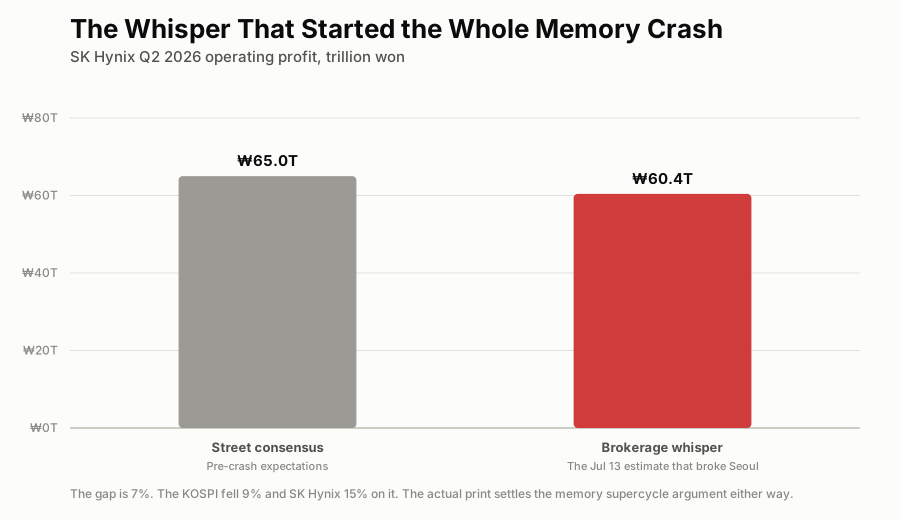
A single analyst note, a 7% estimate gap, and the most violent week in Korean market history. The actual print ends the argument.
Sit with the asymmetry: one brokerage's below-consensus estimate, never confirmed, erased hundreds of billions in market value across two countries, triggered the KOSPI's seventh circuit breaker of the year, and dragged Micron, SanDisk and the whole US memory complex into a drawdown. That's how much leverage this one print carries. If the whisper was wrong, the crash was a gift. If it was right, the crash was the trailer.
The Three Outcomes, Graded in Advance
Beat the ~₩64-65T consensus: the whisper dies, the crash retroactively becomes the best buying opportunity of 2026, the KOSPI dip call pays in full, and the ADR reclaims its $149 IPO price with force. The complex rips: MU, SNDK, EWY, everything.
Land between ₩60.4T and ₩65T: the messy middle, and the mix decides everything. Post-CXMT, the market knows commodity DRAM is contested and HBM isn't. A miss driven by commodity pricing with HBM revenue accelerating is survivable, arguably bullish, because it confirms exactly the narrowed thesis the market has already priced. A miss with soft HBM shipments is the kill shot.
Miss the whisper itself (below ₩60.4T): the supercycle bears were right, the memory complex has another 20% of downside, and every dip-buy of the past month gets stopped out. Low probability given NAND and HBM contract pricing still running at record growth, but that's what the tail is.
What Actually Happens on August 4
The legal gag comes off.
Here is the thing that made the July 29 release strange, and almost nobody covering it explained. SK Hynix posted its fifth consecutive record quarter, watched its stock fall 9.61% into a record ADR low, and said nothing whatsoever about buybacks or dividends. For a company whose share price had roughly halved, that silence looked like indifference.
It was not. It was compliance.
SKHY listed on Nasdaq on July 10. Under SEC Rule 174, prospectus delivery requirements stay in force for up to 25 days after a newly registered public offering, which restricts what a freshly listed issuer can say about material plans while post-offering procedures run. Those procedures complete on August 4. The company has said as much publicly: it could not disclose specific shareholder returns until that date.
So the record quarter and the shareholder response were forced into separate weeks. This week is the second one.
Marked to market on the day itself: the August 4 Seoul session closed with silence, exactly as the rule requires, and the window lapses overnight Korea time. The two sessions leading into it went -7.92% and then about -3%, so the stock arrives at its first legally unmuzzled session on Wednesday, August 5 roughly 11% below the limit-up close instead of front-running the announcement higher. That changes the risk shape: the disappointment scenario (silence for weeks, per management's own "within the year") is now partly priced, and an actual announcement lands on a discounted tape.
The ₩100 trillion number, and why you should not use it
You will see a figure attached to this. Treat it as a report, not a plan.
The Korea Economic Daily reported that SK Hynix was preparing a shareholder return programme of up to ₩100 trillion in the fourth quarter, including roughly ₩40 trillion of buybacks. SK Hynix filed a clarification disclosure with Korean regulators denying it, stating that while it is reviewing measures to enhance shareholder value, it had not decided any specifics including the scale described in the reports. The company's position is that the reported number is inaccurate.
That denial is the most useful sentence in this section, because the figure has since been repeated across aggregator sites without it. For scale, ₩100 trillion would be 1.65 times the ₩60.54 trillion of operating profit the company earned in the single quarter it just reported, and more than twice its previous full-year record of ₩47.2 trillion. It is not an impossible multi-year commitment. It is very much not a confirmed one.
What we can say with confidence is narrower and more tradeable: a restriction expires on August 4, expectations of an announcement are high, the chairman bought ₩4.8 billion of stock on the open market on July 30 for the first time ever, and both Samsung and SK Hynix have publicly moved to defend prices that had halved.
There is also a sentence from the earnings call that most coverage has skipped: management said it would communicate plans "within the year", which is not the same as August 4. We take the whole catalyst apart, including the Rule 174 mechanics and why the ₩40 trillion buyback figure was struck against a stock that has since halved, in the August 4 explainer.
Why this is a bigger deal for the ADR than for Seoul
An announcement that lands in Korean market hours reaches the Seoul line first, and SKHY inherits it through the ADR mechanism rather than by trading it directly. That gap is not academic: the ADR still carries a premium of roughly 22% over the underlying Seoul shares, and a 2.5% conversion cap makes the arbitrage that would normally close it physically impossible. If you are buying the Nasdaq line into a catalyst, read how that premium works first, because it is the part of the position that has nothing to do with memory.
Why the First Nasdaq Print Raises the Stakes
This is more than an earnings report. It's SKHY's first quarterly exam in front of its new American shareholder base, days after those shareholders watched the ADR round-trip from a 13% debut pop to an IPO-price siege. Institutions that fought 7-to-1 for allocation at $149 need this print to justify the fight. A clean quarter converts them into long-term holders; a messy one converts a 7x-oversubscribed book into overhead supply for months.
The Options Angle, Now Graded
The three plays below were written before the print. Here is how they did, and the grading is not flattering to us on the record-keeping.
1. Call spreads two months out, buy near the money and sell 15% higher. The idea was to own the bullish resolution without paying full freight on a three-week-old chain. We cannot grade this, because we never logged a strike, an expiry, a premium or the spot it was struck against. The stock fell from where it was on July 16 to a $130.17 record low on July 29 and has since recovered into the $140s, so an at-the-money spread from mid-July is probably underwater and probably not dead. "Probably" is not a score. This is a fail on process regardless of what the position did.
2. Sell cash-secured puts at $140-145, but only AFTER the print clears with HBM mix intact. This one worked, and it worked because of the condition rather than the view. The print did not clear, so the trade was never entered. Anyone who had sold $140-145 puts ahead of the report, as we first floated on July 13, would have watched the stock print $130.17 and been assigned roughly 7% to 10% underwater against the strike. The conditional is the entire reason this is a win.
3. Two-month MU calls near $840, if it got there first. Same failure as the first play. A trigger level with no logged fill, no expiry and no premium cannot be scored, so we are not going to pretend it can be.
| Play | Logged at entry | Condition | Result |
|---|---|---|---|
| SKHY call spread, ATM / +15%, ~2 months | Nothing logged | none | Ungradeable |
| SKHY cash-secured put, $140-145 | Strike only | Print clears with HBM mix intact | Not triggered, correctly avoided |
| MU calls near $840 | Nothing logged | MU reaches $840 | Ungradeable |
Two of three plays on this page cannot be scored. That is the failure that produced our standing rule that every play now ships with a strike, an expiry, a premium, the spot it was struck against and the implied move, including plays we tell readers to avoid.
Why we are not logging a new play into August 4
We could not source live chain data for SKHY at the time of writing, and a catalyst trade with no logged strike or premium is exactly the failure the table above documents. So there is no new play here, only the shape of the risk:
- This is a headline event with no scheduled time and no consensus number, which is the opposite of an earnings print. There is nothing to price against, so there is nothing to fade.
- The announcement, if it comes, lands in Korean hours. SKHY inherits it at the US open having already moved, which means the ADR holder gets the news and the gap simultaneously.
- You would be buying the memory thesis wrapped in a 22% ADR premium that a 2.5% conversion cap prevents anyone from arbitraging away. Sizing has to account for both.
The One-Line Read
This page was built around one unprinted number, and the number printed: a record ₩60.54 trillion that missed anyway, landing within 0.2% of the single brokerage whisper that had crashed the Kospi sixteen days earlier. What it did not settle is the position, because two sessions later the stock was locked limit-up inside the biggest day in Kospi history, and the reason the company stayed silent on buybacks through all of it was a US offering rule that lapses on August 4, which makes this week, not last week, the one where SK Hynix finally gets to answer its own shareholders.
Next up:GDP, Wednesday at 8:30am ET →
More on $SKHY
Updated Every Saturday
The Week Ahead
Every earnings date, Fed event and setup for the current trading week, on one page.
Refreshed Weekly
Earnings Calendar
Who reports next, when, and what consensus and the whisper expect.
The Week-Ahead Brief
Don’t miss next week’s setups. Get the Saturday brief.
Latest issue, Aug 17“The consumer cracked on Friday. Six retailers answer for it this week.”
Every Saturday: next week’s earnings dates, Fed days and the trades worth watching, from the same desk that writes the week-ahead hub. Free, built for retail investors.