Marking Our Memory Thesis to Market: $900 Broke, China Showed Up, Here's the Updated Call
Marking the memory supercycle thesis to market. MU broke $900 on CXMT's IPO, and SanDisk's Q4 print confirmed the NAND leg at an 84.6% gross margin while its guide missed consensus.
Update, August 5: The NAND Leg Passed, in an Income Statement
SanDisk has reported, and the half of this thesis we kept is the half that just got confirmed. Revenue of $8.965 billion (up 372% year over year, 51% sequentially) and non-GAAP EPS of $39.25, both above the top of the company's own $7.75-8.25 billion and $30-33 guide, and above a consensus that had already been marked above that guide. The full breakdown is in the earnings hub, and the stock fell anyway.
What it settles. On July 16 this framework rotated the trade expression to NAND and HBM pure-plays over commodity DRAM. Reporting splits the 51% sequential revenue increase roughly two-thirds pricing, one-third volume, and non-GAAP gross margin printed 84.6% against a guided 79-81%. That is NAND pricing arriving in the accounts rather than in industry survey data, and the leg is confirmed. The company's own 8.7% overshoot of its twelve-week-old revenue ceiling is, in my read, a mid-upcycle signature rather than a cycle top: tops forecast accurately because prices have stopped moving.
What it does not settle: anything about DRAM. SanDisk has zero CXMT exposure, so tonight carries no information on the leg this piece amputated. The original Test B (CXMT's pricing and disclosed capacity roadmap) remains open, and MU still owns that risk in a way SNDK does not. Anyone treating tonight as a green light for the whole complex is repeating July's mistake of trading four different supply-demand balances as one.
The guide is where the sector lesson actually is. Fiscal Q1 2027 revenue is guided to $10.3-10.8 billion, which is +15% to +20% sequential, against a consensus near $11.16 billion that required +24.5%. So the shortage is extending and the stock fell anyway. For the complex that is the thing to internalise: the bar is no longer "is the shortage real", it is "is the shortage accelerating", and the second question has a much shorter shelf life than the first. Every memory name reporting from here inherits that bar, MU included.
The uncomfortable part, stated plainly. SNDK closed August 5 at $1,350.50, down about 5.4%, and fell a further 4-5% in extended trading on the print (a snapshot, not a close). The fundamental leg passed and the price leg did not. That is July's lesson again: in this complex, being right about the physics has repeatedly not been the same thing as being paid for it.
More on $MU: Mag 7 Slides, Memory Rips: The AI Trade Splits in Two →
TL;DR
- Updated July 29: Test A has printed, and it failed. SK Hynix reported Q2 operating profit of ₩60.54 trillion against a ₩64.1 trillion consensus, landing within 0.2% of the ₩60.4 trillion whisper. The put-selling suspension below is resolved and the framework is re-marked in our teardown of the print.
- Time to grade our own homework. On July 13 we said: MU $900 must hold, SK Hynix earnings is the falsification test, and the flush was late-stage. Two days later, MU broke $900 on an 8% drop and SKHY's ADR fell another 8%.
- What changed: CXMT. A funded, state-backed supply threat to commodity DRAM is a genuinely new fact, not a positioning wave. Our "physics didn't change" line stopped being fully true today.
- What didn't change: HBM is still sold out into 2027, NAND pricing still runs +70-75% quarter over quarter, and CXMT can't build HBM4. The AI half of the thesis is intact.
- Updated call: the supercycle thesis survives, narrowed to HBM and NAND, with the commodity-DRAM leg amputated. New levels, new falsification tests, and the KOSPI call re-graded below.
The Level Broke. Say So Plainly
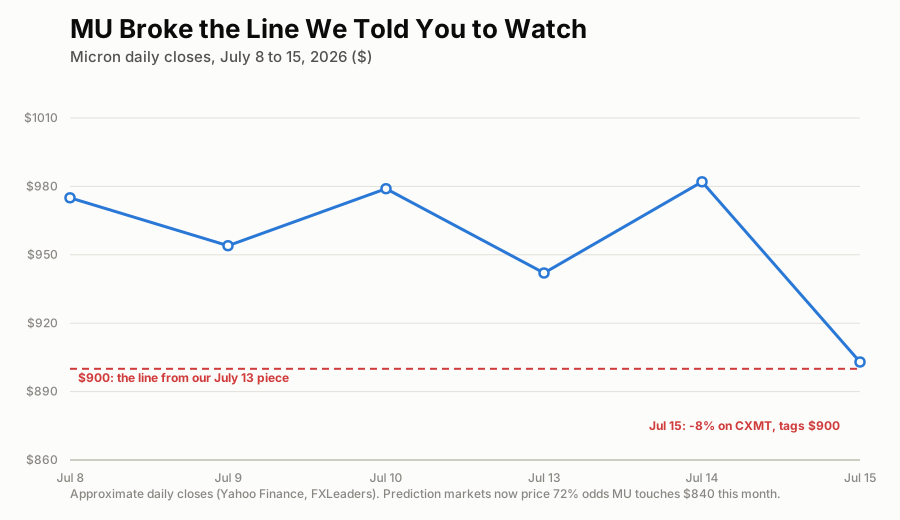
The line we told you to watch, and the day it stopped holding. Prediction markets now put 72% odds on $840 this month.
Our July 13 framework said: hold $900 and the flush bottoms, lose it on volume and the market is telling you something fundamental. Today MU lost it on volume, down 8%, with a specific fundamental attached. The framework worked; the bullish branch of it didn't. When your own if-then triggers the bearish clause, you follow it rather than renegotiate it, so: the commodity-DRAM leg of the memory thesis is marked down, and MU's next stop is the market's $840, not a V-bounce.
What CXMT Actually Changes
Every selloff we defended in the past two weeks was flows: Seoul profit-taking, ETF redemptions, momentum stops. Our argument was that price crashed while physics didn't. CXMT changes the physics, on one leg. An $8.5 billion IPO to scale DRAM at the world's #4 producer, growing sevenfold, with Apple sniffing its output, is future supply, and supply is the one variable a shortage thesis can't absorb. The 2027-2028 "no new capacity" assumption underneath commodity DRAM pricing is now contested.
What CXMT does not change: HBM packaging and yields remain out of its reach for at least two years by every credible read, and the NAND shortage (SanDisk's whole story) is a different technology it isn't attacking. The supercycle isn't dead. It's smaller, and the market spent today figuring out how much smaller.
Re-Grading the KOSPI Call
Yesterday we called the KOSPI dip a buy with SK Hynix earnings as the sole falsification condition. Today added a second condition we didn't have: CXMT attacks Korea's two index heavyweights directly, in their commodity businesses. Honest update: the buy call stands, tranche-sized as designed, because the double-bottom logic and the HBM engine were the core of it and both survive. But the "back the truck up" trigger tightens: it now requires SK Hynix's print to show HBM mix growing fast enough to outrun commodity erosion; a bare headline beat no longer qualifies. The position stays a starter until that shows up in writing.
The Updated Framework
- Two falsification tests now, not one. Test A: SK Hynix's Q2 print (the 60.4-vs-65 trillion won whisper). Test B: CXMT's IPO pricing and disclosed capacity roadmap next week; a bigger-than-expected raise or faster fab timeline extends the commodity markdown.
- New MU levels: $840 is the decision zone (the market's own number, and roughly HBM-only valuation support). Reclaiming $900-940 on volume neutralizes today. There is no bullish case for chasing between the two.
- The trade expression rotates within memory: NAND and HBM pure-plays over commodity DRAM exposure. SNDK over MU on strength; SKHY only after its earnings clear Test A.
The Options Angle
- All memory put-selling stays suspended until Test A prints. We pulled this trade in the wrap and it stays pulled; selling puts into an open supply question is donating.
- The re-entry order, staged now: two-month SNDK calls on a TSMC beat Thursday (NAND story, no CXMT exposure, first to recover if the sector bid returns), then MU at $840 post-SK-Hynix if HBM mix confirms.
- The hedge that pays if we're wrong twice: SOXX puts ten-plus weeks out. If CXMT's roadmap shocks and SK Hynix misses, the whole complex has another leg down, and this covers the book while the longs wait.
The Point of This Exercise
We got the level right and the direction wrong, and the reason was a fact that didn't exist when we wrote the thesis. That's what mark-to-market is for. The memory supercycle enters tonight narrower, better-defined and cheaper than it's been all year: HBM and NAND with the commodity fantasy priced out. Thesis intact, conviction resized, triggers in writing. Grade: B-minus, and the homework continues Thursday.
Next up:GDP, Wednesday at 8:30am ET →
More on $MU
Updated Every Saturday
The Week Ahead
Every earnings date, Fed event and setup for the current trading week, on one page.
Refreshed Weekly
Earnings Calendar
Who reports next, when, and what consensus and the whisper expect.
The Week-Ahead Brief
Don’t miss next week’s setups. Get the Saturday brief.
Latest issue, Aug 17“The consumer cracked on Friday. Six retailers answer for it this week.”
Every Saturday: next week’s earnings dates, Fed days and the trades worth watching, from the same desk that writes the week-ahead hub. Free, built for retail investors.