Kospi Enters a Bull Market, and Is Still 27% Below Its Record
The Kospi fell as much as 6.8% on August 19 as a 19-year-high Treasury yield hit chip stocks, Samsung down 7% and SK Hynix 9%, pulling the index back under the 20% bull-market line.
Updated August 19, after the close: the bond-yield selloff hit Seoul, and the Kospi fell back under the 20% bull-market line it crossed on August 13
The Kospi closed at 6,488.24, down 381.59 points or 5.55%, after falling as much as 6.8% intraday and triggering a "sidecar," a five-minute pause on program sell orders that is a lighter mechanism than the full circuit breakers Seoul triggered twice in late July, per Bloomberg and Trading Economics. Tuesday's close was 6,869.83; 6,869.83 minus 381.59 lands exactly on 6,488.24, so the arithmetic holds.
Samsung Electronics closed at 249,000 won, down 19,500 won or 7.26%, and SK Hynix at 1,508,000 won, down 154,000 won or 9.27%, per Seoul Economic Daily and KED Global. Both stocks were down further intraday before paring, which matches Bloomberg's read of "more than 8%" for each at the session low.
The trigger was Tuesday's US bond market, not a Korea headline. The 30-year Treasury yield touched 5.33% Tuesday, its highest since 2007, before easing to close near 5.285%, per CNBC. US chip stocks reversed the same session, Intel down 6% and Micron and Applied Materials down about 5%, and that reversal is what Seoul was pricing in when it opened Wednesday. A Bloomberg gauge of Asian semiconductor names fell 3.2%, Japan's Nikkei dropped about 3%, SoftBank fell more than 8% and Kioxia more than 10%. Wednesday's 20-year Treasury auction is the next test of whether that yield move keeps going.
The bull-market label from August 13 no longer clears its own bar. Against the July 30 close of 5,593.71 that this piece measured the 20% bull-market threshold from, Wednesday's close is up 16.0%, back under the line. Against the August 13 close of 6,813.34 the index is down 4.77%. Against the June 19 record of 9,385.59 it is 30.9% away, the widest that gap has been since this piece started tracking it.
My read. The August 18 update flagged leverage as the thing to watch, and this session's trigger was a different one entirely: the same chip rally that looked like an AI-demand story is also a rates-sensitive trade, because a Treasury yield spike an ocean away moved Samsung and SK Hynix more than any Korea-specific news has since July. SK Hynix and Samsung have each round-tripped bigger single-day swings than this in August alone, so one session isn't a verdict. But the index spent six days above the 20% bull-market line and needed one bad afternoon in the US bond market to fall back under it, which says the label was closer to the edge than "bull market" sounds.
More on $SKHY: SK Hynix, Samsung Surge as Temasek Eyes First Korea Bet →
Updated August 18, 2:35pm KST (2:35am ET): the Kospi gave back Monday's rally, and the record is still 27% away
The index round-tripped roughly five points in one session. Seoul reopened Tuesday after the Liberation Day holiday and gapped up 2.15% to 7,127.77 against Friday's 6,977.94 close, then ran as high as 7,216.62, up 3.42%, in the first hour, per Seoul Economic Daily. By 2:35pm KST, less than an hour before the 3:30pm close, it had fallen to 6,856.46, down 1.74%, per Yahoo Finance; Investing.com had it a point higher at 6,857.46, down 1.73%, with a session low of 6,788.78. This is a late-session read; the settled close lands after this update was filed.
SK Hynix cleared the July 31 limit-up print intraday, then gave it back too. Against Friday's ₩1,645,000 close, the stock opened near ₩1,748,000-1,750,000, up roughly 6.3-6.4%, per Seoul Economic Daily and TradingKey, which puts it above the ₩1,718,000 limit-up close from July 31 this piece has been tracking since August 13. By early afternoon it had faded to ₩1,664,000, up 1.16%, per Investing.com, back under that mark again. Samsung Electronics ran the same round trip on a wider swing: a ₩274,500 previous close, an open near ₩283,000, an intraday high near ₩288,000 (about +4.9%), and a fade to ₩267,500, down 2.55%.
Monday's setup started on Wall Street, in chip stocks, with no Korea-specific catalyst behind it. SanDisk closed Monday up 8.88% at $1,786.85 against $1,641.11, and Western Digital closed up 5.35% at $536.01 against $508.80, both per stockanalysis.com. The catalyst traces to Friday: entrepreneur Peter Diamandis posted on X that "memory, not compute, is the rate limiter of the Agentic Era," and Elon Musk replied "few realize this." That landed on top of SanDisk's August 13 investor day framework and fresh analyst target hikes, RBC to $1,600 and Wells Fargo to $1,550, both below where the stock actually closed Monday, per 24/7 Wall St. Kioxia caught the same wave in Tokyo's Monday session, up 15.07% to ¥61,840, while Seoul was closed for the holiday.
What turned the Tuesday session was oil, not chips. The 60-day US-Iran agreement expired without an extension over the weekend, reviving Strait of Hormuz supply concerns and pushing Brent crude to $90.87 a barrel, per Seoul Economic Daily. Rising oil and rising Treasury yields are the kind of macro headwind that outruns a sector rally, and Tuesday did it inside a single session instead of over days.
My read. This piece flagged leverage as the third thing to watch back on August 13, on the logic that margin unwinding made July's crash worse than the news alone justified. SK Hynix swinging from +6.4% to +1.2% and Samsung from +4.9% to -2.55% inside one session is what that risk looks like when it's live instead of hypothetical. It isn't a crash, and the index is still a bull market by its own July 30 low. But a 9am gain isn't a verdict on where the day, let alone the trend, ends up.
Updated August 14, Friday morning in Seoul. The Kospi opened at 6,995.67, up 182.33 points or 2.7%, and touched 7,010.86 at about 9:02am KST, its first trade above 7,000 since July 24. It gave the level back inside fifteen minutes and was at 6,960.84, up 2.16%, by 9:15am. Every figure in this paragraph is an intraday snapshot; Friday's close lands at 3:30pm KST, which is 2:30am ET, and is not in this piece yet. SK Hynix was up 5.34% and Samsung Electronics 0.93% at that same 9:15am mark, per the Korea JoongAng Daily. On Thursday's ₩1,593,000 close, a 5.34% gain works out near ₩1,678,000, so the arithmetic below still holds: SK Hynix has not made back its July 31 limit-up print.
TL;DR
- The Kospi closed at 6,813.34 on Thursday, August 13, up 3.56%, a fourth straight gain. That is 21.8% above the July 30 close of 5,593.71, which clears the 20% line and puts the index in a technical bull market.
- Chips did it. SK Hynix closed up 5.92% at ₩1,593,000 and Samsung Electronics up 4.89% at ₩268,000. Both ran higher intraday than they finished, so the closes are the numbers to quote.
- The index is still 27.4% below the June 19 record close of 9,385.59. Getting back needs another 37.8% from here. Bull market and deep drawdown are both true at once.
- The US listing moved first. SK Hynix's Nasdaq ADR, SKHY, closed up 9.01% at $154.41 on Wednesday, four hours before Seoul opened the session that produced the 5.92%.
- July was the worst month for Korean equities since 1997, down 22.19%. Two weeks later the same index is in a bull market. I would hold both facts before deciding this is a recovery.
Why Is the Kospi Up Today?
A revival in the global AI trade pushed Korean chipmakers higher, and the Kospi closed up 3.56% at 6,813.34 on Thursday, August 13. SK Hynix and Samsung Electronics are roughly a third of the index between them, so when memory rallies the benchmark has no choice.
The move crossed a threshold that gets written about: 20% up from a recent low is the conventional definition of a technical bull market, and the index cleared it. Against the July 30 close of 5,593.71 the rebound is 21.8%. Bloomberg measured it from the intraday low and got roughly 22% over ten sessions; Seoul Economic Daily used a July 30 low near 5,550 and got about 23%. All three bases clear 20%, which is why the label stuck regardless of which one a desk used.
Intraday the index was up more than 4%. It finished at 3.56%. If you see both figures today they are the same session at different hours.
The Board
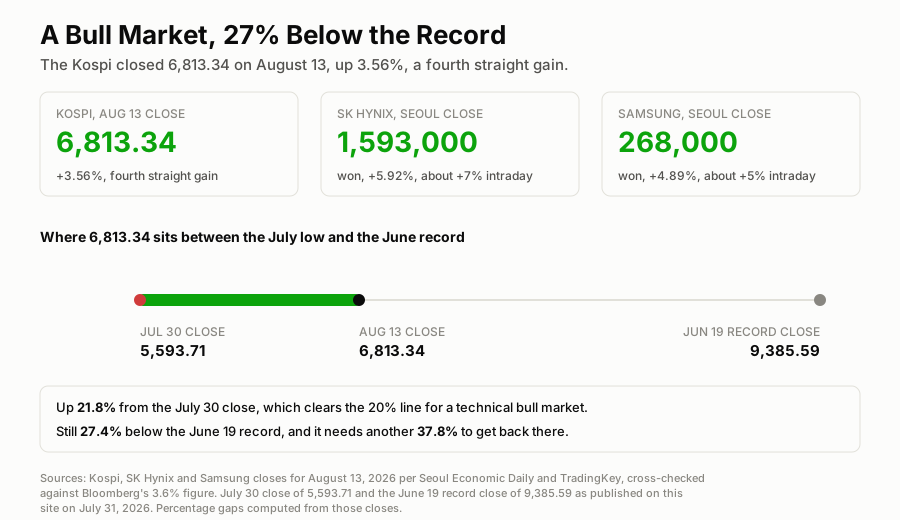
Twenty percent off the low and twenty-seven percent off the high, on the same afternoon.
Twenty Percent Off a Low Is a Weaker Claim Than It Sounds
The bull-market label measures from the bottom. The drawdown measures from the top. Only one of those is where shareholders bought.
The Kospi's record close is 9,385.59, set on June 19, a figure this site has been working from since the July collapse. Thursday's 6,813.34 sits 27.4% under it. To close that gap the index needs another 37.8%, because a percentage fall and the percentage rise that reverses it are never the same number.
So an investor who bought the June high is down 27% and has just read that Korea is in a bull market. Both statements are arithmetic. My rule with the technical labels is to treat them as descriptions of momentum and nothing else, because a 20% bounce off a 40% hole is a real rally and it is also still a hole.
There is a sharper version of the same point inside the index. On July 31 SK Hynix closed limit-up at ₩1,718,000, the maximum daily move Korean rules permit. Thursday's ₩1,593,000 is 7.3% below that print, two weeks later, after the stock has supposedly led the market into a bull run. The biggest constituent has not made back its single best day.
What has genuinely changed is the direction of the memory story. July's rout ran on the fear that hyperscaler AI budgets were about to be cut. Since then Microsoft, Meta and the rest have raised capex, Cisco guided fiscal 2027 AI infrastructure revenue to $7.5 billion, and memory pricing has stayed tight. The bear case that produced the crash has been contradicted by the buyers' own guidance. That is a better reason to be constructive than the 20% threshold is.
The Nasdaq Listing Moved First
Here is the piece of Thursday that I find more interesting than the index level.
Seoul trades 9:00am to 3:30pm KST, which in August is 8:00pm to 2:30am ET. Wednesday's US session had already closed by then. And SKHY, the Nasdaq ADR SK Hynix floated on July 10, rose 9.01% to $154.41 on Wednesday with a market capitalisation of about $774 billion. Seoul opened four hours later and delivered 5.92%.
The US line led and the home market followed it, on a day with no SK Hynix news of its own. That is what a genuinely global listing looks like, and it is new: before July 10 there was no liquid dollar-denominated way to express a view on HBM outside Korean market hours, so price discovery happened overnight in Seoul and Americans read about it in the morning.
For a US reader the practical consequence is that the Korean close is no longer the first quote of the day. SKHY at $154.41 is above its $149 IPO price and below the $168.01 it closed on day one, so the biggest foreign listing in US history has spent a month going sideways through a crash and a bull market. The Temasek stake disclosed on Wednesday is one institution's answer to the same question.
What Would Break This
Three things, in the order I would watch them.
Memory contract pricing for the fourth quarter. The whole re-rating assumes DRAM and HBM pricing holds, and the negotiations that set it are happening now. A flat renewal would do more damage than any index level.
Foreign flows. Overseas investors have been net sellers of Korean equities across 2026, and Seoul Economic Daily reports some money coming back during this rally, with one figure of about $2 billion bought. I could not corroborate that number against a second source, so I would treat the direction as reported and the size as unconfirmed.
And leverage. July's crash was made worse by margin unwinding and leveraged ETF liquidations, which is why the authorities tightened leveraged-ETF rules afterwards. Margin debt coming down is the reason this rally has been steadier than the one that preceded the crash. If it starts climbing again, so does the tail risk. The July circuit-breaker sessions are recent enough to be worth remembering.
How a US Investor Can Actually Hold This
The Kospi itself is not directly buyable from a US brokerage account, which is a constraint worth naming before anyone goes looking for a ticker. The accessible expressions are narrower than the headline suggests:
- SKHY gives dollar exposure to the single stock driving most of the index move, with US market hours and listed options. It is one company, not the market.
- Broad Korea ETFs track the index, and their two largest holdings are the same two chipmakers. So the "diversified" version is substantially the concentrated version.
- Samsung Electronics has no US primary listing. The over-the-counter lines that exist are thin and are not the same instrument as the Seoul shares quoted above.
No options play is logged here. I could not source a live SKHY chain at the time of writing, and I am not going to quote a structure I cannot price.
The One-Line Read
Korea cleared the 20% line and is in a bull market, still 27.4% below the June record. The rally is real, the label flatters it, and the memory contracts negotiated this quarter matter more than either.
Next up:GDP, Wednesday at 8:30am ET →
More on $SKHY
Updated Every Saturday
The Week Ahead
Every earnings date, Fed event and setup for the current trading week, on one page.
Refreshed Weekly
Earnings Calendar
Who reports next, when, and what consensus and the whisper expect.
The Week-Ahead Brief
Don’t miss next week’s setups. Get the Saturday brief.
Latest issue, Aug 17“The consumer cracked on Friday. Six retailers answer for it this week.”
Every Saturday: next week’s earnings dates, Fed days and the trades worth watching, from the same desk that writes the week-ahead hub. Free, built for retail investors.