SK Hynix on August 4: The US Rule That Gagged a Record Quarter, and What Actually Unlocks
SK Hynix posted a record 60.54 trillion won quarter and said nothing about buybacks. SEC Rule 174 is why, and it expires August 4. What the company actually committed to.
Update (August 20, 2026, After the Seoul Close): The Buyback Started Trading, and the Sidecar Ran in the Other Direction
Korea Exchange triggered a buy-side sidecar at 9:59am local time, a five-minute halt on program buy orders that fires automatically when the Kospi 200 Futures Index rises 5% or more for a full minute, per Korea JoongAng Daily. The Kospi hit 6,790.39 at the trigger, up 5.03% from Wednesday's close, and kept climbing toward 6,872.61, a roughly 6% intraday gain, as Korea Economic Daily reported. It is the mirror of the sell-side sidecar that Wednesday's 5.8% plunge triggered at 9:06am, the drop recorded in the update block below. Same index, same five-minute mechanism, opposite direction, one trading day apart.
SK Hynix itself moved 13.14%, Korea Economic Daily's figure as relayed by Biggo Finance; CNBC's own reporting puts the move at over 12%. Samsung rose 8.99%. Against Wednesday's close of roughly ₩1,520,000 (itself down 9.75% on the day the buyback was unveiled), Thursday's move gives back most of that drop in a single session. It is also the first day the ₩40 trillion program is an actual buyer instead of a board resolution: purchases began this morning and run through November 19. Citi analyst Peter Lee called the program a "meaningful floor for the share price, providing tangible downside support in the near term."
I would not credit the buyback alone for Thursday's move. The same morning, the US Treasury said it would at least double its buyback operations for 10-to-30-year debt, pulling the 30-year yield down 9 basis points off Tuesday's 19-year high and easing the exact bond-yield pressure that dragged Samsung and SK Hynix down together two sessions ago. A sovereign buyback and a corporate one both hit the tape the same morning, and both point the same way. Call it support, not proof: a stock that swung 9.75% down and then 13% up inside 48 hours is not settled, it is still finding a level, and one green session after a red one is the smallest possible sample.
More on $SKHY: Kospi Enters a Bull Market, and Is Still 27% Below Its Record →
Update (August 19, 2026, After the Seoul Close): The ₩40 Trillion Buyback Landed, and the Stock Fell Anyway
SK Hynix confirmed a real number today. The board approved a ₩40 trillion ($28.6 billion) share repurchase and cancellation program, announced in a company statement and reported by Bloomberg and Korea Herald. Purchases begin Thursday, August 20, and run roughly three months. Every share bought gets cancelled: it leaves the share count permanently, rather than sitting as treasury stock the company could reissue later. The 2025-2027 shareholder return policy changed with it, from a ceiling of 50% of cumulative free cash flow to a floor above 50%. Those two phrases describe opposite kinds of promise attached to the same number, and the company just moved from one to the other.
Do the arithmetic the company itself published. 24.07 million shares against 730,492,365 shares outstanding is 3.30%, and ₩40 trillion divided by 24.07 million shares works out to ₩1,662,000 a share, which is exactly Tuesday's close. That share count is an estimate struck against a price that stopped being current within a day. SK Hynix fell somewhere between 7.8% and 9.75% in Seoul on Wednesday, depending on the wire (reports from Korea Herald, Yonhap via Korea JoongAng Daily and others don't agree past the first digit), inside a broader rout that took the Kospi down more than 5% as global bond yields hit a 19-year high and Samsung fell alongside it. A fixed won amount buys more shares when the price falls. If SK Hynix actually executes at Wednesday's lower prices instead of Tuesday's, the same ₩40 trillion retires a bigger slice of the company than the 3.3% in the headline. "Buyback announced, stock dropped anyway" sounds like a failure. The arithmetic runs the other way.
One more thing worth flagging: the ₩40 trillion figure lines up with the buyback portion of the ₩100 trillion report SK Hynix denied back on August 4. That earlier report described the buyback as one slice of a combined package due in the fourth quarter. What actually landed today is narrower than that: one company, one board resolution, no fourth-quarter wrapper, and weeks before the fourth quarter even starts. The ₩100 trillion total, and any Samsung-side number attached to it, is still an unconfirmed brokerage estimate. The dividend half of this story also stayed open: SK Hynix said only that it will detail dividend plans at the third-quarter earnings release.
Update (August 16, 2026, Before Monday's Seoul Open): Brokerages Push The Combined Estimate To ₩300 Trillion. The Companies Still Haven't Confirmed A Number.
The figure attached to this catalyst kept climbing through the week. Seoul Economic Daily reported on August 12 that brokerages were modeling a combined shareholder return "over ₩200 trillion" for Samsung and SK Hynix. By August 15, Korea Economic Daily's figure, relayed by Asia Business Daily, had grown to ₩300 trillion (about $216 billion) a year, split roughly ₩200 trillion ($144 billion) at Samsung and ₩100 trillion ($72 billion) at SK Hynix, attributed by name to KB Securities' Kim Dong-won and Daishin Securities' Ryu Hyung-geun. Two other firms, Samsung Securities and DS Investment & Securities, published separate SK Hynix and Samsung models in the same window that don't match those numbers exactly, which is ordinary for competing sell-side desks and a reminder that "the estimate" is really several estimates getting rounded into one headline.
None of it is a company figure. That is the same distinction this page drew on August 4 about the ₩100 trillion Q4 report SK Hynix formally denied, and it still applies here at a larger scale. Reuters reported on August 5 that both companies confirmed only that expanded return plans are in preparation: SK Hynix aims to finalize details by year-end, and Samsung CFO Park Soon-cheol said the board is discussing a special dividend and the next policy "in depth." Neither has put a won figure on the record since.
Run the scale check anyway. Samsung's ₩89.49 trillion Q2 operating profit makes ₩200 trillion a year plausible against its own policy of returning half of free cash flow. SK Hynix's ₩100 trillion is 1.65 times the ₩60.54 trillion it earned in the single record quarter this whole conversation is built on, the same ratio that made the denied Q4 report look strained in the first place.
Seoul is shut until Monday morning. The prints that session opens against: the Kospi closed Friday, August 14 at 6,977.34, up 2.41%, an 11.5% weekly gain that snapped a seven-week losing streak; SK Hynix rose 3.26% to ₩1,645,000 and Samsung 2.43% to ₩274,500; the Nasdaq ADR SKHY closed Friday at $166.33, up 0.40%. A market already up double digits for the week gets a weekend's worth of bigger, still-unconfirmed numbers to trade against when it reopens.
Update (August 4, 2026): The Last Gagged Session Is Done
Seoul's August 4 session has closed and the Rule 174 window lapses tonight Korea time, which makes Wednesday, August 5 in Seoul the first session where SK Hynix can legally say anything. Nothing was announced today, because nothing could be. The market stopped waiting anyway: SK Hynix fell 7.92% Monday to ₩1,582,000 inside a 5.12% Kospi drop, then slipped about another 3% Tuesday to near ₩1.53 million, roughly 11% below Friday's record limit-up close. That is the "you cannot hedge a non-event" shape this page described, arriving a day early. The two pass rows in the trade log below stay open and get scored on August 14 exactly as written.
And as of Wednesday morning in Seoul, the window is open and the wires are quiet. The first legally unmuzzled session began with no announcement, which is exactly what "within the year" permits. One mechanical consequence is already visible: the ADR closed Tuesday at $142.72, within a dollar of Friday, while Seoul sits roughly 11% lower, so the waiting has widened the ADR premium, not narrowed it.
TL;DR
- SK Hynix posted its fifth consecutive record quarter on July 29, watched its stock fall 9.61% to a record ADR low, and announced no buyback and no special dividend. That silence was legally required, not a choice.
- SEC Rule 174 keeps prospectus delivery obligations alive for 25 days after a registered offering. SKHY listed July 10 US time, so the window closes on the night of August 4 Korea time. Disclosing a buyback inside it would have invited a US class action.
- The ₩100 trillion figure doing the rounds is a press report SK Hynix formally denied, in a clarification disclosure to Korean regulators. The company said it had not decided any specifics, including scale.
- The ₩40 trillion buyback attached to that report was priced against a share price roughly 60% above Friday's close. The same 2% of shares now costs about ₩25 trillion. Same buyback, ₩15 trillion less money.
- The sentence almost nobody is quoting: on the earnings call management said it would communicate plans "within the year", not on August 4. The date is when the company may speak, not when it said it would.
What Happens to SK Hynix on August 4?
A US securities rule stops applying, and SK Hynix becomes legally free to talk about buybacks and special dividends for the first time since it listed on Nasdaq. That is all that is scheduled. An actual announcement is possible, widely expected, and not promised.
That distinction is the whole article, because the market is currently pricing a date the company never gave it.
The Board
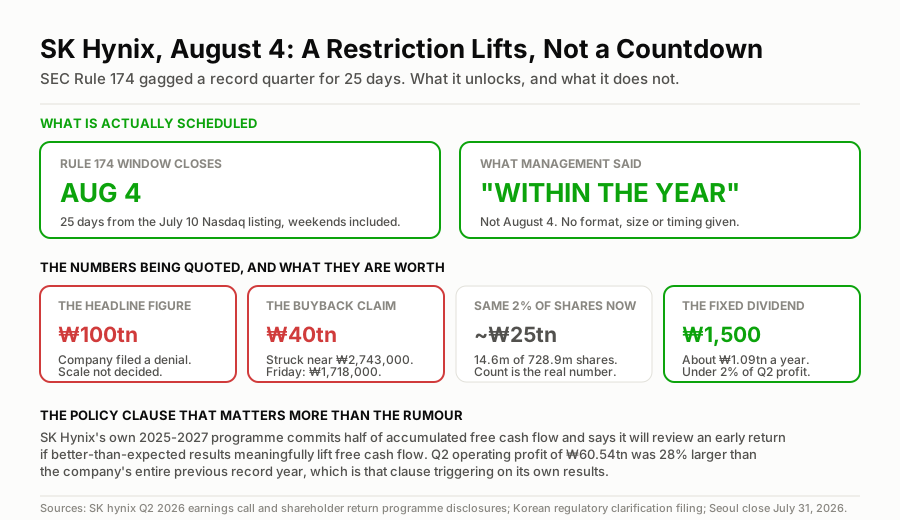
A restriction lifting is not an announcement. Every currency figure on this page was struck against a share price that has since halved.
Why a Record Quarter Came With Total Silence
Rewind to July 29. SK Hynix reported revenue of ₩79.32 trillion, up 51% sequentially and 257% year over year, and operating profit of ₩60.54 trillion at a 76% operating margin. One quarter of profit was 28% larger than the company's entire previous annual record.
The stock fell 9.61% in Seoul and the ADRs hit a record low near $130, because the print missed a consensus that had been set too high.
And a company whose shares had roughly halved, sitting on the largest quarterly profit in its 43-year history, said nothing at all about returning any of it to shareholders.
That looked like arrogance. It was compliance.
Rule 174, Explained Without the Law Degree
When a company completes a registered public offering in the United States, the prospectus is the legal document investors are entitled to rely on. SEC Rule 174 keeps prospectus delivery obligations in force for up to 25 days after the offering starts trading, weekends included.
Here is the part that matters. During that window, announcing material information that was not in the offering document creates real legal exposure. A large buyback or a special dividend is exactly that kind of information: it moves investment decisions. Disclose it inside the window and every investor who bought during the offering has a colourable claim that the prospectus they relied on was incomplete. In the United States, that is a class action.
So the arithmetic is simple and unforgiving:
| Event | Date |
|---|---|
| SKHY begins trading on Nasdaq | July 10 (US time) |
| Rule 174 window, 25 calendar days | July 10 to August 4 |
| Q2 earnings land inside the window | July 29 |
| Window closes | Night of August 4, Korea time |
The record quarter and the shareholder response were forced into separate weeks by a rule written for a completely different purpose. SK Hynix confirmed as much publicly: it said the ADR offering procedures prevented it from disclosing new material information not contained in the offering document.
This is not a Korean quirk. Any foreign company listing ADRs in the US runs into the same 25-day muzzle, which is worth remembering the next time a newly listed name reports and appears to ignore its own share price.
The ₩100 Trillion Number Is a Report the Company Denied
You will see a figure attached to this catalyst everywhere. Do not use it.
The Korea Economic Daily reported that SK Hynix was preparing a shareholder return programme worth up to ₩100 trillion in the fourth quarter, including roughly ₩40 trillion of buybacks. SK Hynix filed a clarification disclosure with Korean regulators denying it, stating that while it was reviewing measures to enhance shareholder value, it had not decided any specific details including the scale described. The company's position is that the reported number is inaccurate.
That denial has since been stripped off as the figure travelled. It is now quoted by aggregator sites as though it were a plan.
Run the scale check the company's own numbers invite:
- ₩100 trillion is 1.65 times the ₩60.54 trillion the company earned in the quarter it just reported.
- It is more than twice its previous full-year operating profit record of ₩47.2 trillion.
Neither of those makes it impossible as a multi-year commitment. Both of them make it a very strange thing to assert as fact when the issuer has said in writing that it is not decided.
The ₩40 Trillion Buyback Was Struck Against a Different Stock
This is the part that survives the denial and is worth understanding anyway, because the same reports describe the buyback as covering about 2% of shares outstanding.
Do the multiplication, which nobody publishing the ₩40 trillion figure appears to have done. SK Hynix has roughly 728.9 million shares outstanding. Two percent of that is about 14.6 million shares. For 14.6 million shares to cost ₩40 trillion, the share price has to be about ₩2,743,000.
Friday's close was ₩1,718,000. The ₩40 trillion figure implies a share price roughly 60% above where the stock actually is.
That is not a contradiction, it is a stale snapshot. The report was written when the stock was worth far more, and the stock has since roughly halved and partially recovered. The durable number is the share count, not the money. Two percent of the company today costs around ₩25 trillion, and a reader comparing a ₩40 trillion headline against today's tape will conclude the plan was cut when nothing of the sort happened.
Ask it every time you see a tranche quoted in currency: percentage of what, and at what price?
What SK Hynix Has Actually Committed To
Strip out the speculation and there is a real, published policy underneath, and it is more informative than the rumour.
Under the shareholder return programme running 2025 to 2027, SK Hynix committed to:
- Allocating half of accumulated free cash flow to shareholder returns.
- A fixed annual dividend of ₩1,500 per share, raised 25% from ₩1,200.
- An additional return if financial targets are met by the time the three-year programme ends in 2027.
That fixed dividend reconciles cleanly against the share count: ₩1,500 × 728.9 million shares is about ₩1.09 trillion a year, which matches the roughly ₩1 trillion annual cash dividend the company forecast when it set the policy. The figures agree, which is more than can be said for the rumour.
Now put ₩1.09 trillion next to what the company just earned. The entire annual dividend is under 2% of a single quarter's operating profit. That gap, not any press report, is why expectations are running hot.
And there is a clause in the company's own policy that matters more than anything a newspaper printed. SK Hynix said it would review an early return to shareholders, before the programme expires, if better-than-expected performance produced a meaningful increase in free cash flow.
Read that against a quarter that earned 28% more than the company's entire previous record year. The case for an August announcement is not press speculation. It is SK Hynix's own written policy triggering on its own results.
The Sentence Everyone Is Skipping
Here is where the consensus and the evidence part company.
On the July 29 earnings call, management said it could not provide details on format, size or timing, that it was reviewing measures from multiple angles, and that it intended to communicate plans to the market "within the year" once finalised.
Within the year. Not on August 4.
The market has converted "the gag order lifts on August 4" into "the announcement comes on August 4". Those are different claims, and only the first one has a source. The reports that do put a date on the programme itself point to the fourth quarter, which is consistent with "within the year" and inconsistent with this week.
So the catalyst is narrower than the excitement around it: August 4 removes an obstacle. It does not create an obligation. It is entirely possible that the window closes, nothing is said for weeks, and the stock gives back whatever it front-ran.
What is genuinely supportive, and verifiable:
- Chairman Chey Tae-won bought about ₩4.8 billion of SK Hynix stock on the open market on July 30, his first ever such purchase.
- Both Samsung and SK Hynix moved publicly to defend share prices that had halved, with Samsung formalising the possibility of a special dividend alongside buybacks and cancellations.
- Management stated that strengthened cash generation would let it meaningfully expand shareholder returns while funding growth.
Those are three real signals. None of them is a date.
Why This Hits the ADR Differently
If you own SKHY rather than the Seoul line, the mechanics work against you twice.
First, timing. The Rule 174 window closes on the night of August 4 Korea time. Any announcement reaches the Seoul shares during Korean hours, and SKHY inherits it through the ADR mechanism at the US open, having already moved. The ADR holder gets the news and the gap in the same instant.
Second, the premium. SKHY still trades at roughly 22% above the underlying Seoul shares, and a 2.5% conversion cap makes the arbitrage that would normally close that gap physically impossible. A shareholder return announcement improves the Korean company. It does nothing for the premium sitting on top of the Nasdaq line, and that premium has already fallen from about 51% since listing. The full mechanics are here, and they are the part of the position that has nothing to do with memory.
The Options Angle
- This is an event with no scheduled time, no consensus number and no guaranteed occurrence. An earnings print has all three, which is what makes it tradeable. Here there is nothing to price against, so there is nothing to fade and nothing to fairly call cheap.
- The asymmetry is worse than it looks, because the disappointment case is silence. A stock that has rallied into a date can sell off on nothing being said, and "nothing was said" is an outcome with no headline attached to it. You cannot hedge a non-event.
- If you want exposure, own it in Seoul terms and size for the premium. Every dollar of SKHY is roughly 22 cents of ADR scarcity that a Korean buyback does not touch.
- The one structure that fits the shape of this risk is defined-risk and dated past the fourth quarter, because the company's own guidance is "within the year", not this week. Anything expiring in August is betting on the market's assumed date rather than the company's stated one.
Trade log
| # | Stance | Structure | Strikes and expiry | Cost or credit | Spot at writing | Implied move | Breakeven |
|---|---|---|---|---|---|---|---|
| 1 | Pass | Long calls into August 4 | n/a, no position taken | live SKHY chain data could not be sourced at writing | about $143, July 31 regular close (sources differ between $142.60 and $143.73) | not sourced | Scored as a loss if SKHY rallies on an announcement by August 14 |
| 2 | Pass | Short puts before the window closes | n/a, no position taken | live SKHY chain data could not be sourced at writing | about $143, July 31 regular close | not sourced | Scored as a loss if SKHY is flat to higher on August 14 |
Both rows are passes, and both are scoreable. If SK Hynix announces a large buyback this week and the ADR gaps higher, this page told you not to buy it, and that is a losing call that will appear in the next scorecard. We are taking that risk rather than logging a play we could not price, because two of the three plays on the earnings preview turned out to be ungradeable and that is not happening again.
The One-Line Read
SK Hynix earned more in three months than in any full year of its history and said nothing about giving any of it back, because a 25-day US prospectus rule made saying so a litigation risk rather than a courtesy, and that rule expires on the night of August 4: what lifts is a restriction, not a countdown, the ₩100 trillion figure attached to it is a report the company has formally denied, and management's own words point to an announcement "within the year" rather than this week, which means the tradeable event here is a permission, and permissions do not have expected moves.
Next up:GDP, Wednesday at 8:30am ET →
More on $SKHY
Updated Every Saturday
The Week Ahead
Every earnings date, Fed event and setup for the current trading week, on one page.
Refreshed Weekly
Earnings Calendar
Who reports next, when, and what consensus and the whisper expect.
The Week-Ahead Brief
Don’t miss next week’s setups. Get the Saturday brief.
Latest issue, Aug 17“The consumer cracked on Friday. Six retailers answer for it this week.”
Every Saturday: next week’s earnings dates, Fed days and the trades worth watching, from the same desk that writes the week-ahead hub. Free, built for retail investors.