Stock Market Week Ahead (August 17-21): Walmart, Target, Home Depot and the Fed Minutes
Week ahead August 17-21: retail earnings week lands three days after retail sales fell 0.6%. Home Depot Tuesday, Target and the FOMC minutes Wednesday, Walmart and Alibaba Thursday.
TL;DR
- Six of America's biggest retailers report three days after the consumer data cracked. July retail sales fell 0.6% against a +0.1% consensus, and preliminary August sentiment dropped to 51.0 from 55.2. Home Depot goes Tuesday, Target, Lowe's and TJX Wednesday, Walmart, Deere and Ross Stores Thursday, BJ's Friday.
- The July FOMC minutes land Wednesday at 2:00pm ET. That meeting held at 3.50-3.75% with three dissents in favour of a hike, the most since September 2016. Chair Kevin Warsh has stripped forward guidance out of the statements, so the minutes are the only look inside the split before Jackson Hole.
- The tape going in is split down the middle. The S&P 500 closed Friday at 7,785.76, down 0.17% from Thursday's record 7,798.99 but up 0.36% on the week, its third straight gain. The Russell 2000 set a record close at 3,068.42, up 0.51% and 1.1% on the week. The Dow closed Friday at 53,732.41.
- Walmart's consensus sits at the top of Walmart's own guide again: $0.74 against a $0.72-0.74 range. The last time that setup appeared it produced a miss and a 4% morning drop.
- Before any of Wednesday's earnings, the 50% Section 338 tariffs on Canada take effect at 12:01am ET. They cover about $20bn of imports, roughly 5% of the $383bn America buys from Canada, and talks were still running Friday.
- Friday carries flash PMIs at 9:45am ET, and the SpaceX day-70 tranche lands on the 20th or the 21st depending on which source counts it: roughly 319 million shares by our own derivation, the second supply test in three weeks.
UPDATE (August 19): retail week's first two mornings are in. Home Depot beat on Tuesday with comps accelerating to 1.7% and held its guide. Wednesday split the consumer by ticket size: Target comped +3.8% and printed $4.11 of EPS with $1.65 of tariff refunds inside it (about $2.46 on operations), TJX comped +4% and raised its year through the Street's number, and Estée Lauder beat its own guide ceiling and guided fiscal 2027 EPS up 24-34%, while Lowe's comped just 0.2% and cut its full year to the bottom of every range. All four Wednesday moves and the results detail are in the retail hub and the hour-by-hour timetable. Walmart, Alibaba and Deere land Thursday.
UPDATE (August 19, after the close): Wednesday's premarket read did not survive the session. Target closed +4.28% at $159.00, a 52-week high, after trading down to $146.21 in the morning; Lowe's closed +2.37% on a cut guide; Estée Lauder closed +16.30%. TJX was the exception, -4.21%, on a Q3 guide of $1.30-1.32 against a $1.35 consensus. Analog Devices beat and guided its margin to 52% and still closed -0.89%. After the bell, Wolfspeed reported $149.6m of revenue and gave AI data center growth as a percentage for a second quarter, Coty printed the two-cent loss its guide implied and would only guide one quarter of fiscal 2027, and BILL beat its own guide on every line. The July minutes at 2:00pm showed the hawkish case reaching well past the three dissenters.
More on $SPY: Stock Market Week Ahead (August 24-28): Nvidia, July PCE, and Warsh at Jackson Hole →
What to Expect From the Stock Market This Week
Last week the macro did all the talking and CPI landed dead on the nowcast, which settled nothing about September. This week the companies talk back.
The sequencing is what makes it worth watching. On Friday the government said American consumers spent 0.6% less in July, and the University of Michigan said they feel worse about it than at almost any point on record. Starting Tuesday morning, the companies that actually take that money report what happened in their stores. Macro data is a survey and a seasonal adjustment. Home Depot's comp is a count of transactions. The sector heatmap is the fastest way to see whether the rotation that carried small caps to a record survives the answer.
The Board
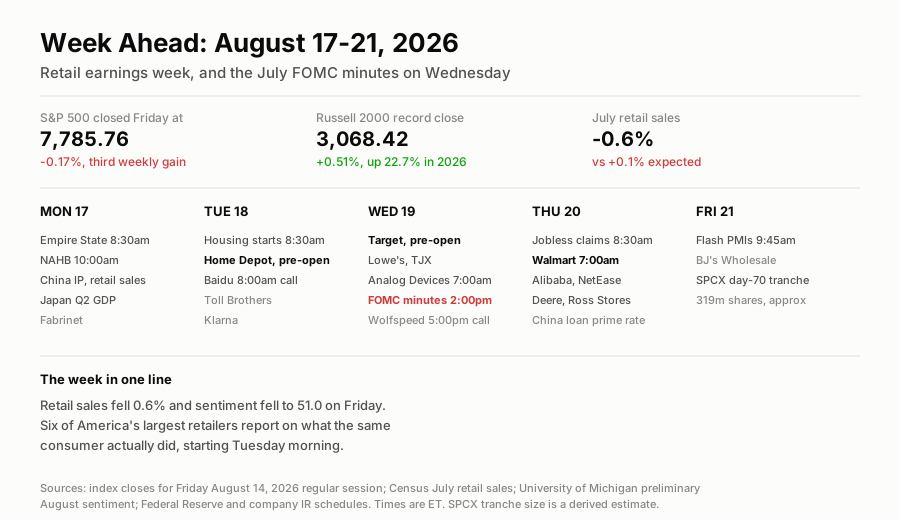
Retail earnings week, arriving three days after the consumer prints fell apart.
Why Friday's Two Prints Set Up Everything
July retail sales fell 0.6% against a consensus that wanted a small gain. Strip out the online category and the core measures held up better than the headline, which is the argument the bulls will make all week and it is a fair one.
Sentiment is harder to explain away. The preliminary August reading of 51.0, down from 55.2, came with inflation expectations moving up rather than down. Falling confidence alongside rising expected prices is the combination that historically precedes weak discretionary spending.
Put those next to what the market did anyway. The Russell 2000 closed at a record 3,068.42, its second in as many days after Thursday's 3,052.85, and small caps are now up about 22.7% in 2026, roughly 9.5 points ahead of the S&P 500. Small caps are the most rate-sensitive and most domestically exposed corner of the market. They are rallying on the view that the Fed is done hiking, and that view is downstream of a consumer who is weakening. If the retailers confirm the weakness, that trade gets both its wish and its punishment in the same week.
Underneath the index, semiconductors went two ways on the same question. Broadcom closed at $393.08, down 5.92%, after Bank of America put a large number on the debt inside its AI financing platform. AMD closed at $514.39, up 6.50%, in the same session that it priced $4.75 billion of its own notes and Baird doubled its target to $1,250. The market is now pricing how each name funds the buildout, and it is charging very different rates for it: what the $1,250 target actually requires is here.
Monday, August 17: China Data, and the Biggest Print of the Day Is at 4:00pm
Empire State manufacturing at 8:30am ET and the NAHB housing index at 10:00am are the only US prints, and neither usually moves an index.
The overnight session carries more. China reports industrial production, retail sales and fixed asset investment, and Japan publishes preliminary Q2 GDP. Both matter for the three Chinese ADRs reporting later in the week. Fabrinet reports after the close, with the call at 5:00pm ET: the first AI-infrastructure read of the week, guiding to $1.25-$1.29 billion and roughly 40% growth. It has beaten and sold off twice running, by 10.22% in February and 8.01% in May, and the options price about 12% this time.
The closing auction is the thing to watch. Reddit joins the S&P 500 before Tuesday's open, replacing AvalonBay Communities, so the index trackers have to own their weight by Monday's close: roughly 14 to 17 million shares, with J.P. Morgan's estimate at 16.7 million, against 5.83 million shares of average daily volume and 19.21 million sold short. RDDT closed Friday at $178.09, up 12.63% on the announcement. Whether that gain survives the print is a cleaner test of how much an index seat is still worth than anything the macro calendar offers this week.
The other half of that swap completes the same day. AvalonBay's merger with Equity Residential closes Monday, so Monday should be AVB's last session: each share converts into 2.793 shares of the combined company, which trades as VMRK from Tuesday's open. The dividend income on that stake rises 10.2% in the swap, because AVB holders receive 2.793 shares of a stock paying $2.81 a year in place of one paying $7.12.
Tuesday, August 18: Home Depot Opens Retail Week
Home Depot reports before the open, and it is the cleanest read on the big-ticket consumer in the whole season. Consensus wants $4.71 of EPS, up 0.6%, on revenue near $47.5 billion. That growth number is the point: the Street models a flat year. Q1 comps ran +0.6%, and the full-year guide of flat-to-+2% comps needs a back-half acceleration that 30-year mortgage rates near 6.66% have not delivered yet. Our verdict on buying it into the print is here.
Baidu reports the same morning with the call at 8:00am ET, per its own 6-K. Online marketing revenue fell 22% last quarter while AI-powered revenue rose 49% and crossed half the business. Net cash and investments cover 79% of the market cap, which is the whole argument in our verdict on buying it into the print. Housing starts and building permits land at 8:30am, and Toll Brothers reports after the close, which makes Tuesday a housing day as much as a retail one. La-Z-Boy joins it that evening, guided to $490-510m of sales against $492m a year ago, after the stock rose about 25% on a June quarter carrying $0.16 of one-off tax benefit.
Two more land at the same hour and neither is about the consumer. Keysight booked $2.051bn of orders last quarter, up 56%, then guided this quarter's revenue up about 1% sequentially, so Tuesday is a question about the order book rather than the quarter. Mercury Systems reports at 5:00pm with record bookings of $348m, a 1.48 book-to-bill and free cash flow of minus $1.8m in the same quarter, into a stock trading above the mean target of the nine analysts who all rate it a Buy.
A hard deadline closes at 5:00pm ET: RE/MAX holders must elect cash or stock in the Real Brokerage merger, approved by both sides on Friday. The choice is $13.80 in cash or 5.15 Real shares, and at Friday's closes those legs are worth $13.80 against $12.36. Doing nothing defaults to the cheaper one, and the cash is capped at $60m to $80m in aggregate so it prorates.
Wednesday, August 19: Four Consumer Names, Then the Minutes
It is the densest day of the week, so it has its own hour-by-hour timetable, from the midnight tariff through to the 5:00pm call.
The day starts before anyone rings a bell. The 50% Section 338 tariffs on Canada take effect at 12:01am ET unless a deal lands first, hitting roughly $20 billion of imports on goods entered for consumption from that moment. USMCA origin buys no exemption. Every retail call that morning now carries a tariff question, and Walmart's Thursday margin commentary is the closest thing to a live read on who absorbs it.
Target reports before the open with consensus at $2.21-2.23, up about 8%, on revenue near $26.1 billion. The tension sits in the full year, where the Street's $8.48 is two cents below the top of Target's own $7.50-8.50 guide, into a stock at a 52-week high. The buy-or-wait call is in the companion piece. Lowe's and TJX report the same morning, and TJX is the one to watch if the consumer is trading down rather than spending less. Estee Lauder closes out its fiscal year the same morning, with the call at 8:30am ET, adding prestige beauty to a day that already spans big-box and off-price. Nine months of adjusted EPS leave $0.23-$0.33 inside its own full-year guide, and the Street is at $0.32.
After the close, two more that the retail framing misses. Coty guided its June quarter to adjusted EPS of breakeven to a two-cent loss and consensus sits dead centre of it, so the print is knowable and the move comes from an FY27 guide landing on $2.96bn of net debt against a $2.51bn market cap. BILL gives its first full-year guide since cutting 709 jobs, about 30% of its workforce, on the same afternoon it authorized a $1bn buyback worth a fifth of the company.
Analog Devices reports at 7:00am with the call at 10:00am, guided to $3.9 billion and $3.30. Operating margin is guided to approximately 49.0%, flat against last quarter, after every prior quarter of this upcycle expanded it. Wolfspeed closes the day at 5:00pm with revenue guided to another decline, and the options market prices 14% into a name whose last two prints ran past implied.
The week's one new listing is also Wednesday: Lyntris priced its NYSE defense-tech IPO under LYNX below its marketed $19-22 range, at $17.50 for a downsized $297.5m deal, and closed its first session down 14.2% at $15.01. The insider-heavy split held even as the deal shrank, at roughly 66% existing holders, and the full pricing-to-Friday breakdown, including why the debt is less risky than it looks, is in the updated piece.
One hour before the minutes, Treasury sells $16 billion of a new 20-year bond with bids closing at 1:00pm ET. Last Thursday's 30-year sale cleared at 5.216%, the highest in Treasury's published auction records, and the 20-year needs only a few basis points of concession to set a record of its own at 5.245%. A soft auction at 1:00pm going into the minutes at 2:00pm is the one sequence that could spoil an otherwise well-supported tape.
The FOMC minutes hit at 2:00pm ET. July's hold drew dissents from Hammack, Kashkari and Logan, all wanting a hike. What I want from the minutes is the count behind the count: how many non-voters leaned the same way, and what the committee said about a labour market that has since shed jobs. With no forward guidance in the statements, this document is the closest thing to a signal available before Warsh speaks at Jackson Hole on August 28.
Thursday, August 20: Walmart, Alibaba, Deere
Walmart releases at 7:00am ET with the call at 8:00am, per Walmart's own event page, which puts the materials out at 6am CT and the call at 7am CT. Consensus of $0.74 sits at the very top of the guided $0.72-0.74, on revenue near $186 billion. That is the same trap the stock walked into last time and it produced a miss. The substance is the tariff whipsaw: Walmart raised prices citing duties in the spring, then cut prices on thousands of items in early July, so the gross margin commentary is the best read available on who is absorbing tariff costs. Our verdict is here.
Alibaba reports before the open with its call at 7:30am ET, half an hour ahead of Walmart's, and whether to own it into the print is the companion piece. NetEase, whose profit line still carries a June 30 mark on Alibaba and Pinduoduo, Deere and Ross Stores follow, with jobless claims at 8:30am and China's loan prime rate overnight. Deere is the industrial consumer read and Ross is the discount one, which makes Thursday the most information-dense session of the week. Advance Auto Parts reports the same morning and is the one retail name that historically improves when consumers get poorer: it comped 3.5% in a 16-week Q1 and then reaffirmed a full-year guide of 1.0-2.0%, which asks the remaining 36 weeks for roughly zero. Dates for everything are in the earnings calendar.
Friday, August 21: PMIs, With the Unlock a Day Behind
Flash manufacturing and services PMIs at 9:45am ET are the first August activity data anyone gets, ahead of the hard numbers in September. BJ's Wholesale reports before the open, with the call at 8:00am ET. Its ex-gasoline comps ran 1.5% last quarter against a full-year guide of 2.0-3.0% that management reaffirmed anyway.
The SpaceX day-70 tranche lands Thursday, August 20, roughly 319 million shares on our own derived count. This edition originally left the date open between the 20th and the 21st; the prospectus counts from its own June 11 date, which is CNBC's reading, and the site's lock-up calendar was restated to that basis on August 17. The first unlock produced a 6.1% rally rather than the crash everyone feared, and the case for waiting through this one is here. The lock-up calendar has the full staircase.
The Playbook
- Trade the retailers as one position, because that is what they are. Home Depot, Target, Lowe's, TJX, Walmart and Ross all report inside 72 hours against the same consumer. Sizing six independent-looking bets on a single macro variable is how a book gets accidentally concentrated.
- The trade-down split is where the information is. If TJX and Ross beat while Target and Home Depot miss, the consumer is rotating rather than retreating, and that is a materially better outcome for the index than the headline retail sales number implies. Watch that pair before you read anything into the group.
- Walmart's guide matters more than Walmart's quarter. The full-year $2.75-2.85 came in light in May and the stock still sits about 16% below its May record. A raise is the catalyst; another quarter of holding it is the disappointment, whatever the EPS line does.
- Wednesday afternoon is a genuine event, and it is being underpriced. Minutes releases are usually filler. This one documents the most divided committee since 2016 at the exact moment the market has decided the hiking cycle is over. I would rather be flat into 2:00pm than clever.
- Nvidia reports August 26, two days before Warsh speaks. Anything structured past this Friday's expiry is carrying both, and the following week is the harder one to hold through. Jackson Hole runs August 27-29, and Marvell reports on the 27th with consensus sitting on the guide midpoint. XPeng opens that week on the 24th, with its delivery count already public and flat against last year.
- The first week of September is already stacked. Palo Alto Networks closes its fiscal year on the 1st, Snowflake reports the 2nd with product revenue guided to decelerate four points, and Dell follows on the 3rd after booking $24.4bn of AI orders in a quarter it only shipped $16.1bn into.
The One-Line Read
The market spent Friday learning the consumer stopped spending, then closed small caps at a record on the theory it means no more hikes. Six retailers and the Fed minutes get to referee that argument this week.
Next up:GDP, Wednesday at 8:30am ET →
More on $SPY
Updated Every Saturday
The Week Ahead
Every earnings date, Fed event and setup for the current trading week, on one page.
Refreshed Weekly
Earnings Calendar
Who reports next, when, and what consensus and the whisper expect.
The Week-Ahead Brief
Don’t miss next week’s setups. Get the Saturday brief.
Latest issue, Aug 17“The consumer cracked on Friday. Six retailers answer for it this week.”
Every Saturday: next week’s earnings dates, Fed days and the trades worth watching, from the same desk that writes the week-ahead hub. Free, built for retail investors.