July PPI Report: Flat, and the Margin Gap Shrank to 1.3 Points
July PPI came in unchanged on the month and 4.7% on the year, down from 5.5%. Against 3.4% consumer inflation the gap narrowed to 1.3 points, though energy did most of the work.
Updated August 13 at 9:30am ET with the July release. The preview said the 12-month line would matter more than the monthly one, and that the direction of any narrowing would decide whether this was margin relief or pass-through. The gap narrowed, and it narrowed from the producer side.
TL;DR
- July PPI was unchanged on the month, against a +0.2% consensus. The 12-month rate fell to 4.7% from 5.5% in June.
- The producer-consumer gap closed to 1.3 points from 2.0 in June, against a July CPI of 3.4%. It closed from the top, which is the margin-relief version.
- Energy did the work. Final demand goods fell 0.7%, with energy off 3.1% and foods off 0.9%. Services rose 0.2%.
- The cleanest underlying line was the firmest. Ex foods, energy and trade services rose 0.4% on the month, twice the pace of core ex-foods-and-energy at 0.2%.
- Trade services fell 0.1%, and that series is wholesaler and retailer margins. The middle of the chain took slightly less per unit than it did in June.
More on $SPY: Stock Market Week Ahead (August 24-28): Nvidia, July PCE, and Warsh at Jackson Hole →
The Board
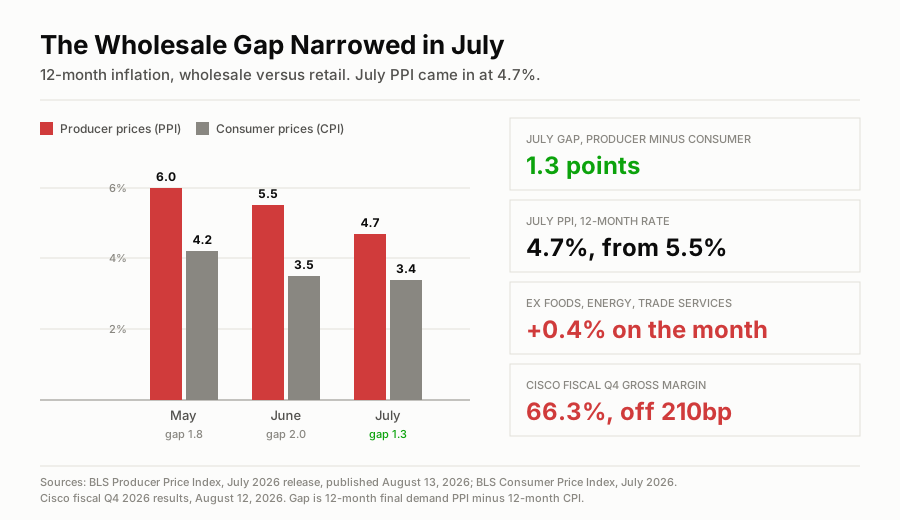
Three months of overlap. The red bar finally came down toward the grey one.
Did July PPI Come In Hot or Cold?
Cold on the headline, mixed underneath. Final demand producer prices were unchanged in July on a seasonally adjusted basis, against a Dow Jones consensus of +0.2%. Over the twelve months to July the index rose 4.7%, down from 5.5% in June.
The Bureau of Labor Statistics released it at 8:30am ET. The hour-by-hour timetable for the rest of the day is here, including Applied Materials after the close.
Initial jobless claims were published in the same minute. The figure I found came from a single source and I could not match it against a second before filing, so it is left out here.
The Gap Closed From the Top
Consumer prices rose 3.4% in the year to July, confirmed on Wednesday. Producer prices rose 4.7%. That is a spread of 1.3 points, against 2.0 in June and 1.8 in May.
Two ways that spread could have closed. Producer inflation falling toward consumer inflation is margin relief. Consumer inflation rising toward producer inflation is pass-through, and it is the version the Fed reacts to. July delivered the first: consumer inflation barely moved while the producer line dropped eight tenths of a point.
The 2026 producer series now reads 3.1% in January, 3.4% in February, 4.3% in March, 5.7% in April, 6.0% in May, 5.5% in June and 4.7% in July. May was the peak. Two months of decline is not something I would rebuild a portfolio around, but it is the first time this year the series has gone the right way twice running.
A note on how it got there. The monthly print was zero, so almost all of that 0.8-point drop is the July 2025 base month rolling out of the calculation. The level did not fall. The comparison did.
Energy Did the Work Again
June's decline was gasoline, which this site flagged at the time as an artefact. July looks like the same shape: final demand goods fell 0.7%, energy fell 3.1%, foods fell 0.9%. Services rose 0.2%.
Strip the volatile pieces and it firms up. Final demand less foods, energy and trade services rose 0.4% in July, the warmest of the monthly cuts, though its 12-month rate still eased to 4.7% from 5.1% in June. Core ex foods and energy rose 0.2%, on a 12-month rate of 4.2%.
My read: a headline flattered by commodities for the second month running, with the underlying services line still warm. The annual gap genuinely narrowed. The monthly detail supports less margin relief than that annual number advertises.
The Line Nobody Quotes
Final demand trade services fell 0.1%.
That series measures the margins wholesalers and retailers earn on what passes through them, which makes it the one line in this release that is directly about who absorbs cost. It went down. Distributors charged a little less per unit in July than they did in June, in a month when their own input costs on the cleanest measure rose 0.4%.
That is a small number and I do not want to hang an argument on one month of it. It points the opposite way to the comforting headline.
What Cisco Still Has to Deal With
Cisco reported fiscal Q4 after Wednesday's close: revenue of $17.3 billion, up 18%, non-GAAP EPS of $1.22, up 23%, both above guidance. Non-GAAP gross margin still fell 210 basis points to 66.3% on a heavier hardware mix and higher memory costs. CFO Mark Patterson told the call that price increases contributed about 5 points of the quarter's revenue growth, with another 4 to 5 points planned for fiscal 2027. Q1 gross margin is guided to 65-66%.
The stock closed the regular session at $123.88 and traded down to $118.69 after hours, a 4.19% decline on a report with no weak line in it. The full breakdown sits in the earnings hub, and the sector version of the problem is in the memory cost piece.
A cooler PPI does not give Cisco those 210 basis points back. Memory pricing is a supply story with its own clock, and it sits inside the goods complex that just fell on energy. Sector reaction is easiest to read on the heatmap.
The One-Line Read
Producer inflation fell to 4.7% and the gap over consumers shrank to 1.3 points, mostly because last July's base month rolled off. Energy flattered it again. Cisco's 210 basis points are still gone.
Next up:GDP, Wednesday at 8:30am ET →
More on $SPY
Updated Every Saturday
The Week Ahead
Every earnings date, Fed event and setup for the current trading week, on one page.
Refreshed Weekly
Earnings Calendar
Who reports next, when, and what consensus and the whisper expect.
The Week-Ahead Brief
Don’t miss next week’s setups. Get the Saturday brief.
Latest issue, Aug 17“The consumer cracked on Friday. Six retailers answer for it this week.”
Every Saturday: next week’s earnings dates, Fed days and the trades worth watching, from the same desk that writes the week-ahead hub. Free, built for retail investors.