What Is RPO? The Metric That Moved Microsoft 8% and How to Read It Yourself
Remaining performance obligation is contracted revenue not yet recognised. Microsoft's hit $678 billion and the stock rose 8%. What RPO is, where to find it, and the four traps.
UPDATE (August 6, 2026): the figures below are refreshed and the cross-company table now exists. Two numbers in the original version have moved with new reporting: AWS disclosed $496 billion at Q2, up from the $364 billion quoted here at publication, and Microsoft's weighted average duration is 2.3 years on the FQ4 call, not the 2.5 originally cited. Everything RPO-related on this site now feeds the free RPO and Backlog Tracker, which does the division this article recommends, for eleven companies, with every denominator published.
TL;DR
- RPO is contracted revenue a company has signed but not yet recognised. Customers have committed. The money has not landed on the income statement yet.
- It is the metric now deciding AI stocks. Microsoft disclosed commercial RPO of $678 billion, up 84%, and the stock rose about 8% on it, hours after the market had spent a fortnight punishing every company that spent on AI without proof of demand.
- RPO = deferred revenue + backlog. Deferred revenue is money invoiced but not yet earned. Backlog is contracted but not yet invoiced. RPO is both, which is why it is bigger and more useful than either alone.
- Scale check: Microsoft $678 billion, Oracle around $638 billion, Alphabet's Google Cloud $513.9 billion, AWS $496 billion. These are the biggest forward-revenue commitments in corporate history, and we now track them all, with the coverage ratio attached, in the free RPO and Backlog Tracker.
- Four traps: duration, concentration, cancellability, and the fact that a backlog carries no information about the margin it converts at. Learn those and you can read the metric better than most of the market.
More on $MSFT: Microsoft Just Had the Biggest Up Day in Market History. Is MSFT a Buy 12% Below the High? →
What Is Remaining Performance Obligation?
RPO is the total value of contracts a company has signed where it still owes the customer something. It is revenue that is legally committed but not yet delivered, and therefore not yet on the income statement.
An example makes it concrete. A company signs a customer to a three-year cloud contract worth $300 million, at $100 million a year. On day one, revenue recognised is roughly zero. But $300 million goes into RPO, and it drains out of RPO into revenue as the service is delivered.
That is why RPO matters. Revenue is what a company earned last quarter. RPO is what customers have already agreed to pay it in future quarters. One is a rear-view mirror, the other is closer to a windscreen.
RPO vs Backlog vs Deferred Revenue
These three get used interchangeably by people who should know better. They are not the same thing, and the difference is where the insight lives.
| Term | What it means | Invoiced? | Cash received? |
|---|---|---|---|
| Deferred revenue | Billed, not yet earned | Yes | Usually yes |
| Backlog | Contracted, not yet billed | No | No |
| RPO | Both of the above | Mixed | Mixed |
Deferred revenue sits on the balance sheet as a liability, because the company owes a service it has been paid for. It is real, conservative and small relative to total commitments.
Backlog is the contracted work not yet invoiced. Bigger, softer, and not always disclosed.
RPO is the sum, which is why it is the number the cloud companies quote. It captures everything a customer has committed to, whether or not an invoice has gone out.
The practical consequence: a company can grow RPO enormously while collecting almost no cash. That is not a scandal, it is how long contracts work. But it means RPO growth and cash flow can move in opposite directions, and you have to look at both.
The Board
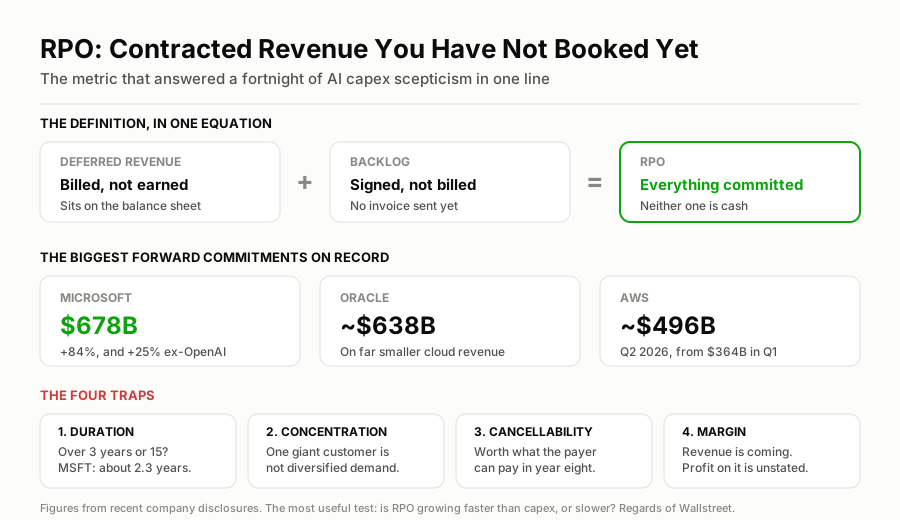
RPO is the sum of what is billed and what is merely signed. Both count. Neither is cash.
Why It Suddenly Decides Stock Prices
Because of a specific argument that has dominated the market this month.
The bear case on AI was never that demand was absent. It was narrower: you are spending tens of billions a quarter against a forecast rather than a contract. Alphabet handed the bears their evidence by posting the first negative free cash flow since its 2004 IPO on $44.9 billion of quarterly capex, with no comparable proof of committed demand. That print is what tipped the Nasdaq 100 into a correction, as we covered in the correction piece.
Microsoft answered with RPO. $678 billion, up 84%, and, pre-empting the obvious objection, up 25% excluding OpenAI, with all sequential growth coming from customers outside the frontier model companies. Then it guided capex higher and the stock rose about 8%.
So the market now has a template: if you are going to spend like this, show the contracts. Full detail in the Microsoft breakdown, and the sector question in can Microsoft save tech stocks?
For scale, the latest disclosures put Microsoft at $678 billion, Oracle around $638 billion, Alphabet's Google Cloud backlog at $513.9 billion and AWS at $496 billion, the last of those up from $364 billion a single quarter earlier. Oracle's figure is the striking one, because its annual revenue is a fraction of the others': RPO and current revenue can diverge enormously. Put every disclosure side by side with its own revenue and the ranking inverts: that table is now live at /data/rpo.
The Four Traps
This is the part that separates reading RPO from being impressed by it.
1. Duration. A backlog is only as good as the speed it converts. $678 billion over three years is a very different business from $678 billion over fifteen. Microsoft put its weighted average duration at 2.3 years including OpenAI on the FQ4 call, with roughly 30% of the balance due to be recognised within twelve months. Always look for the duration disclosure. If a company gives you a headline RPO and no duration, it is showing you the flattering half of the number, and most of them do exactly that: of the eleven disclosures in our tracker, only two publish a duration at all.
2. Concentration. A backlog built on one enormous customer is a single point of failure, not diversified demand. This is exactly why Microsoft's "up 25% excluding OpenAI" disclosure mattered more than the 84% headline. Whenever you see a giant AI backlog, ask who signed it. Oracle's growth has been driven substantially by a handful of names.
3. Cancellability. RPO is meant to capture non-cancellable commitments, but terms vary, and a contract with a young, loss-making counterparty is worth less than the same contract with a Fortune 100 treasury behind it. A commitment is only as strong as the entity making it.
4. Margin. This is the one almost nobody mentions. RPO counts revenue that is coming. The profit on that revenue appears nowhere in it. If that revenue is delivered on infrastructure bought at inflated component prices, the margin can be poor even as the revenue lands exactly as promised. Given that memory and component costs are now visible on Microsoft's and Qualcomm's own statements, this is a live concern, not a theoretical one. See the Qualcomm breakdown.
How to Find It Yourself
You do not need a terminal.
- In the 10-Q or 10-K, search for "remaining performance obligation." It is usually in the revenue note. Companies are required to disclose it, along with an expected recognition timeframe.
- In the earnings release or shareholder letter, cloud companies increasingly headline it, because it flatters them.
- On the call, listen for the qualifiers: duration, growth excluding a named customer, and any comment on cancellation terms. Those asides carry more information than the headline.
- Compare it to revenue. RPO divided by trailing annual revenue gives you a "years of contracted revenue" figure, and it makes companies comparable in a way the raw dollar number never does. Two rules make it honest: use trailing revenue rather than an annualised run rate off the latest quarter, and match the scopes, since a segment backlog belongs over segment revenue. We publish this for every large disclosure in the free RPO and Backlog Tracker, denominators and all, so you do not have to build it yourself.
Years of Contracted Revenue, Company by Company
Run that division across the market and the league table rearranges itself. Microsoft's record-breaking $678 billion is 2.0 times its annual revenue, which is roughly where enterprise software sits. Oracle is at 9.5 times. Alphabet's cloud backlog is 6.6 times Google Cloud's trailing revenue, AWS is 3.3 times AWS revenue, and Palantir, for all the noise, is at 0.8 times, because its RPO counts only the non-cancellable portion of contracts.
The most useful row in that table is not an AI name at all. Boeing carries a $715 billion backlog on $94 billion of trailing revenue, which is 7.6 times, wider than AWS and above Alphabet. Nobody calls Boeing a bubble, because an aircraft backlog is understood to convert over the better part of a decade. That is the frame worth carrying into every AI backlog argument, and the whole reason we built the tracker.
The Playbook
- Use RPO to test a capex story, not to value a company. Its single best use is answering "is the spending backed by commitments?" It is a poor input to a target price.
- Never accept an RPO number without its duration. That one habit puts you ahead of most commentary.
- Watch the ex-largest-customer figure. If a company will not give it, assume the concentration is worse than you would like.
- Track RPO growth against capex growth. If capex is compounding faster than the backlog, the buildout is being funded on faith. If the backlog is growing faster, the spending is being pulled by demand. That single comparison is the most useful thing in this entire article.
- The limitation to keep front of mind: a large RPO did not save Alphabet from a negative free cash flow quarter, and it will not save anyone from a bad margin. Contracted revenue is a reason to believe the demand is real. It is not a reason to believe the returns will be good.
The One-Line Read
RPO is contracted revenue not yet recognised, the sum of deferred revenue and backlog, and it has become the number that decides AI stocks because Microsoft answered a fortnight of capex scepticism with $678 billion of signed commitments and got an 8% rally for it: read it with the duration, the concentration and the margin attached, and use it to test whether spending is pulled by demand rather than pushed by hope.
Next up:GDP, Wednesday at 8:30am ET →
More on $MSFT
Updated Every Saturday
The Week Ahead
Every earnings date, Fed event and setup for the current trading week, on one page.
Refreshed Weekly
Earnings Calendar
Who reports next, when, and what consensus and the whisper expect.
The Week-Ahead Brief
Don’t miss next week’s setups. Get the Saturday brief.
Latest issue, Aug 17“The consumer cracked on Friday. Six retailers answer for it this week.”
Every Saturday: next week’s earnings dates, Fed days and the trades worth watching, from the same desk that writes the week-ahead hub. Free, built for retail investors.