Microsoft Q4 FY2026 Earnings Breakdown: Azure Grew 43%, the Backlog Grew 84%, and the Stock Jumped 8%
Microsoft posted $90B revenue and $4.74 adjusted EPS with Azure up 43%, and shares jumped 8% after hours. Commercial RPO up 84% to $678B is the number that did it, not Azure.
TL;DR
- Revenue of $90 billion beat the $87.72 billion consensus. Adjusted EPS of $4.74 beat the $4.24 estimate. Both lines cleared comfortably.
- Azure grew 43%, above the 39-40% management had guided and the ~40% the street modelled, and it accelerated from the prior quarter. In a week when the market decided AI spending does not pay, that is the single most important number printed by anyone.
- Azure passed $100 billion of annual revenue for the first time in fiscal 2026, up 41% for the year.
- The composition improved too. AI services contributed 22 percentage points of Azure's growth, up from 16 points last quarter. The AI revenue has stopped being a rounding error. It is now the majority of the growth.
- Commercial remaining performance obligation grew 84% to $678 billion, and up 25% excluding OpenAI. That is contracted, signed, not-yet-delivered revenue, and it is the number that actually moved the stock.
- Shares jumped 8% in extended trading, building through the evening from about 3% right after the release. Microsoft went into this print down roughly 18% year to date.
More on $MSFT: Microsoft Just Had the Biggest Up Day in Market History. Is MSFT a Buy 12% Below the High? →
What Microsoft Actually Reported
The headline numbers, against what was expected:
| Line | Reported | Expected |
|---|---|---|
| Revenue | $90.01B, +18% | $87.62B |
| Adjusted EPS | $4.74 | $4.24 |
| Azure growth | 43% cc | 40.2% consensus |
| FY26 Azure revenue | >$100B, +41% | First time above $100B |
| AI share of Azure growth | 22 points | 16 points prior quarter |
| Commercial RPO | $678B, +84% | +25% excluding OpenAI |
| Bookings | +10% | +11% constant currency |
| Capex and finance leases | $41B, +69% | Cash paid for PP&E $35.8B |
Forward guidance was the second surprise: Microsoft guided fiscal Q1 Azure growth to 45% at constant currency, against a StreetAccount consensus of 41.4%. Guiding above an already-elevated bar, one quarter after accelerating, is not what a company with a demand problem does.
The Board
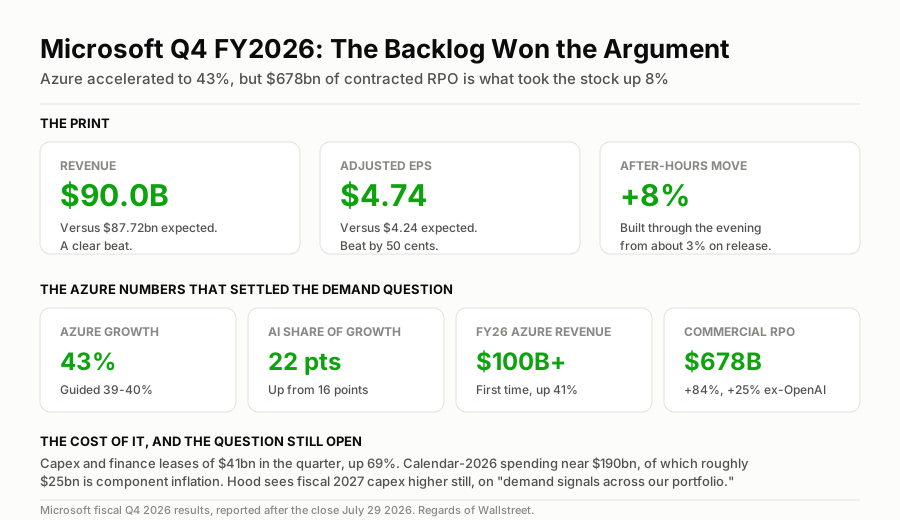
Every revenue line beat. Then the backlog line arrived and the stock went up 8%.
The Number That Actually Moved the Stock
It was not Azure. It was remaining performance obligation.
Commercial RPO grew 84% to $678 billion. RPO is contracted revenue that has been signed and not yet delivered. It is the closest thing in accounting to a receipt, and Microsoft just produced two-thirds of a trillion dollars of them.
Why that matters more than a growth rate: for two weeks the market's objection to AI capex has not been "is there demand today", it has been "is the demand contracted, or are you building on a forecast?" Alphabet posted the first negative free cash flow since its 2004 IPO on $44.9 billion of quarterly capex and had no comparable answer. That single line tipped the Nasdaq 100 into a correction.
Microsoft's answer is $678 billion of signed commitments. And it pre-empted the obvious follow-up: RPO grew 25% excluding OpenAI, and all sequential RPO growth came from customers outside the frontier model companies. That is the circularity objection closed. The backlog is enterprises, not one enormous related-party commitment.
Set against it: capex and finance leases of $41 billion in the quarter, up 69%, with cash paid for property and equipment of $35.8 billion. CFO Amy Hood then said she sees further capex growth in fiscal 2027, citing "demand signals across our portfolio."
Read those two paragraphs together and you have the inversion of the entire month. Alphabet guided capex up and got sold. Microsoft guided capex up and got bought 8%. The spending did not change. One of them showed the contracts.
The Bit Microsoft Still Has Not Fixed
Calendar-2026 spending is tracking around $190 billion, including roughly $25 billion attributable purely to higher component pricing. Sit with that: a meaningful slice of the increase buys no extra capacity at all. It is the same capacity costing more, because memory prices have gone vertical. We explained the mechanism in what HBM actually is and in the CXMT explainer, and Qualcomm put the same cost squeeze on its own income statement hours later in its guide-down.
Going into the print the street was bracketing fiscal 2027 capex at roughly $255 to $260 billion, about 35% growth. Hood's comments point in that direction rather than away from it. Capex growth and Azure growth are running at broadly similar rates, which means the buildout is still being financed partly out of the rest of the business.
So the scorecard: Microsoft has now answered the demand question and the contracted question. It has not answered the return on capital question, and no single quarter can.
Scoring Our Own Preview
Our July 16 preview argued the market was underpricing the tails: options implied only ±4%, and we said either resolution (Azure acceleration relief or capex-shock contagion) travels further than 4%. The recommended trade was a strangle, six to eight weeks out.
That call is working. The resolution was Azure acceleration relief, exactly the branch we named, and an 8% move is double the ±4% that was priced. Buying the underpriced tail was the right read on a print the market had decided in advance would be quiet.
One caveat that still stands: after-hours pricing on a night with five major reports is thin, and Thursday's cash close is what settles it. An 8% extended-hours print is not an 8% realised move. It did settle, and higher: Microsoft opened Thursday and ran to about $427.50, roughly 9.5% above the $390.54 close, peaking at $429.88. See why Microsoft pumped 9%. But the direction of the error is now in the trade's favour rather than against it, which is the opposite of what we wrote earlier this evening when the move was tracking 2% to 3%.
The Bull Case and the Bear Case
Bull case. Azure is a $100 billion-plus business growing 41% annually and accelerating, with AI now supplying the majority of the growth, and behind it sits $678 billion of contracted backlog that grew 25% even excluding OpenAI. Management guided next quarter higher, to 45% constant currency. No other company at this scale has shown the contracts. Microsoft went into the print down roughly 18% year to date, priced with the group rather than apart from it, and an 8% move barely dents that.
Bear case. Spending roughly $190 billion in a calendar year is a return-on-capital question that RPO does not answer: a backlog tells you revenue is coming, not what margin it arrives at, and Microsoft's own numbers show $25 billion of that spend buying nothing but component inflation. Hood has already signalled fiscal 2027 capex goes higher. And $678 billion only converts as fast as its weighted average duration allows, which Microsoft has recently put around 2.5 years including OpenAI. The capex is being spent now either way. If you want the mechanics of the metric, see what RPO actually is.
Our read: a buy, and the highest-quality way to own AI infrastructure. Tonight changed the argument in Microsoft's favour more than we credited when the move was tracking 2%: the market's objection was that AI capex had no receipts, and Microsoft produced $678 billion of them. What is still unresolved is the return on that capital, so the thing to track is no longer whether demand exists but the margin the backlog converts at.
The Options Angle
- Post-print implied volatility is collapsing, so buying calls to chase an 8% gap is the worst version of this trade.
- The interesting expression is longer dated. If you think the sector correction ends with Microsoft leading, calls out past the next print let you own the re-rating without paying event premium.
- If you hold shares, a covered call into Thursday strength harvests the gap, but pick the strike honestly: a stock down 18% year to date that just found its catalyst is the wrong one to cap tightly.
- Do not size anything on the assumption the 8% holds. The macro driver is the 30-year Treasury above 5.19%, which is not a Microsoft variable and does not care about RPO.
The One-Line Read
Microsoft beat on every line, but the number that took the stock up 8% was $678 billion of contracted backlog growing 84%, and 25% even without OpenAI, because that is the receipt the market has spent two weeks demanding from everyone spending on AI: the demand argument is now settled, the return-on-capital argument is not, and the metric to follow from here is the margin that backlog converts at.
Next up:GDP, Wednesday at 8:30am ET →
More on $MSFT
$MSFT · 2026-08-10
Microsoft Just Had the Biggest Up Day in Market History. Is MSFT a Buy 12% Below the High?
$MSFT · 2026-07-30
Why Did Microsoft Pump 9%? Four Things Converged, and the Fourth One Nobody Predicted
$MSFT · 2026-07-29
What Is RPO? The Metric That Moved Microsoft 8% and How to Read It Yourself
Updated Every Saturday
The Week Ahead
Every earnings date, Fed event and setup for the current trading week, on one page.
Refreshed Weekly
Earnings Calendar
Who reports next, when, and what consensus and the whisper expect.
The Week-Ahead Brief
Don’t miss next week’s setups. Get the Saturday brief.
Latest issue, Aug 17“The consumer cracked on Friday. Six retailers answer for it this week.”
Every Saturday: next week’s earnings dates, Fed days and the trades worth watching, from the same desk that writes the week-ahead hub. Free, built for retail investors.