SanDisk Earnings Preview: Prove the Shortage, Keep the Multiple
SanDisk's fiscal Q4 print: revenue of $8.965 billion, up 372%, and non-GAAP EPS of $39.25, both above the company's own guide. What it settles about the NAND shortage and memory stocks.
The Print: $8.965bn, $39.25, and Both Above the Company's Own Guide
UPDATE (August 5, 2026, after the close): SanDisk did the thing this preview said it had to do. Revenue landed at $8.965 billion, up 372% from $1.90 billion a year ago and up 51% sequentially from Q3's $5.95 billion. Non-GAAP EPS came in at $39.25, against $0.29 in the year-ago quarter and $23.41 in Q3.
Both numbers cleared the top of management's own April guidance, which was $7.75-8.25 billion of revenue and $30-33 of non-GAAP EPS. Revenue came in 8.7% above the top end, EPS 18.9% above it. Against the Street it was a 7% revenue beat and a 14% EPS beat (consensus $8.39 billion and $34.52).
Read that sequence carefully, because it is the whole point. Consensus had already been marked above what the company promised in April, on the theory that NAND pricing was outrunning the guide. The company then cleared the marked-up consensus as well. My read: that is not a company beating a sandbagged number, it is a pricing environment moving faster than the people selling into it could forecast one quarter ahead.
The stock walked in hot, then handed some of it back on the day itself. SNDK rose 6.0% on Monday August 3 to $1,288.03 and 10.84% on Tuesday August 4 to $1,427.62, roughly 25% across five sessions, against an implied earnings move quoted anywhere between 12% and 25% depending on source and expiry. Then Wednesday sold off into the release: down about 3.2% at the open, near 3.5% through the middle of the day, and closing at $1,350.50, off 5.40%. So the bar was raised twice before the numbers existed, once by consensus and once by the tape, and the tape took part of its own contribution back in the hours before the print.
The guide is the reason it fell, and it arrived after this update first published. Fiscal Q1 2027 revenue is guided to $10.3-10.8 billion against consensus near $11.16 billion, with adjusted EPS of $44-46 against about $45.58 expected and adjusted gross margin of 83-85%. The guide represents +15% to +20% sequential growth and is still a miss, because consensus had come to require +24.5%. Its midpoint sits about 5.5% below the Street, which is close to the size of the after-hours fall. Q4 non-GAAP gross margin, meanwhile, came in at 84.6% against a guided 79-81%, and the board authorised a further $14 billion buyback, taking the remaining authorisation to roughly $15.5 billion. The full breakdown is in why the stock fell.
Then it was sold again on the numbers. Early reporting has the shares down a further 4% to 5% in extended trading, measured from that $1,350.50 close, having cleared both the guide and the marked-up consensus on the quarter itself. Treat the extended-hours figure as what it is: a snapshot, not a close, and not yet the number that scores anything. Stack it on Wednesday's regular session, though, and SNDK has given back roughly a tenth of its value across two days in which it reported the best quarter in its history. That is precisely the reaction this preview flagged twice, in the Broadcom comparison and in SanDisk's own April print, when a 60% EPS beat was met with a 6% after-hours fall. When a stock has already been paid for, no printable number counts as a surprise.
More on $SNDK: SanDisk Investor Day: The 80% Margin Is the Floor Case →
Two Days to the Print: A 26% Session, a Tripled Implied Move, and One Dead Play Since This Was Written
UPDATE (August 3, 2026): the three weeks since this preview published were the most violent in the stock's short life. SanDisk got dragged through the complex-wide flush (July 28 took everything down at once), then ripped +26.29% on July 30 in the relief rally we covered live, and closed Friday, July 31 at $1,214.83, still one of the year's best performers. (Corrected August 5: this update originally cited TipRanks at "+578% year to date". That label does not hold up. Published year-to-date readings for SNDK in early August range from +406% to +501% depending on the source and the day, and the ~578% figure appears to be a trailing-twelve-month return rather than a year-to-date one. Since the sources genuinely conflict, this piece no longer quotes a year-to-date percentage: the durable, checkable facts are the closes themselves and July's 47% fall, and those are what it uses.) Korea gave a third of the bounce back this morning; whether that rally was a dead cat is its own piece.
The numbers to beat are now public and enormous. Consensus sits at $8.42 billion of revenue, up 343% from $1.90 billion a year ago, with EPS near $34.67 against $0.29 a year ago. That consensus sits at or above the top of the company's own $7.75 to 8.25 billion guide, which is the whisper economy in one sentence: the market has already marked the quarter above what management promised.
Options now price roughly a ±25% move, quoted as high as 25% and no lower than 17.5% anywhere we have seen, against an average post-earnings move of about 6.45% over the past four quarters. In July this preview said ±9%. Three weeks later it has tripled, which is how fast this season reprices memory risk.
And our July options play is dead. Scored as a loss below. The put spread "under $1,650" was written when that floor had survived two flushes. The third flush went through it: the stock closed July 31 at $1,214.83. The trade log at the bottom now carries that call the way the scorecard rules require: visibly.
TL;DR
- The print, August 5: revenue $8.965 billion, up 372% year over year and 51% sequentially. Non-GAAP EPS $39.25, against $0.29 a year ago. Both figures landed above the top of the company's own $7.75-8.25 billion and $30-33 guide.
- Against the Street that is a 7% revenue beat and a 14% EPS beat (consensus $8.39 billion, $34.52). Consensus had already been marked above the company's guide, and the company cleared it anyway.
- SNDK walked in hot (+6.0% on August 3, +10.84% on August 4 to $1,427.62, roughly 25% in five sessions) and then sold off on the day of the print, closing August 5 at $1,350.50, down 5.40%.
- The guide is why it fell: fiscal Q1 2027 revenue of $10.3-10.8 billion against $11.16 billion consensus. That is +15-20% sequential growth judged against a Street demanding +24.5%.
- The tape sold the numbers too, a further 4-5% in extended trading off that close on early reporting, which is a snapshot and not a close. Q4 gross margin was 84.6% against a guided 79-81%, and a further $14 billion buyback was authorised.
- An Investor Day follows on August 13, which is where the fiscal 2027 framing gets set. (Corrected earlier: this piece originally said the print was July 29. The company had set August 5 in a July 9 release.)
- SNDK walks in as the memory complex's cleanest story: NAND contract prices up 70-75% quarter over quarter, a reported ~$42 billion AI backlog, and, critically, zero CXMT exposure (China's new threat attacks DRAM, a different technology).
- The stock is no longer the complex's quiet fortress: a +26.29% single session on July 30, a $1,214.83 close on July 31, and a five-week stretch where realised moves beat implied every time it mattered.
- The print's one job is unchanged: prove the shortage extends into the guide. The setup, the risk, and the updated trade log below.
The Print Against the Guide
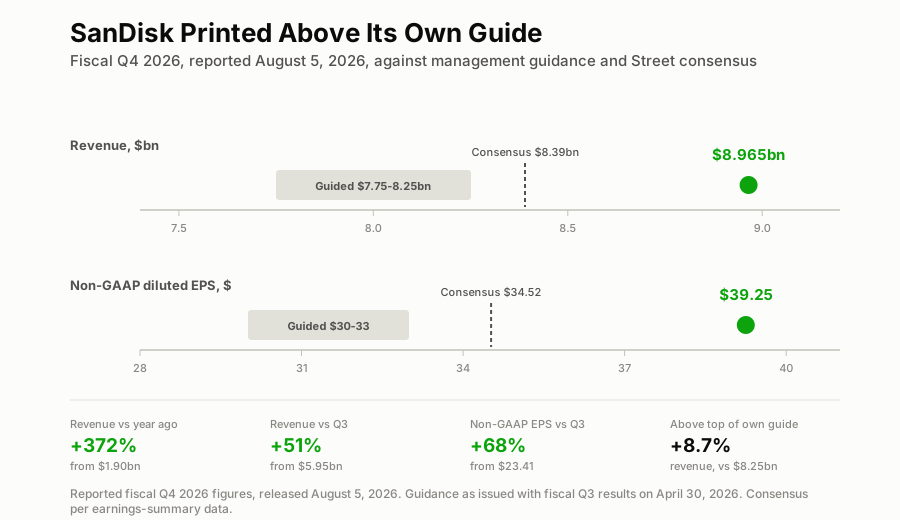
The grey bands are what management promised in April. The dashed lines are what the Street had marked it up to. The green dots are what happened.
The Chart That Explains the Stakes
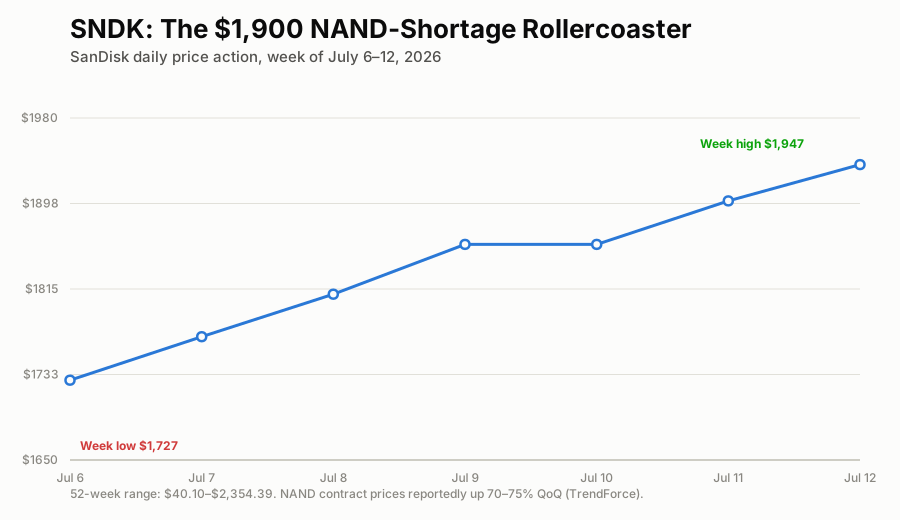
A stock that moves $220 in a normal week. Earnings week is not a normal week.
SanDisk is the purest public expression of the NAND shortage: one company, one technology, one physical supply-demand imbalance running at record pricing. That purity made it 2026's most violent big-cap chart, and it made SNDK the complex's relative fortress during the CXMT crisis, because CXMT builds DRAM and SanDisk sells NAND. While MU broke $900 on the China threat, SNDK's thesis didn't take a scratch.
Earnings is where that clean story gets audited.
What This Print Means for Memory Stocks as a Whole
It validates the NAND half of the memory trade with hard numbers, it says nothing new about the DRAM half, and the most interesting thing in it is not the beat but the size of the company's own forecast error.
The shortage is being collected, not just observed. That distinction was the one this preview kept insisting on. Industry data had NAND contract prices up 70-75% quarter over quarter, but industry data is not an income statement. Reporting on the quarter splits the 51% sequential revenue jump roughly two-thirds pricing and one-third volume, and a non-GAAP gross margin of 84.6% against a guided 79-81% is the margin line confirming who captured it. (Corrected: an earlier version of this section called the jump pure pricing and no volume. The split above is the accurate version.) For Micron, Kioxia, Western Digital and Seagate, all selling into the same tightness, that is the read-through: the pricing is real and it lands.
The forecast error is the actual signal. Management guided $7.75-8.25 billion in April and delivered $8.965 billion twelve weeks later, missing its own ceiling by 8.7% to the upside. My read is that this is a cycle-position tell rather than a sandbagging tell. Companies at a cycle top forecast accurately, because prices have stopped moving. Companies mid-upcycle under-forecast, because every contract reset lands above the last one. A 19% overshoot on EPS says the same thing louder, since that is operating leverage on prices nobody had modelled in April.
But it is a NAND print, and the complex is not one asset. SanDisk sells NAND and has zero CXMT exposure, because China's new entrant attacks commodity DRAM, a different technology. Nothing SanDisk reported tonight tells you whether CXMT floods DRAM in 2027. Anyone reading this print as a green light for the whole complex is doing the thing that got the sector into July's mess: treating four different supply-demand balances as one trade. Our thesis mark-to-market narrowed the call to HBM and NAND and amputated the commodity-DRAM leg. Tonight's numbers support that narrowing rather than reversing it.
It also settles an argument about July. SNDK fell 47% in July, its worst month since the February 2025 spinoff, with more than $150 billion of market value erased, and reporting at the time attributed the fall to Korean regulators tightening single-stock leveraged ETF rules and forcing passive deleveraging, not to anything in the business. The business has now reported, above its own guide. That does not make the July drawdown irrational (crowded positioning unwinding is a real risk that really costs money), but it does retire the argument that the fundamentals were rolling over. They were not. Whether the late-July bounce was a dead cat now has a fundamental answer attached to it.
The bear case that survives the print. Three things, none of them refuted tonight. A gross margin in the high seventies is an invitation, and the industry's answer to invitations is capacity. Hyperscaler order books can be digested rather than repeated, which is a demand-timing risk no supply analysis catches. And the stock walked into the print up 25% in five sessions, so the numbers had to beat a bar the tape had already raised. Good numbers and a bad reaction are entirely compatible, and this month's Broadcom episode is the template. SanDisk's own last quarter is the closer precedent, and it is the one worth holding in mind tonight. In April the company beat Q3 consensus by roughly 60% on EPS ($23.41 reported against $14.62 expected) on revenue of $5.95 billion against a $4.72 billion forecast, then guided the following quarter to $7.75-8.25 billion against a Street sitting near $6.62 billion. Sherwood News reported the shares fell about 6% after hours anyway. A company can beat its own guide, raise the bar, and still be sold by a tape that had already paid for it.
Where the read-through is most useful. My view is that SanDisk itself is now the most crowded way to express this, and the cleaner expressions of "NAND pricing is real" are the names that have not re-rated 500%: the laggards in the complex rather than its trophy. That is a statement about asymmetry, not about SanDisk's quality, which the print just demonstrated.
What the Print Has to Show
- The pricing flows through. NAND contracts up 70-75% quarter over quarter is the industry data; the income statement has to show SanDisk capturing it, in gross margin above all. A revenue beat with margin leakage would say the shortage is real but SanDisk isn't the one collecting it.
- The guide extends the shortage. This is the entire ballgame. Backward numbers are known-spectacular; the multiple lives on shortage-through-2027-2028. Management guiding the next quarter's pricing and the backlog trajectory confidently is worth more than any headline beat. A cautious guide, in this month's whisper-economy tape, gets treated as the cycle top regardless of what the actual numbers said.
- Capacity discipline language. The shortage thesis dies by supply. Any hint SanDisk itself is racing to add capacity invites the market to price the glut early, exactly the way it front-ran CXMT's DRAM capacity onto Micron.
The Broadcom Warning Label
Read what happened to Broadcom before positioning: +200% AI guidance, sold anyway, because crowded positioning made every printable number a disappointment. SNDK carries the same risk profile in miniature: an adored story, a retail favorite via the memory ETF wave, and expectations that have inflated past published consensus into whisper territory. The shortage math says the numbers will be great. The month's reaction function says night one can sell great anyway.
That's an argument about the first 24 hours, though, not the trade. Post-earnings drift in names with confirmed pricing power has run bullish all season once the whisper-flush clears.
The Options Angle
The July bullets are preserved below with their scars, because pretending they were never written is not how this site works.
Skip the naked pre-print calls; the ±9% straddle plus whisper risk makes them a donation.Updated August 3: half wrong, and the profitable half. The implied move has since tripled to as much as ±25%, so the "donation" framing was right about price and wrong about the season: SanDisk then moved 26.29% in a single session without an earnings report at all. The July calibration lesson, realised beating implied across memory, applies here in full.The structure that fits: sell a put spread under $1,650, 30-45 days out, into any pre-earnings weakness.This call is dead and it is scored as a loss below. The $1,650 floor that had "survived two complex-wide flushes" did not survive the third: the stock closed July 31 at $1,214.83. A put spread sold under $1,650 in mid-July is at or near max loss. It goes in the August scorecard against our name.- The confirmation trade survives, updated: two-month calls the morning after, if and only if the guide extends the shortage into 2027. Same playbook as the thesis-check framework. One change of context: SK Hynix has now reported, missed consensus with a record quarter exactly as the whisper said, and the stock went limit-up two sessions later anyway. The bar for "clean memory print" is officially weird, which strengthens the case for waiting until the guide is on paper.
- No directional bet into Wednesday itself. With the implied quoted between 17.5% and 25%, consensus already above the top of the company's own guide, and direction genuinely unresolved, the position for the print is set out in Monday's Micron piece and not duplicated here. When magnitude is knowable and direction is not, you buy the move or you wait for the guide. You do not pick a side.
Trade log
| # | Stance | Structure | Strikes and expiry | Cost or credit | Spot at writing | Implied move | Breakeven |
|---|---|---|---|---|---|---|---|
| 1 | Bullish floor (July 16 call, now dead) | Short put spread | Short strikes under $1,650, 30-45 days from mid-July | Credit; live chain was not sourced on July 16 | ~$1,800s at the July 16 writing (intraweek range $1,727-1,947) | ±9% at the time | Loss. Spot closed $1,214.83 on Jul 31, through the floor; scored at or near max loss in the August scorecard |
| 2 | Pass | Directional bet into the Aug 5 print, either side | Aug 7 weekly | Not taken | $1,214.83, July 31 close | Quoted 17.5% to ~25% | Pass scored against Wednesday's realised move |
| 3 | Conditional | Two-month confirmation calls, morning after, only if the guide extends the shortage | Oct expiry, struck Aug 6 | Struck off the Aug 6 open | To be struck Aug 6 | n/a | Scored against the post-guide entry if triggered |
Row 1 is the loss this update exists to record. Row 2 is now live and unscored: the numbers are public, the reaction is not finished, and a pass on a directional bet gets graded against the realised move once the session that follows the print has closed, not against the after-hours tape. It will be marked here either way. Row 3 stays conditional on the guide, and the August 13 Investor Day is the second half of that condition.
Sooo... The Cleanest Memory Print?
Yes, and treat that as a warning as much as a compliment. SanDisk has the fortnight's most defensible fundamentals and its least discounted stock, which means the print is priced for proof, not hope. The shortage is physical, the pricing is in the contracts, and the guide either extends it or the multiple pays. Take the premium before, the confirmation after, and nothing in between.
Next up:GDP, Wednesday at 8:30am ET →
More on $SNDK
Updated Every Saturday
The Week Ahead
Every earnings date, Fed event and setup for the current trading week, on one page.
Refreshed Weekly
Earnings Calendar
Who reports next, when, and what consensus and the whisper expect.
The Week-Ahead Brief
Don’t miss next week’s setups. Get the Saturday brief.
Latest issue, Aug 17“The consumer cracked on Friday. Six retailers answer for it this week.”
Every Saturday: next week’s earnings dates, Fed days and the trades worth watching, from the same desk that writes the week-ahead hub. Free, built for retail investors.