Sallie Mae Earnings July 23: EPS Fell to $0.29 and Missed by a Third, With the Margin Down 56 Basis Points
Sallie Mae's Q2 2026: EPS of $0.29 missed the $0.46 expected and fell 9.4%, revenue of $338.8 million missed, net interest income dropped 11.7% and the margin contracted to 4.75%.
The Loan-Sale Machine Did Not Manufacture the Quarter This Time
UPDATE (August 7, 2026): Sallie Mae reported on July 23, and the framing on this page was refuted in the most useful way. We described the model as EPS rising while revenue falls, manufactured by selling loans and buying back stock. This quarter EPS fell too. Earnings of $0.29 per share missed the $0.44-0.46 expected by roughly a third and declined 9.4% year over year, against a consensus that had wanted 38% growth.
Revenue and margin were the cause. Revenue of $338.8 million missed the $348-355 million modelled. Net interest income fell 11.7% to $332.8 million from $376.8 million, and the net interest margin contracted 56 basis points to 4.75%. Higher provisions for credit losses and higher expenses did the rest. When the spread compresses that fast, share count reduction cannot carry the per-share line, and that is the limit of the machine this page described.
On credit, which this page called the real health check, the news was better than the earnings. Management guided full-year net charge-offs to $365-385 million and described credit quality as stable, with a slight improvement in average FICO scores and strong cosigner participation. Originations rose about 4.5% to $716 million.
So the model is not broken; it is being squeezed. Management reaffirmed 2026 EPS guidance of $3.10-3.20, which after a 29-cent quarter requires the back half to do most of the work. That reaffirmation, not the quarter, is the thing to hold them to.
More on Earnings: Options Scorecard: The Week of August 10, Graded (35 Calls, 51% Right) →
TL;DR
- Sallie Mae reports after Thursday's close, July 23 (webcast 5:30pm Eastern). The Street wants about $0.44 in EPS, up 38% on the year, on roughly $348 million in revenue, down about 8%.
- EPS up while revenue down is the entire Sallie Mae machine: it sells loans and buys back stock, manufacturing earnings per share even when the lending business shrinks.
- The real health check is credit: private student-loan charge-offs and delinquencies are the number that decides whether the model is clever or fragile.
- Read and trade below.
The Board
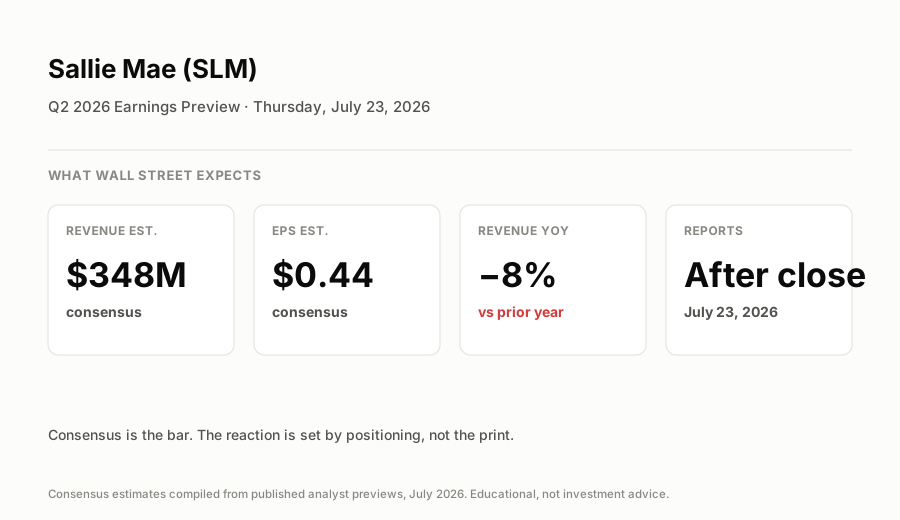
EPS up, revenue down: the loan-sale machine in one picture.
How EPS Goes Up While The Business Shrinks
Sallie Mae is a financial-engineering story wearing a student-lender's uniform. Two levers push EPS up even as net interest revenue falls:
- Loan sales. SLM originates private student loans and sells chunks of them, booking gains and freeing capital. Management has targeted an incremental $1 billion in loan sales and guides full-year EPS to $3.10 to $3.20 on the back of it.
- Buybacks. The proceeds fund aggressive repurchases, shrinking the share count so each remaining share claims more of a smaller pie.
That is why revenue down 8% and EPS up 38% live in the same press release without contradiction. It works beautifully until credit turns.
The Number That Can Break It
The bull case and the bear case both run through charge-offs. Sallie Mae lends to students and cosigners, a borrower base sensitive to the job market. As long as the consumer-credit picture holds, rising delinquencies stay contained and the loan-sale-plus-buyback flywheel spins. If unemployment ticks and young borrowers start missing payments, the gains on sale dry up and the buyback cannot outrun the provisions. This is the same earnings-quality question that separates a real beat from an accounting one.
The Options Angle
- Options on SLM tend to underprice the gap risk around credit commentary. The stock can sit still on the EPS beat and then lurch on a single sentence about charge-offs.
- Trade the credit metrics and the guide, not the headline EPS. A raise to the $3.10 to $3.20 full-year range on clean credit is the buy; a maintained guide with creeping delinquency is the quiet warning.
- The buyback is a tailwind, not a thesis. It supports the stock but cannot offset a genuine deterioration in the loan book. Let the credit line lead.
The One-Line Read
Sallie Mae will show you rising EPS on falling revenue and call it strength, and it is, right up until charge-offs turn, so read Thursday's print through the credit and delinquency lines, because the loan-sale machine is only as sound as the borrowers underneath it.
Next up:GDP, Wednesday at 8:30am ET →
More on Earnings
Updated Every Saturday
The Week Ahead
Every earnings date, Fed event and setup for the current trading week, on one page.
Refreshed Weekly
Earnings Calendar
Who reports next, when, and what consensus and the whisper expect.
The Week-Ahead Brief
Don’t miss next week’s setups. Get the Saturday brief.
Latest issue, Aug 17“The consumer cracked on Friday. Six retailers answer for it this week.”
Every Saturday: next week’s earnings dates, Fed days and the trades worth watching, from the same desk that writes the week-ahead hub. Free, built for retail investors.