Nvidia Earnings Preview (August 26): The $91 Billion Bar, Zero China in the Guide, and What Beats Are Worth
Nvidia reports fiscal Q2 2027 on August 26 after the close. The guide is $91 billion and a 75% gross margin with zero China assumed; consensus sits at $91.8-93.5 billion. The scenarios and the plays.
Updated August 20, six days out. NVDA closed $216.85 on August 20, down 0.33% per stockanalysis.com, with a second feed reading $216.95, a ten-cent gap between tapes on a settled session. The August 28 weekly chain is now sourced and prices a ±5.8% reaction, against a 4.8% twelve-quarter realised average. The Options Angle below carries that comparison and a fourth logged row: a pass on buying front-week calls into the print. The scenario work is unchanged.
Updated August 19, one week out. NVDA closed $219.74 on August 18, down 2.34%, per stockanalysis.com and investing.com, so the stock walks into the print about 2% below the $223.96 reference this piece was struck against. Nothing in the setup has changed: the guide is still $91 billion, the Street is still parked at or above it, and the two questions are still the beat's composition and the October-quarter guide. The spot references below keep their original August 7 stamp because the logged calls were struck against it.
TL;DR
- Nvidia reports fiscal Q2 2027 on Wednesday, August 26, after the close: results near 4:20pm ET, call at 5:00pm ET. Date, times and the guidance detail are in the earnings-date piece; this is the scenario work. The rest of that Wednesday, including July PCE and the Q2 GDP revision at 8:30am, is in the hour-by-hour board.
- The bar is management's own: $91 billion, plus or minus 2%, at a 75% non-GAAP gross margin, and it assumes zero data-centre compute revenue from China.
- Published consensus runs $91.8 billion to roughly $93.5 billion depending on the compiler, the top of that range sitting above the guided band. The Street is pre-paying for a beat.
- The base it grows from: Q1's record $81.6 billion, up 85%, with data centre at $75.2 billion, more than 92% of everything Nvidia sells.
- The stock closed $223.96 on August 7. Earnings-day moves have averaged about 8% over the decade but nearer 5.4% the last two years, and the recent pattern is beats that get sold. The buy-or-wait call is in the decision piece.
More on $NVDA: DeepSeek Raised AI Prices 4.5x the Week OpenAI Hit Pause. What It Says Before Nvidia's Print →
What the Market Expects, and Why the Spread Matters
Management guided $91 billion ±2%, so the band tops out near $92.8 billion. Compilers do not agree on where the Street sits inside or above it: Barchart carries roughly $91.8 billion, while the figure we verified earlier this month ran near $93.5 billion with $2.13 of EPS, above the top of the guide.
Both versions say the same thing about positioning. Analysts normally hide inside a guided range; here at least part of the Street is betting on the beat before it happens. That converts a routine beat into table stakes. Clearing $91 billion is the floor. Clearing $93.5 billion is the test. A company guiding ±2% on a $91 billion base usually clears its own number, so the print risk is not the revenue line at all.
The Board
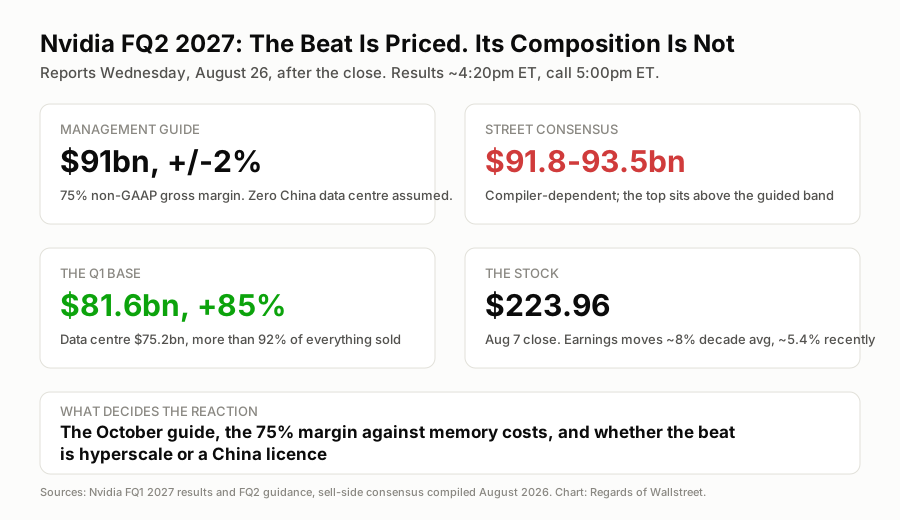
The Street is already above the guide. The beat is priced; its composition is not.
The China Line Is a Free Option, and It Cuts Both Ways
The $91 billion guide books nothing from China data-centre compute. Any licence-driven China revenue lands as pure upside against a bar that excluded it.
Which is exactly why a China-flavoured beat would be the low-quality version. A beat built from hyperscale and enterprise demand says the order books are still filling. A beat that needed a licence change says the underlying engine matched the guide and the delta was regulatory luck. Same headline, different multiple. On the call, the segment split does the telling: Q1 had hyperscale at $38 billion against $37 billion for AI, cloud, industrial and enterprise, almost perfectly balanced. Which side carries the growth is the most informative number in the release.
Gross Margin Against the Memory Squeeze
Nvidia is guiding 75% non-GAAP gross margin into the same memory-cost wave that has been rolling downstream through everyone who buys DRAM and NAND. HBM is the scarcest input in the complex, and Samsung is on record saying the shortage runs into 2028.
Holding 75% while component costs inflate would be a genuine pricing-power statement. A guide-down to 73% would be the story of the night, whatever revenue does. My read is that Nvidia holds it this quarter, because HBM was contracted well ahead, and that the risk lives in the January-quarter guide where new contract pricing bites. Watch the margin guidance line, not the margin print.
What Decides the Reaction
The season has answered this already: the next guide, not this quarter. Apple set records and fell on its outlook. Roblox beat and lost 29% on guidance. Nvidia's October-quarter guide has to extend an 11% sequential staircase on a base that is now above $90 billion a quarter. Every incremental point of sequential growth is roughly another billion dollars of quarterly revenue that has to come from customers whose capex is already at record highs, which is why Microsoft's $678 billion backlog disclosure matters more to Nvidia's multiple than most of Nvidia's own lines: it is the evidence the funding continues.
And note the precedent: Q1 was a record in every direction and the stock fell anyway. The stock has spent 2026 going sideways while earnings grew into the multiple. Priced-for-perfection names treat good prints as hurdles cleared, not catalysts.
Last week supplied a fresher version of it from the supply chain. Applied Materials beat fiscal Q3 and guided Q4 about $700m above consensus, then fell 5.12% on August 14, with China down to 28% of revenue from 35%. A semiconductor equipment bellwether beat, raised, and got sold on the multiple it had already run to. Nvidia walks into the same setup on the 26th.
The Options Angle
Updated August 20, with the chain finally sourced. The options market is pricing about ±5.8% for the reaction, roughly $12.60 either way against Thursday's $216.85 close, per moomoo's read of the August 28 weeklies. That puts the market's range at about $204 to $229.
Set that against what Nvidia actually does on earnings day:
| Reference | Figure |
|---|---|
| Implied move now, Aug 28 weeklies | ±5.8% |
| Average realised move, last 12 quarters | 4.8% |
| Average realised, last 4 quarters | ~2.8% |
| Reports where realised came in under implied | 6 of the last 8 |
| Frequency realised has beaten implied | ~25% |
Sources: moomoo and EarningsWatcher, whose ten-year series puts the average peak move at ±8.3% and the two-year at ±5.4%.
So the print is priced a full point above its own twelve-quarter norm, in a name that has cleared its implied move roughly a quarter of the time. That is the arithmetic against buying this event.
- Buying calls or puts into the print stays a pass, and the sourced chain makes the case stronger than it was on August 7. A long call needs direction and magnitude, and it is paying above the historical norm for both.
- One thing cuts the other way, and it is worth naming: puts are bid materially richer than equivalent calls. If I were forced to be long premium here, the call side is the relatively cheaper half. That argument picks the leg. It does not make the trade worth putting on.
- For holders, the covered call is the structure the base rate actually supports. A market pricing 5.8% against a 4.8% norm is paying holders above the odds to sit through Wednesday, with the standard caveat that the whole position wears any downside.
- July's house lesson, that realised kept beating implied, came from mid-caps with dispersed estimates. Nvidia is the opposite regime: the most-analysed stock on earth, where estimates cluster and implied overprices. I do not want that lesson applied here by reflex.
- Six days is a short runway now. Warsh's first Jackson Hole speech on August 28 lands 36 hours after the print, inside the same weekly expiry, which is a second event the front-week premium is also carrying.
One structure I looked at and am not logging: selling the August 28 weekly against a longer-dated call, to harvest the crush while keeping exposure to the multi-quarter inference-demand argument. I could not source strike-level premiums, and a calendar's outcome turns on the term structure rather than the move alone, so there is no way to grade it later from the move. It stays an idea rather than a logged call.
Trade log
| # | Stance | Structure | Strikes and expiry | Cost or credit | Spot at writing | Implied move | Conviction | Breakeven |
|---|---|---|---|---|---|---|---|---|
| 1 | Pass | Long straddle | $224, Aug 28 | live chain not sourced; recent realised ~5.4% | $223.96 (Aug 7 close) | not sourced at writing | not recorded | needs > recent realised |
| 2 | Neutral-constructive | Covered call for holders | short call above $224, Aug 28 | credit unquoted, chain not sourced | $223.96 (Aug 7 close) | not sourced at writing | not recorded | spot minus credit |
| 3 | Pass | Naked premium sale | around $224, Aug 28 | credit unquoted | $223.96 (Aug 7 close) | not sourced at writing | not recorded | loses beyond the move |
| 4 | Pass | Long weekly calls into the print | at-the-money, Aug 28 | premium not quoted; straddle prices ~5.8% of spot | $216.85 (Aug 20 close) | ±5.8% | 7/10 | needs > 5.8% close-to-close, and the right direction |
Rows 1-3 keep their original August 7 stamp and their unsourced implied-move fields, because that is what was on the page when the calls were made. Row 4 is a fresh call struck against Thursday's close with the chain sourced. Conviction recording started on this site on August 14, after rows 1-3 were logged, so those three carry no number rather than one invented afterwards.
The One-Line Read
Nvidia walks into August 26 with the Street already parked at or above the top of its own $91 billion guide, so the revenue beat is priced and the reaction hangs on three things the headline will not show: whether the beat came from hyperscale demand or a China licence, whether the 75% margin survives into the October guide against rising memory costs, and whether that guide keeps an 11% sequential staircase going on a $90 billion base.
Next up:NVDA reports Wednesday after the close →
More on $NVDA
$NVDA · 2026-08-20
DeepSeek Raised AI Prices 4.5x the Week OpenAI Hit Pause. What It Says Before Nvidia's Print
$NVDA · 2026-08-10
Is Nvidia a Buy Before August 26 Earnings? Yes, With One Caveat That Decides the Sizing
$NVDA · 2026-08-01
When Does Nvidia Report Earnings? Wednesday, August 26, After the Close. The Bar Is $91 Billion
Updated Every Saturday
The Week Ahead
Every earnings date, Fed event and setup for the current trading week, on one page.
Refreshed Weekly
Earnings Calendar
Who reports next, when, and what consensus and the whisper expect.
The Week-Ahead Brief
Don’t miss next week’s setups. Get the Saturday brief.
Latest issue, Aug 17“The consumer cracked on Friday. Six retailers answer for it this week.”
Every Saturday: next week’s earnings dates, Fed days and the trades worth watching, from the same desk that writes the week-ahead hub. Free, built for retail investors.