Why Did Apple Stock Drop After Earnings? Services Missed, Then the September Guide Came In Light
Apple fell 7.8% after hours despite beating on revenue and EPS. Services missed at $30.74bn, then Apple guided September to 9% to 11% growth against the 12% expected. Why it dropped.
UPDATE (July 31, 2026): the after-hours move held into the close. Apple finished Friday's regular session at $308.91, down about 7.3%, its worst single day in 16 months. The extended-hours figures below were the first read; this is the one that counts. On the call, Tim Cook flagged an increasing impact from the memory shortage, and Greater China came in short alongside Services.
TL;DR
- Apple closed Friday July 31 at $308.91, down about 7.3%, its worst day in 16 months. In extended trade on Thursday it had fallen about 7.8%, touching $305.07. It had already fallen 1.9% during Thursday's regular session.
- It dropped on a quarter that beat. Revenue $109.42 billion, up 16.4%, against ~$108.65bn. EPS $2.02 against $1.89. iPhone up 21.7% to $54.25 billion, the best fiscal third quarter for iPhone Apple has ever had.
- Two things caused the fall, and the second is the bigger one. Services missed at $30.74 billion against $31.22bn expected. Then on the call, CFO Kevan Parekh guided September-quarter revenue growth to 9% to 11%, against the 12% the street had modelled.
- The beat and the weak guide are the same fact. Customers rushed to buy ahead of price rises driven by the component shortage. That flatters June and borrows from September.
- The record 50.1% gross margin is smaller than it looks: tariff refunds contributed two points of it. Excluding them, margin was 48.1%, and 11 cents of the $2.02 in EPS came from the same refunds.
More on $AAPL: John Ternus Takes Over Apple on September 1. What a Hardware Engineer as CEO Means for AAPL →
Why Did Apple Stock Drop After Earnings?
Apple beat on almost every line in the release, then guided the next quarter below what Wall Street expected. Services revenue missed at $30.74 billion against $31.22 billion, and on the call Apple forecast September-quarter revenue growth of 9% to 11% against the 12% analysts had modelled.
Everything in the printed release was good. Revenue beat, earnings beat, iPhone had its best-ever June quarter, Mac beat by nearly 18%, and gross margin set a company record. None of it held, because the market does not price Apple on the quarter it just finished. It prices Apple on the annuity, and on the next quarter. Both disappointed.
How Much Did Apple Stock Fall?
Apple closed Thursday's regular session already down 1.9% on the day. After the release it fell as low as $305.07, and settled around 7.8% lower in extended trade. The next day it closed at $308.91, down about 7.3%, which confirmed the overnight verdict rather than fading it. Where the two differ, prefer the close: extended-hours prints move for hours and are not the next session.
The fall came in two stages. The initial reaction was roughly 4%, on the release and the Services line alone. It then roughly doubled during Tim Cook's final earnings call as chief executive, which is exactly when Parekh delivered the September guide.
So the two legs have two separate causes. The release cost Apple about four points. The guidance cost it about four more.
Did Apple Beat Earnings Expectations?
Yes, on every line in the release. Which is what makes the reaction worth understanding.
| Line | FQ3 2026 | Expected | Result |
|---|---|---|---|
| Revenue | $109.42B, up 16.4% | ~$108.65B, up 15.5% | Beat |
| Diluted EPS | $2.02 | $1.89 | Beat |
| Gross margin | 50.1%, a record | 47.5% to 48.5% guided | Beat |
| iPhone | $54.25B, up 21.7% | $53.86B | Beat |
| Mac | $10.35B, up 28.7% | $8.74B | Large beat |
| Wearables | $7.88B, up 6.5% | $7.82B | Slight beat |
| Services | $30.74B, up 12.1% | $31.22B | Miss |
| iPad | $6.19B, down 5.9% | $6.92B | Miss |
| Greater China | $18.82B, up 22.4% | $19.67B | Miss |
| September guide | 9% to 11% growth | 12% | Miss |
Consensus figures are LSEG, except Greater China, which is the average of six analysts polled by Visible Alpha. The fiscal third quarter ended June 27.
Note the Mac line. Analysts modelled $8.74 billion and Apple delivered $10.35 billion, an 18% beat on a mature product line whose prices Apple had just raised. Hold that thought.
The Board
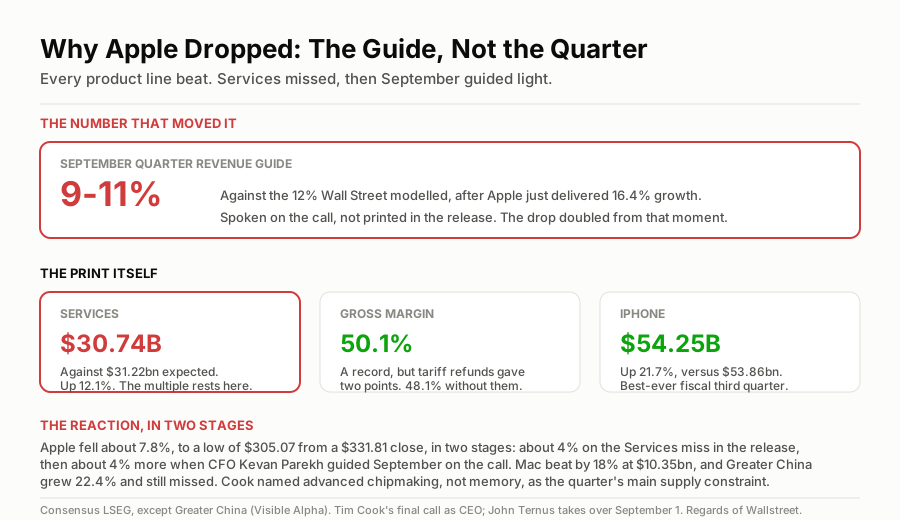
Every product line beat. The annuity missed, and then the guide missed.
What Is Apple's Guidance for the September Quarter?
Revenue growth of 9% to 11% year over year, per CFO Kevan Parekh on the call. The street wanted 12%.
On its own, a point or two of guidance is small. What makes it matter is the shape of the deceleration. Apple just delivered 16.4% growth and is telling you the next quarter is 9% to 11%. That is a slowdown of five to seven points, guided by a management team that habitually sets ranges it clears, and it lands in the quarter that contains the September iPhone launch, normally the most reliably strong guide of Apple's year.
The strong June quarter and the weak September guide are the same event, viewed twice.
A global shortage in memory and advanced chipmaking pushed Apple to raise prices, with some Mac and iPad starting prices up by at least $100. It is the same squeeze now working through the companies that buy memory downstream. Apple has so far spared the iPhone, and analysts increasingly expect a price rise at the September launch event. Customers can read that as well as anyone. So they bought early.
That is what an 18% Mac beat into a price increase actually looks like, and it is what a best-ever June quarter for iPhone looks like in a quarter when phone sales normally cool as buyers wait for the new model. Demand did not appear from nowhere. It moved forward in time.
Bob O'Donnell of TECHnalysis Research put the concern directly, noting the June quarter may reflect a buying flurry that does not carry into the current one, and asking what happens to Macs "in this quarter, when the new prices are fully there."
That question is the bear case in a sentence, and Apple's own guide is the first answer to it.
Why Did Apple Services Revenue Miss?
Services grew 12.1% to $30.74 billion, roughly $480 million short of consensus. On a $109 billion quarter, that shortfall is under half a percent of revenue.
So why does a rounding error move a company this size by 8%?
Because of what Services represents. Hardware is cyclical: it depends on a product cycle, it is exposed to component costs, and it is lumpy. Services is recurring: subscriptions, App Store, iCloud, payments and licensing, at far higher margin, arriving whether or not anyone upgrades a phone. Services is the line that turns Apple from a hardware manufacturer into a compounding annuity in an analyst's model.
Gil Luria of D.A. Davidson framed the worry precisely: Services is decelerating while iPhone grows more than 20%, which raises the question of what Services does once iPhone growth comes back to earth.
That is the right way to read it. Apple beat on the parts of the business that depend on this year's cycle, missed on the part that is supposed to grow regardless, then guided the cycle down. For a stock priced near $5 trillion, that combination is the wrong way round.
What Was Apple's Gross Margin, and Why Did It Not Help?
Gross margin came in at 50.1%, a company record, and it is the line our preview said would decide the print.
Then Apple disclosed the composition, and the record got a great deal smaller. Tariff refunds from the US government contributed two full points of it. Excluding them, gross margin was 48.1%: above the 47.92% consensus and above the midpoint of Apple's own 47.5% to 48.5% range, but comfortably inside that range rather than 160 basis points above the top of it.
The same applies to earnings. Of the $2.02 in EPS, 11 cents came from those same refunds. Strip them out and Apple earned $1.91 against a $1.89 estimate. A two-cent beat, not a thirteen-cent one.
So the underlying operational beat is real, and it is modest. The spectacular version of both headlines was a policy outcome.
Add the second mechanism and the picture completes. Apple raised prices on several Macs and iPads by at least $100, explicitly because of the memory shortage. Which means Apple did not absorb the component cost shock. It passed it to customers and collected a refund from the government. Entirely rational, and good for the income statement. It is just not the durable cost advantage a 50.1% headline implies.
It also confirms the screen we published in which stocks get hit next by memory costs, which argued the question was never who buys memory but who buys memory and has run out of pricing power. Apple had pricing power and used it. The iPad decline of 5.9% is the first visible cost of that, though Cook attributed it to a tough comparison against the launch of the budget A16 iPad a year earlier.
What Did Tim Cook Say About Supply?
This is the most important thing on the call that is not a number, and it changes the shape of the shortage story.
Cook said Apple's main constraint in the quarter was not memory. It was an industry-wide shortage of the advanced chipmaking technology used to produce the Apple silicon at the heart of its devices, and it bit hardest on the Mac line, where sales grew 29% on the strength of the entry-level MacBook Neo and the high-end MacBook Pro despite the price rises.
"If you look at the root causes behind those, it's that we're having an incredibly strong product cycle beyond our expectations, and the (advanced chipmaking) supply chain just fundamentally has less flexibility in it to meet the high levels of demand."
On the call he was blunter, describing "very significant constraints currently with limited flexibility in the supply chain to remedy it."
Two things follow.
First, this is a better problem than a demand problem. Apple is not struggling to sell Macs. It is struggling to build them. That is the constraint you want, and it means the September guide is partly a supply statement rather than purely a demand statement.
Second, it widens the bottleneck the whole market has been trading. For a month the squeeze has been framed as memory, priced off Micron and the memory complex and CXMT's arrival in China. Cook has now named leading-edge foundry capacity at TSMC as a binding constraint alongside it, on the same node capacity every AI accelerator in the world is competing for. Apple has plenty of money. It is queuing, like everyone else, behind the data-centre build-out, and it is doing so while openly at odds with longtime memory supplier Micron.
Is Apple Stock a Buy After the Drop?
Our answer: hold, and do not rush to buy the first 8%.
The case for buying it. The quarter was strong in aggregate: revenue and EPS beat, iPhone had its best-ever June quarter, Mac beat by 18%, and the Services shortfall was under half a percent of revenue. The supply constraint is a build problem rather than a demand problem, and build problems resolve with capacity. Apple also remains the megacap with the least AI capex exposure at a moment when Alphabet, Meta and Amazon all show compressed cash conversion. Amazon's trailing free cash flow is negative $7.6 billion. Apple has no equivalent problem. And the stock came into this up more than 22% on the year, having just taken the title of most valuable company in the world back from Nvidia.
The case against. The guide implies demand was pulled forward, which means the June beat is partly borrowed from September. Services is decelerating against expectations while iPhone runs above 20%, the wrong pairing for a multiple built on recurring revenue. Greater China grew 22.4% and still missed. The margin record was two points of tariff refund. And Apple has ended its longtime goal of returning all of its cash to shareholders, a quiet but real signal that it sees capital needs coming, arriving one month before a CEO transition on September 1. Our view on that is in what an engineer as CEO means for AAPL.
What would change our mind: Services reaccelerating, and a September quarter that lands at the top of the 9% to 11% range rather than the bottom. The first would mean the annuity is intact; the second, that the pull-forward was smaller than the guide implies.
What Will Apple Stock Do on Friday?
Base case: a weak open, with less chance of a clean recovery than the raw size of the drop suggests.
Overnight moves like this in megacaps often retrace part of the decline at the cash open, as institutional money reprices more carefully than thin after-hours flow. The reason to expect less of that here is that the second leg came from guidance rather than from a headline. A guide is not something analysts talk themselves out of overnight. It goes straight into the model, and the model is what sets Friday's price targets.
What argues for stabilising. The Services miss is small in absolute terms. The macro turned supportive on Thursday, with core PCE printing in line at 3.3% and the Nasdaq Composite closing up 2.48% at 25,049.96. And the rest of the tape is strong: Microsoft finished around +9.5%, Amazon closed up more than 15% at $271.58, and the whole memory complex rallied double digits.
What argues for more downside. Every model gets rebuilt overnight around a 9% to 11% guide, and Services is the input those models are most sensitive to. Apple's index weight means passive selling follows active selling with a lag.
One factor that is pure noise: Friday is July 31, month end. Rebalancing flow in a stock this heavily weighted can move it a percent in either direction with no fundamental content at all. Do not read Friday's close as a verdict on the quarter.
A Correction to What We Published Earlier
Worth stating plainly rather than burying.
An earlier version of this article, written before the call and before the segment detail was available, argued the base case for Friday was "modestly positive rather than neutral" on the strength of the record margin. The stock fell about 7.8%. That call was wrong.
It was wrong in an instructive way. The preview correctly ranked gross margin first, and margin did beat. What we underweighted is that a headline margin can be assembled from tariff refunds rather than earned, and that the reaction to an Apple print is set on the call rather than in the release. The number that moved this stock never appeared in the press release. The CFO said it out loud forty minutes later.
We also briefly published figures from an outlet whose numbers were internally inconsistent. Those are corrected throughout, and the verified set is in the table above.
The One-Line Read
Apple beat on revenue, EPS, iPhone, Mac and wearables and set a record 50.1% gross margin, then fell 7.8%, because Services missed at $30.74 billion and the CFO guided the September quarter to 9% to 11% growth against 12% expected: the best-ever June iPhone quarter and the soft September guide are the same fact seen twice, since customers bought ahead of price rises forced by a component shortage, and two of those 50.1 margin points were a tariff refund rather than anything Apple built.
Next up:GDP, Wednesday at 8:30am ET →
More on $AAPL
$AAPL · 2026-07-29
John Ternus Takes Over Apple on September 1. What a Hardware Engineer as CEO Means for AAPL
$AAPL · 2026-07-29
Apple Reports Tonight: $108.9 Billion Expected, iPhone Up 23%, and Tim Cook's Last Earnings Call as CEO
$AAPL · 2026-07-27
Apple Options Before Earnings: $442 Million in Calls, a 4% Implied Move, and What It Actually Predicts
Updated Every Saturday
The Week Ahead
Every earnings date, Fed event and setup for the current trading week, on one page.
Refreshed Weekly
Earnings Calendar
Who reports next, when, and what consensus and the whisper expect.
The Week-Ahead Brief
Don’t miss next week’s setups. Get the Saturday brief.
Latest issue, Aug 17“The consumer cracked on Friday. Six retailers answer for it this week.”
Every Saturday: next week’s earnings dates, Fed days and the trades worth watching, from the same desk that writes the week-ahead hub. Free, built for retail investors.