Hut 8 Signed a Second $9.8 Billion AI Lease and Jumped 14%. Now Read the Fine Print.
HUT stock jumped 14% after a second $9.8 billion, 15-year AI data center lease fully booked its 1 GW Beacon Point campus. What the $19.6 billion really means.
Q2 Landed on August 4. The Revenue Is Small. The Financing Is Not.
UPDATE (August 4, 2026): Hut 8 reported Q2 2026 results before Tuesday's open, and both halves of this article's argument showed up in the same release. Revenue of $74.9 million, up 81% from a year ago but below the roughly $80 million consensus, with a net loss of $177.1 million that contains $138.6 million of mostly unrealized losses on digital assets. And the answer to this piece's biggest objection: $7.5 billion of investment-grade project financing closed in a single quarter, covering River Bend and Beacon Point Phase 1, non-dilutive and without recourse to Hut 8 Corp. The stock had run from its $100.93 announcement-day close to $112.69 by Friday's close as analyst targets stacked up, gave the entire run back with a 10.78% drop on Monday, then shrugged off the miss itself: after a roughly 2% premarket dip, it closed results day at $102.00, up 0.83%. The full marking is in the Q2 section below.
More on AI & Semiconductors: Ingenic Semiconductor IPO: HK$100 Price, 689x Demand, Aug. 25 Debut →
TL;DR
- Updated August 4: Q2 is in. Revenue $74.9 million (consensus ~$80 million), a $177.1 million net loss that is mostly bitcoin marks, adjusted EBITDA of $10.4 million, and $7.5 billion of investment-grade project financing for the AI buildout. The 2028 revenue story now has its construction money. The stock closed results day at $102.00, up 0.83%, a dollar above where lease day ended.
- Hut 8 jumped as much as 14% after signing a second $9.8 billion, 15-year, 352 MW lease that fully commercializes its 1-gigawatt Beacon Point AI campus in Texas.
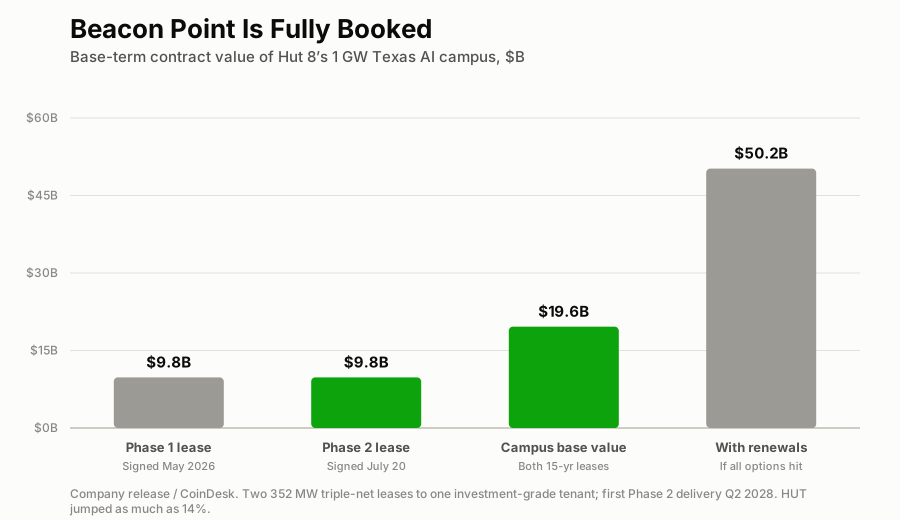
- Same investment-grade tenant as the May lease, now committed to 704 MW total. Campus base contract value: $19.6 billion, with renewal options that could stretch it to $50.2 billion.
- The fine print: the first Phase 2 data hall doesn't deliver until Q2 2028. The market is paying today for revenue that starts in two years and must be built with billions of upfront capex.
- Across the whole portfolio, contracted IT capacity now stands at 949 MW with $26.6 billion of cumulative base-term value, all of it leased to or backstopped by investment-grade counterparties. That is the number that matters more than the campus headline.
- Short-term verdict: real deal, real counterparty, but a momentum trade inside a downtrend. HUT was still down about 30% from its June peak going into announcement day, and closed it at $100.93.
The Board
A former bitcoin miner now has a $19.6 billion contracted campus. The word "former" is doing real work.
What the Deal Actually Is
Monday morning, Hut 8 announced the second 352 MW IT lease at Beacon Point, its 1-gigawatt AI data center campus in Nueces County, Texas. The terms: 15 years, triple net, a 3.0% annual rent escalator, and $9.8 billion in base-term contract value. The tenant is the same high-investment-grade company that signed the identical Phase 1 lease in May, doubling its commitment to 704 MW.
That takes the campus to fully commercialized: $19.6 billion of base contract value across both leases, and if the tenant exercises all three five-year renewal options per lease, potential campus-level value of $50.2 billion. The second 352 MW AI factory will be built to Nvidia's DSX reference architecture for gigawatt-scale infrastructure, supported by 500 MW of utility capacity.
The number the coverage mostly skipped is the portfolio one. Across all of Hut 8, contracted IT capacity now stands at 949 MW with a cumulative base-term value of $26.6 billion, every megawatt of it leased to or backstopped by investment-grade counterparties. Beacon Point is the headline; 949 MW is the company.
The market treated it as sector-wide validation. IREN, Cipher Mining, TeraWulf and the CoinShares miners ETF all caught bids in sympathy, and IREN had its own $2.8 billion contract news the same morning, which we covered in the IREN ARR breakdown.
The Fine Print Nobody Reads on Green Days
$19.6 billion is not revenue. It's 15 years of contracted future revenue, and the second phase doesn't even start delivering until Q2 2028. Hut 8's own disclosure puts each 352 MW lease at roughly $655 million of average annual net operating income upon stabilisation, so the fully leased campus runs at about $1.3 billion a year, which is the number to anchor on: divide the $19.6 billion headline by fifteen years and you get the same figure, and it is far more ordinary than the press release implies. (An earlier version of this piece attributed the $655 million to the whole campus; it is the per-lease figure.) Between now and then sits the unglamorous part: construction schedules, grid interconnection, GPU-era cooling builds, and financing the whole thing. Data center campuses at this scale consume billions in capex before the first rent check clears.
One tenant holds 704 MW. Investment-grade or not, single-tenant concentration at a single campus is the kind of detail that doesn't matter at all until the one day it's the only thing that matters.
And the stock has been telling you something. HUT peaked near $138 in early June and slid roughly 30% to a one-month low around $96 before the announcement, even while Benchmark was nearly doubling its price target from $85 to $165. It closed announcement day at $100.93, and the target raises kept coming afterwards: Needham to $145 and Benchmark to $195. When a stock falls 30% while analysts turn more bullish, the market is repricing the sector's risk, not the company's execution. The whole miner-to-AI cohort has been trading as a leveraged bet on AI capex sentiment, with a side of crypto beta left over from its bitcoin mining origins.
The Q2 Print, Marked Against This Article (Added August 4)
The buildout is funded, the schedule held, and the income statement is still a bitcoin proxy while the AI rent waits for 2027.
Hut 8 reported Q2 2026 before the open on Tuesday, August 4, and the release reads like a stress test of this article's framing.
- Revenue: $74.9 million, up 81% from $41.3 million a year earlier, and below the roughly $80 million consensus. The split is the whole thesis in one line: Compute $72.5 million, Power $1.2 million, and Digital Infrastructure, the segment the $26.6 billion of contracts belongs to, $1.3 million. The AI landlord business barely produces revenue yet. That is not a scandal; it is the Q2 2028 delivery schedule this piece led with.
- Net loss: $177.1 million, against net income of $137.5 million a year ago. Strip the noise before reacting: $138.6 million of the loss is mostly unrealized digital-asset marks from bitcoin's slide, and the year-ago profit was itself larger than that quarter's entire revenue for the mirror-image reason, bitcoin marked up instead of down. Adjusted EBITDA was $10.4 million. The GAAP loss of $1.27 per share landed far below the roughly -$0.64 consensus, and nearly all of the gap is those marks.
- The financing question got its answer. This article's fine-print section asked how a company this size pays for billions of capex before the first rent check clears. The release answered: $7.5 billion of fully amortizing, investment-grade project financing closed in a single quarter, split between $3.25 billion of senior secured notes for River Bend, which Hut 8 calls the first investment-grade construction financing for a single-sponsor data center project, and $4.25 billion for Beacon Point Phase 1. Both non-dilutive, both without recourse to Hut 8 Corp. The company ended June with roughly $8.1 billion of cash, restricted cash and bitcoin, $7.6 billion of it attributable to Hut 8 and $497.2 million to American Bitcoin, most of that the freshly raised construction money.
- The schedule held, and got specific. Facilities representing 1,330 MW of utility capacity are in active construction across River Bend and Beacon Point, with first data halls targeted for Q2 2027 at River Bend and Q3 2027 at Beacon Point Phase 1. The Phase 2 lease this article covers still delivers from Q2 2028. Portfolio-wide, the 949 MW and $26.6 billion of base-term value now carry a company-stated expectation of more than $1.75 billion of average annual NOI.
Marking the July 20 playbook honestly: the call-spread suggestion below shipped without a strike, an expiry or a premium, which makes it ungradeable under our standing rule that a play you cannot score is not analysis. What can be marked: the stock never needed the chase, and then it never got it. From the $100.93 announcement-day close it ran about 12% to $112.69 at Friday's close (July 31) as targets stacked up (Benchmark $195, B. Riley $163, Morgan Stanley initiating at $263), gave the entire run back with a 10.78% drop on Monday, and on results day dipped about 2% in the premarket before closing at $102.00, up 0.83% on the session. A revenue miss and a $177 million headline loss, and the stock ended earnings day a dollar above where the lease landed. That round trip, up 12% and back on no company news, is the sector's sentiment beta in miniature. The market is still paying for 2027-2028 rent with 2026 money; the difference after August 4 is that the construction financing is no longer hypothetical.
Hype or Real?
The deal is real; the day-one price action is the hype-shaped part. A 15-year triple-net lease with an investment-grade tenant is about the strongest form of validation an AI infrastructure company can print, and doing it twice at the same campus removes the "one-off" objection. But the revenue is back-loaded to 2028 and beyond, which means today's 14% pop is the market re-rating a story, not discounting new cash flow. Story re-ratings can retrace as fast as they arrive, especially in a sector where the capex math itself is under interrogation.
The same trade is being repriced across the whole power complex right now. Vistra reports this week sitting on a signed 20-year Meta contract for 2,609 megawatts that is not in its guidance, Oklo reports as a $6.76 billion company expected to book about $3.8 million of revenue, and Caterpillar fell 23% from a record under a Michael Burry short. Hut 8's contracted-revenue-in-2028 problem is the sector's problem in miniature.
The Playbook
- Chasing the open is the worst entry of the week. Sympathy rallies in this sector fade hard; let the gap digest. If the news is as good as it looks, the stock doesn't need you in the first hour.
- For a swing long, use call spreads over shares or naked calls. HUT's realized volatility is enormous and its IV prices that in. Spreads let you own the re-rating thesis without paying meme-tier premium; the basics are in our calls and puts guide.
- The level that matters is the $96 area. That was the pre-news low. Reclaiming and holding above the June range would turn this from a bounce into a trend change; slipping back below it means the lease got sold into, and the downtrend keeps the wheel.
- Don't short the headline. Yes it's a 2028 story, but fighting a fresh $9.8 billion contract with an investment-grade counterparty on announcement day is how shorts become case studies.
The One-Line Read
Hut 8 just fully booked a gigawatt campus with $19.6 billion of contracted value and the pop is deserved, but the cash arrives starting 2028 while the risk arrives daily, so trade it like what it is: a real company inside a sentiment sector, best played with spreads, patience, and an exit level you actually honor.
Next up:GDP, Wednesday at 8:30am ET →
More on AI & Semiconductors
Updated Every Saturday
The Week Ahead
Every earnings date, Fed event and setup for the current trading week, on one page.
Refreshed Weekly
Earnings Calendar
Who reports next, when, and what consensus and the whisper expect.
The Week-Ahead Brief
Don’t miss next week’s setups. Get the Saturday brief.
Latest issue, Aug 17“The consumer cracked on Friday. Six retailers answer for it this week.”
Every Saturday: next week’s earnings dates, Fed days and the trades worth watching, from the same desk that writes the week-ahead hub. Free, built for retail investors.