UPS Earnings (July 28): Revenue of $22.8 Billion Beat, Adjusted EPS $1.76, and the Full-Year Target Rose to $91.2 Billion
UPS's Q2 2026: revenue of $22.8 billion beat the $21.8 billion expected, adjusted EPS of $1.76 beat $1.66, and the company raised its full-year revenue target to about $91.2 billion.
The Beat Was Wider Than the Setup Allowed For
UPDATE (August 7, 2026): UPS reported on July 28 and beat on both lines. Revenue of $22.8 billion cleared the roughly $21.8 billion consensus quoted below by about a billion dollars, against a setup that modelled only 2.5% growth. Adjusted EPS of $1.76 beat the $1.66 expected.
The guide went up. UPS raised its full-year revenue target to approximately $91.2 billion from $89.7 billion, and full-year adjusted diluted EPS guidance to approximately $7.22.
Read the GAAP line separately, because it describes a different company. Net income fell to $604 million, or $0.71 per diluted share, from $1.28 billion and $1.51 a year ago, on $891 million of after-tax transformation charges, primarily employee separation costs tied to the Driver Choice Program. That is the deliberate volume-shedding strategy this page described, showing up as a charge. The adjusted line reflects the operating quarter; the GAAP line reflects what the restructuring costs to run.
Not sourced, and it matters: the US Domestic margin figure this page called the number that actually decides the print. A revenue and EPS beat says the quarter was good; it does not say whether the trade of volume for revenue per piece is working, which was the argument.
On the options call, this page rated a long strangle 6/10 against a 6.3% implied move, the highest long-premium rating it gave that week. Grading it needs the realised move, which we could not verify against a second source, so it stays open rather than claimed in either direction.
More on Earnings: Options Scorecard: The Week of August 10, Graded (35 Calls, 51% Right) →
TL;DR
- UPS reports Tuesday July 28 at 6:00am ET, the earliest print of the day. Consensus is $1.66 EPS (up about 6.5%) on revenue of roughly $21.8 billion, up 2.5%.
- UPS is deliberately shedding volume. CEO Carol Tomé has been explicit that Amazon was not the company's most profitable customer, and the network is being right-sized around that.
- The number that decides Tuesday is US Domestic margin, not revenue. In Q1, domestic revenue fell 2.3% to $14.1 billion while revenue per piece rose 8.3%. That trade is either working or it is not.
- Free tailwind nobody has modelled properly: Brent settled at $85.87 on Monday, down 6.3%. UPS burns an enormous amount of fuel.
- Options price a 6.3% move, which is large for a logistics bellwether. Unlike the other three names Tuesday, we think buying volatility here is genuinely defensible: 6/10 on a strangle, and the highest we will rate a long-premium trade all week.
When Does UPS Report Q2 2026 Earnings?
Tuesday July 28 at 6:00am ET, three and a half hours before the open. That timing matters for traders. You get a full premarket session to reprice, which means the 9:30am open is often past the best fill rather than the moment of it.
The Board
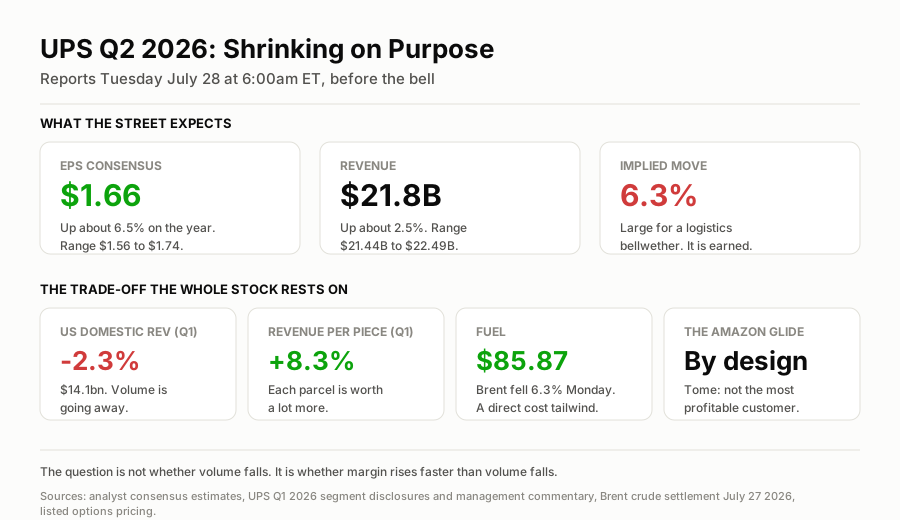
Two numbers on the bottom row point in opposite directions. Which one wins is the entire quarter.
What Actually Matters: One Trade-Off
Almost everything written about UPS misses the point by focusing on the revenue line. UPS is executing a strategy that makes revenue go down on purpose. Judging it on revenue is like judging a diet on body weight and calling the loss a problem.
Here is the actual mechanism. UPS is walking away from low-margin Amazon volume. In Q1 that showed up exactly as you would expect: US Domestic Package revenue of $14.1 billion, down 2.3% year on year, driven by an expected volume decline, while revenue per piece grew 8.3%. Fewer parcels, each one worth substantially more.
The strategy works if and only if two things hold:
1. Revenue per piece keeps outrunning volume decline. An 8.3% price and mix gain against a low single digit volume drop is a winning ratio. If revenue per piece decelerates while volume keeps falling, the whole thesis inverts and UPS is just a shrinking company.
2. The network shrinks as fast as the volume. This is the harder part and the part that actually determines margin. Parcel networks are enormously fixed-cost. If you remove 10% of the packages but only 4% of the buildings, aircraft and routes, your cost per piece rises and the margin gain evaporates. Tomé has framed the volume reduction as compelling UPS to right-size its network, which is management language for closing facilities and parking planes. Watch the domestic operating margin line, and watch it against the volume decline, not against last quarter.
3. Guidance. Consensus sits at $1.65 to $1.66 with a range of $1.56 to $1.74, and revenue estimates span $21.44 billion to $22.49 billion. That is a wide band for a mature industrial, and it tells you the Street genuinely does not know how the network cost-out is tracking.
The free tailwind: Monday's oil crash. Brent settled at $85.87, down 6.3%, and WTI fell about 7% to $83.15, after crude traded as high as $102 last week. Fuel is one of UPS's largest variable costs. Most of that benefit lands in Q3, not the quarter being reported, but it changes the guidance conversation. If management sounds relaxed about the back half, cheap jet fuel and diesel are a large part of why. We covered Monday's oil move and the session it drove.
The Options Angle
UPS options imply a 6.3% move. For a $100 billion-ish logistics company with a mature business and a well-telegraphed strategy, that is a big number. Our view is that it is close to fair, and possibly cheap, for one specific structural reason.
UPS does not move by its average. This is the crucial insight and the reason we rate long premium higher here than in the other three names. UPS earnings outcomes cluster at the extremes: either the cost-out is tracking and the stock gaps up, or the network is carrying too much fixed cost against falling volume and it gaps down. The quiet, in-between, "roughly in line" reaction is the rarest outcome, not the most common one. When a distribution is bimodal, the average move systematically understates what actually happens, and premium sellers get paid for a middle that rarely arrives.
The ranking, worst to best.
Iron condor. Conviction: 2/10. The worst trade on this board and the one that looks most attractive on a screen. An iron condor sells the middle of the distribution. For UPS, the middle is precisely where the stock does not go. You are collecting a small premium to be short the two outcomes that are actually likely.
Short strangle. Conviction: 1/10. The undefined-risk version of the same error. Do not.
Long straddle. Conviction: 5/10. Directionally the right instinct, priced slightly wrong. At 6.3% implied you need better than a 6.3% move to profit after IV crush, and a straddle buys both wings at full price. Workable. Not optimal.
Long strangle. Conviction: 6/10, and the best long-premium trade we will name this week. The cheaper expression of the same bimodal view. A strangle buys out-of-the-money calls and puts, which is exactly where a bimodal distribution actually lands. You need a genuine gap to win, and a genuine gap is the base case here rather than the tail. Two caveats that keep this at 6 and not 8: the 6:00am report time means most of the move happens in thin premarket trading where your ability to exit is poor, and if UPS does deliver a boring in-line quarter you lose most of the premium.
Put spread as a hedge on a long position. Conviction: 7/10. If you hold UPS for the dividend, this is the cleanest expression on the board. You are not predicting the quarter. You are defining what a bad one costs you, for a known price, over a known window. That is what hedging is supposed to be, and it is the only trade here that does not require you to be right about the network cost-out.
The One-Line Read
UPS is deliberately becoming a smaller, richer company, and Tuesday is the quarter where the market finds out whether the network shrank as fast as the volume did. The 6.3% implied move is not fear, it is an accurate read on a stock that does not know how to move a little, which makes this the one name this week where paying for volatility is a real trade rather than a consolation prize.
Also reporting before the bell Tuesday: Boeing, PayPal and Coca-Cola. The full week is mapped here.
Next up:GDP, Wednesday at 8:30am ET →
More on Earnings
Updated Every Saturday
The Week Ahead
Every earnings date, Fed event and setup for the current trading week, on one page.
Refreshed Weekly
Earnings Calendar
Who reports next, when, and what consensus and the whisper expect.
The Week-Ahead Brief
Don’t miss next week’s setups. Get the Saturday brief.
Latest issue, Aug 17“The consumer cracked on Friday. Six retailers answer for it this week.”
Every Saturday: next week’s earnings dates, Fed days and the trades worth watching, from the same desk that writes the week-ahead hub. Free, built for retail investors.