Oklo Earnings (August 7): First Revenue of $1.21 Million, and Criticality Came From the Other Reactor
Oklo booked its first revenue, $1.21 million, and lost $48.5 million in Q2 2026. The Groves isotope reactor in Texas went critical on August 5; Aurora in Idaho did not.
The Criticality Question Got Answered by a Reactor This Page Was Not Watching
UPDATE (August 7, 2026): Oklo has reported, and the binary framed below was the wrong binary. The company booked $1.21 million of revenue, the first in its history, against zero a year ago and roughly $0.1 million expected. The loss went the other way: $48.5 million, or $0.28 a share, against the $0.16 consensus loss logged below, and wider than the $33.1 million lost in Q1 2026. Operating expenses were $74.4 million against $28.0 million a year ago, with R&D at $39.5 million against $11.5 million. This is a company spending faster, not slower.
On criticality, the answer is yes and no, from two different reactors. The Groves isotope test reactor at Lockhart, Texas reached first criticality at 9:19pm ET on Wednesday, August 5, less than a year after breaking ground: the first reactor under the Department of Energy's Reactor Pilot Program to go critical on private land from a greenfield site, and the fifth reactor to reach criticality under that authorisation process. Aurora at Idaho National Laboratory, the reactor this page said the call would settle, did not go critical. It is a 75 MW build that the company now points at commercial operations in 2028.
The balance sheet is the other thing that changed, and it cuts both ways. Cash and marketable securities stood at $3.0 billion at quarter end, of which $1.9 billion was raised year to date through the at-the-market equity programme. Against the $6.8 billion market capitalisation this page logged on the August 3 close of $38.83, that is 44% of the market cap sitting in cash and an enterprise value nearer $3.8 billion. The "1,800 times sales" bear case below is arithmetically correct and materially overstated once the cash is netted off, and the offsetting cost is that shareholders paid for that cash in dilution. Year-to-date cash used in operating activities was $65.5 million.
The stock traded up off that $38.83 close into the mid-$40s around the criticality announcement, roughly 15% higher. A verified regular-session quote for August 7 was not sourceable at the time of writing, so no post-print move is claimed here. The other two results from the same morning: Take-Two and Vistra.
More on $OKLO: Is Oklo a Buy at $44? A $3 Billion War Chest, $1.2 Million of Revenue, and a Decade of In-Between →
TL;DR
- Oklo reports Q2 2026 results Friday, August 7, before the open, with the business update call at 8:30am ET, into the same tape as the July jobs report.
- The financials are almost a formality: zero revenue expected, with a consensus loss of $0.16 per share against $0.18 a year ago. Analysts expect Oklo's first commercial revenue this year, about $3.8 million, from radioisotopes rather than electricity, against a market cap near $6.8 billion.
- The call is about milestones, and one dominates: whether the Aurora reactor at Idaho National Laboratory hit the executive-order target of an advanced reactor reaching criticality by July 4, 2026. That answer was not public as of this writing; Friday should settle it.
- The regulatory scoreboard has been genuinely good: the NRC approved Oklo's Principal Design Criteria topical report in May, and DOE signed off on key safety documents for both the pilot program and the isotope test reactor.
- The stock closed Monday at $38.83, down about 46% this year and roughly 80% below its 52-week high near $194, unwound with the whole AI-energy trade. Options price about 13% for the print.
When Does Oklo Report Earnings?
Friday August 7, before the market opens, with the call at 8:30am ET, the same pre-open window as payrolls and Vistra, the week's other electricity print.
The Board
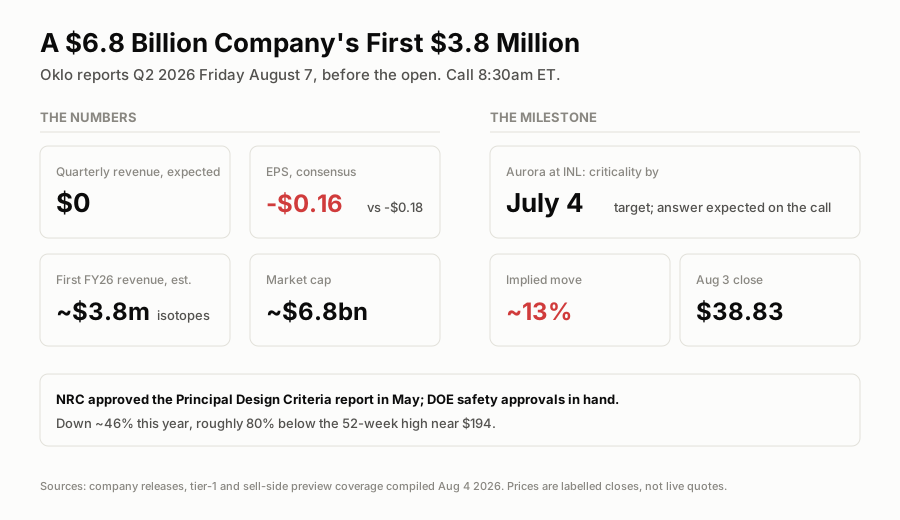
There is no quarter to analyse. There is a checklist, and one date on it matters more than everything else.
The Only Question: Did Aurora Go Critical?
Oklo spent 2026 collecting regulatory wins: the NRC approved the Principal Design Criteria topical report for the Aurora powerhouse in May, DOE approved the Nuclear Safety Design Agreement under the Reactor Pilot Program, and the isotope test reactor's safety analysis cleared. All of it points at one target: the executive-order goal of an advanced reactor reaching criticality by July 4, 2026.
Whether Aurora actually made that date has not been confirmed publicly. That makes Friday's call unusually binary for a company with no revenue: "we achieved criticality" is a genuine, dated, physical milestone that separates Oklo from every paper-reactor peer; a slipped date is a slipped date at a company valued entirely on schedule credibility.
The First Revenue Is Not Electricity
The strangest fact in the setup, and the reason the site flagged Oklo in the week-ahead hub: analysts expect Oklo's first commercial revenue this year to be roughly $3.8 million, from the Atomic Alchemy radioisotope business it bought for $25 million, not from selling power. The same analyst work models a ramp toward $434 million by 2030. Hold that against a $6.8 billion market cap and the arithmetic is the bear case: about 1,800 times this year's expected sales, all of it schedule risk.
The demand side is why bulls stay: hyperscalers have been contracting nuclear capacity at scale (trade press counts up to 6.6 GW across TerraPower, Oklo and Vistra for Meta alone; exact Oklo terms are not public, so treat specifics cautiously until management states them). Any firmed-up customer disclosure on Friday is new information.
The Options Angle
Options price about 13% for the print, per Bloomberg-derived data. On a milestone stock, that is a bet on headlines, not financials.
- No pre-print position, either direction. A binary criticality answer plus a payrolls morning is pure gap risk; there is no analytical edge in guessing a press release.
- The conditional: confirmed criticality plus any customer firm-up is the momentum entry, accepting that this remains a pre-revenue story where sizing discipline is the entire risk management.
Trade log
| # | Stance | Structure | Strikes and expiry | Cost or credit | Spot at writing | Implied move | Breakeven |
|---|---|---|---|---|---|---|---|
| 1 | Pass | Any pre-print options position | Aug expiries | Not sourced | $38.83, Aug 3 close | ~13% | n/a; pass scored against the realised move |
| 2 | Conditional | Post-print long (shares only, small size) if Aurora criticality is confirmed | Struck off the Aug 7 post-open | Struck off the Aug 7 post-open | To be struck Aug 7 | n/a | Scored against the post-print entry if triggered |
The Options Angle, Now Graded
Both rows lost, and they lost for the same reason: this page treated an earnings date as the event when the event was a press release two days earlier.
| # | Play as logged | Condition | Result |
|---|---|---|---|
| 1 | Pass on any pre-print options position, either direction, ~13% implied | none | Loss. The stock ran roughly 15% from the $38.83 August 3 close into the mid-$40s on the August 5 criticality news, inside the August expiries the pass declined. |
| 2 | Conditional post-print long, shares only, small size | Aurora criticality confirmed | Not triggered, because the trigger named the wrong reactor. Groves went critical; Aurora did not. No position is logged and none will be backfilled. |
Row 1 is the expensive one and the reasoning behind it is worth naming, because it was internally coherent and still wrong. The argument was that a binary criticality answer landing on a payrolls morning is pure gap risk with no analytical edge. That is a fair description of an earnings print. It is not a fair description of a milestone company, where the milestone is announced whenever the physics allows and has no obligation to wait for the reporting calendar. Oklo announced criticality at 9:19pm on a Wednesday. Nothing about the August 7 date was load-bearing.
The generalisable version, and the one worth carrying into the next pre-revenue name: when a company's value turns on dated engineering milestones rather than quarterly financials, the earnings date is not the catalyst and sizing a decision around it is a category error. The implied move priced into the print was 13%; the move that actually happened was not in the print at all.
Row 2 is a smaller loss but a more embarrassing one. The page below asserted that Friday "should settle" whether Aurora went critical, and built the entry condition on that single reactor. Aurora was never the reactor closest to criticality: Groves had cleared its DOE safety analysis in early July and was publicly targeting first criticality that month, a fact the page below actually records and then does not act on. The binary was mis-specified against the company's own published schedule, so the trigger could not fire on the news that mattered. Aurora remains a 2028 commercial-operations story, which is a different investment horizon entirely from the one this page implied was days away.
The One-Line Read
Oklo's income statement on Friday will say what it always says, nothing, minus expenses; the only line that can move a $6.8 billion valuation sitting 80% below its high is a sentence about whether a reactor in Idaho went critical on schedule, and for once the market gets a clean yes or no.
Next up:GDP, Wednesday at 8:30am ET →
More on $OKLO
Updated Every Saturday
The Week Ahead
Every earnings date, Fed event and setup for the current trading week, on one page.
Refreshed Weekly
Earnings Calendar
Who reports next, when, and what consensus and the whisper expect.
The Week-Ahead Brief
Don’t miss next week’s setups. Get the Saturday brief.
Latest issue, Aug 17“The consumer cracked on Friday. Six retailers answer for it this week.”
Every Saturday: next week’s earnings dates, Fed days and the trades worth watching, from the same desk that writes the week-ahead hub. Free, built for retail investors.