Capricor (CAPR) Narrows to Upper Limb, and the August 22 FDA Date Moves
An activist investor is pushing Capricor's board for a cash freeze and new directors, and STAT News says deramiocel's rejection looks near-certain, a day CAPR fell 8% to $6.29. No replacement PDUFA date has been set.
Updated August 22, 8:20am ET: an activist investor wants a cash freeze, and STAT calls the rejection near-certain
Kaos Capital, an investment firm, sent Capricor's board a public letter on August 21 asking for a meeting within 15 business days, a formal cash-preservation plan, and two new independent directors to sit on a proposed M&A and Strategic Alternatives Committee. Source: Kaos Capital's release on PR Newswire. Kaos has not disclosed the size of its stake.
The letter's numbers match what this page already has. Kaos cites $237.9 million in cash as of June 30, an $80.2 million drop from the $318.1 million Capricor held at the end of 2025, the same two figures in the August 13 update below, and puts first-half 2026 operating expenses at $79.7 million, with G&A of $23.5 million roughly double the year-ago period. Kaos's line: "Conviction in a lead program is not a license for a Board to concentrate all of a public company's capital, risk, and future in a single regulatory outcome." Capricor has not publicly responded. Source: BioPharma Dive.
Separately, STAT News's Adam Feuerstein wrote on August 20 that deramiocel's rejection looks near-certain, calling the 24-month open-label-extension data Capricor is submitting "a stall tactic. Nothing more," and arguing the only route left to approval is an entirely new randomized trial. That is one veteran biotech reporter's read on a file this site has already flagged as split, not an FDA statement, and it is behind a paywall: STAT News, secondhand via Seeking Alpha.
CAPR closed Friday at $6.29, down 8.04% against Thursday's $6.84, per stockanalysis.com; investing.com has $6.290, -7.97%, against a $6.835 prior close, and shows the stock at $6.38 after hours. Market cap is around $365 million, still roughly 50% above where the stock sat before the August 14 rally described below.
The August 22 date in this article's title is not resolving today. As the August 14 update below recorded, the FDA told Capricor it would extend the PDUFA action date once the BLA amendment is received; nothing found this week names a replacement date. Today's date is nominal, and the letter and the STAT piece are what actually moved the stock this week.
My read. Kaos is making a capital-allocation argument, not a clinical one, and it lands at a moment the clinical case looks weaker than it did on August 14: back then the news was the FDA agreeing to look at narrower data, this week's news is a named reporter and an activist both treating a rejection as the base case. Nothing here changes the trade log below; the binary already happened on August 14 and is already scored as a loss.
More on $CAPR: Why Capricor (CAPR) Rose 58%: The FDA Decision Went Away, and I Called It Wrong →
Updated August 14, after the close: $6.65, up 57.96%, near the low of the day
CAPR closed at $6.65, up 57.96%, against Thursday's $4.21, per stockanalysis.com; investing.com has $6.66, +58.19%. Volume was about 65 million shares against a three-month average near 3.1 million, so more stock changed hands than the company has outstanding. The session ran the other way all day: Reuters had $9.18, up 118%, before the bell, the stock opened at $7.68 and closed near the bottom of a $6.05-$8.15 range.
At the close the market cap is near $386 million against $237.9 million of cash, so the programme is valued around $149 million, against roughly $7 million at Thursday's bell.
The August 12 call on this page is now graded, and it is a loss. The logged pass on any directional structure into August 22 was struck against a $3.90-3.95 spot; the stock closed 69% above it. The scorecard, and why a PDUFA date is not an expiry, is here; the row is in the Track Record ledger.
Updated August 14, 1:20pm ET: Cantor went from $3.50 to $28 on the same trial data
Cantor Fitzgerald upgraded CAPR to Overweight from Neutral and raised its target to $28 from $3.50. That $3.50 is the number recorded further down this page, set after the panel vote and itself cut from $62. So one firm has moved its target by a factor of eight in two weeks, in both directions, without a new efficacy readout arriving in between. What changed is the regulatory path: Cantor's note points at the BLA amendment carrying the 24-month open-label extension data and the FDA's openness to reviewing it, which is the same amendment described in the 4:15am update below. Sources: Investing.com's report of the upgrade and StocksToTrade.
Correction, filed 6:00pm ET: the Lancet publication is not new. This update originally described the HOPE-3 peer-reviewed publication as part of Friday's news, following several outlets that ran the day as "Lancet data and analyst upgrades collide". Capricor's own release dates the publication July 29, 2026, the same day the advisory committee voted. It reports the 54% slowing of upper limb decline at p=0.03, the endpoint this page already recorded, and it was three weeks old on Friday. Nothing in the efficacy package changed this week. Oppenheimer reiterated Outperform on the risk-reward after the drawdown; B. Riley stayed Neutral with a $5 target.
The sell-side average has moved with it. stockanalysis.com now carries a consensus 12-month target of $10.50, against the $4.38 recorded on this page at 6:05am today.
The price, and what it pays for the drug. CAPR is at $6.58, up 56.29%, at about 1:00pm ET against Thursday's $4.21 close, for a market cap near $382 million. Take out the $237.9 million of cash and the programme is being valued around $145 million: less than the $158 million implied at 11:04am and well under the $215 million the 6:05am premarket print implied. The stock has spent the session giving back the overnight move while the sell-side has spent it catching up.
My read has not moved with the targets. A $28 target and a $5 target published in the same week describe the same file, and the gap between them is the probability each firm assigns to an approval nobody has a date for. I would rather own the fact that the FDA agreed to look at the amendment than any of the numbers being attached to it.
Updated August 14, 11:10am ET: the cash session is holding most of it, about a point below the premarket
CAPR is at $6.83, up 62.23%, at 11:04am ET against Thursday's $4.21 close, per stockanalysis.com; those two subtract to the quoted $2.62 change. An hour and a half into regular trading, the stock is roughly a dollar below the $7.82 premarket print recorded below, and still above the $7 target Alliance Global Partners set after the panel vote.
Redoing the valuation at the cash price. On 57.91 million shares, $6.83 is about $396 million of market cap against $237.9 million of cash, so the programme is being valued near $158 million rather than the $215 million the 6:05am price implied. This is an intraday quote and not a close, and I would not read a dollar of give-back as the market changing its mind about the amendment.
Updated August 14, 6:05am ET: the premarket has passed every price target set after the panel vote
CAPR is at $7.82, up 85.75%, at 6:00am ET per stockanalysis.com, and investing.com has $7.83, up 85.99%, at 6:02am. The two feeds carry Thursday's close a couple of cents apart, $4.19 against $4.21, which is the same spread noted below. Either way the move has widened by roughly 20 points since the 4:05am print.
The stock is now trading above the sell-side. After the July 29 panel vote, Alliance Global Partners cut deramiocel to Neutral from Buy and took its target to $7 from $51, citing a lower probability of approval, a higher discount rate and a smaller sales forecast; H.C. Wainwright went to Neutral on the same file. The consensus 12-month target that stockanalysis.com carries is $4.38. At $7.82 the premarket sits above the first of those and roughly 79% above the second. None of those targets has been revisited since Thursday's call, so they price a company that had not yet said it would narrow the label.
What the price now pays for the drug. On 57.91 million shares, $7.82 is about $453 million of market cap against $237.9 million of cash, so the programme is being valued near $215 million. That was about $6 million at Thursday's bell and $163 million at 4:05am. My read has not changed with the price: the amendment improves the odds of an eventual approval and shrinks what an approval is worth, and a stock that has trebled off the floor in one overnight session has priced a good deal of the first half of that.
Updated August 14, 4:15am ET: the label is being narrowed, and August 22 is moving
The date in this article's own slug is going to slip. On Thursday's 4:30pm call Capricor said it will file an amendment to the deramiocel BLA, and that the FDA has indicated the current action date will be pushed out once that amendment is received. Parent Project Muscular Dystrophy, the DMD advocacy organisation that has tracked this file throughout, published the same account on August 13: "FDA has suggested to Capricor that once the amendment is submitted and received by the agency, the current Prescription Drug User Fee Act (PDUFA) action date of August 22, 2026, will be extended."
The amendment narrows the label to upper limb dysfunction only, and carries the 24-month open-label extension data from HOPE-3 plus further analyses of the existing package. Set that against the split trial described further down this page. The cardiomyopathy indication is the one the advisory committee rejected 9 to 3, and it rested on the LVEF endpoint that lost significance at p=.09 under the revised model. Upper limb function is the endpoint that actually hit, at p=.029. Capricor is refiling on the half of HOPE-3 that worked and letting go of the half that did not.
My read: this is the sensible move and it is also an admission. A company that believed the cardiac data would clear on August 22 does not narrow its own label eight days out. Trading the drug's original reason for existing, a cardiac cell therapy, for the indication its trial can actually support is the trade worth making, and it still leaves a smaller commercial opportunity than the one this stock was priced on a year ago.
Nobody has said how long the delay runs, and the range matters. A major amendment normally buys the FDA a three-month extension. Capricor did not say whether this one will be classified that way, and PPMD notes that a non-major amendment carries no such defined clock. So the new date could be late November or it could be a few weeks; I cannot narrow it further than that, and neither, on the record, can anyone else.
The premarket. CAPR traded at $6.92, up 64.37%, at 4:05am ET against Thursday's $4.21 close, per stockanalysis.com. On 57.91 million shares that is about $401 million of market cap against $237.9 million of cash, so the market is now paying roughly $163 million for the drug programme, against about $6 million at Thursday's bell.
What the 4:05pm press release did not say. The release itself carries none of this. It says the BLA "remains under active FDA review" and that Capricor "is continuing to work with the FDA on the review of its BLA." The amendment and the extension came out on the call that followed. The August 13 update below, written before any transcript existed, took the release at its word and said the August 22 date was intact. That is the part of it now superseded; the financials in it check out against the filed release and stand.
Updated August 13, after the close: CAPR traded up about 59% in extended hours
Capricor closed the regular session at $4.21-4.23, up under 1%, then traded to $6.68-6.69 after hours. Two quote sources agree within a cent: stockanalysis.com had $6.69, +58.91%, at 5:51pm ET against a $4.21 close; investing.com had $6.68, +58.67%, at 5:53pm against $4.23. On 57.91 million shares outstanding that is a market cap moving from about $244 million at the bell to roughly $387 million two hours later, with no FDA decision and no new trial data in between.
The level to hold onto is $6.57. That was the July 29 close, the last print before the panel voted 3-9. The after-hours tape is above it, so the extended session has taken back the entire 36% drop described below.
What the 4:05pm release actually said. Cash and marketable securities of $237.9 million at June 30, down from $318.1 million at the end of 2025. Q2 net loss of $40.7 million, $0.70 per share, against $25.9 million and $0.57 a year earlier, with R&D at $28.9 million and G&A tripling to $14.1 million from $5.7 million, which is launch spending. No revenue. Aggregators had the Street at -$0.58, so this was a miss on a line item nobody trades in a pre-revenue biotech. Source: Capricor's Q2 release.
The regulatory items are the ones with money attached. The FDA ran a Bioresearch Monitoring inspection of the HOPE-3 clinical work from July 6 to July 20 and closed it with a Form 483 carrying one observation, on standard operating procedures, documentation practices, vendor oversight and audit report timeliness. Capricor has filed its responses, is awaiting feedback, and says it does not believe the observation touches HOPE-3 data integrity. The BLA remains under active FDA review with the August 22 target date intact. The San Diego GMP facility is operational and able to support an initial launch; the second-floor expansion is still targeted for validation and FDA inspection in 2027.
My read. A file that could have been derailed by an inspection was not, and nine days out the agency has neither pushed the date nor asked for more time. For a stock the market had written down to almost nothing, that is a real change in the odds. Run the arithmetic at Thursday's close: $243.8 million of market cap against $237.9 million of cash left roughly $6 million for the drug program. At $6.69 after hours it is nearer $150 million. Both of those are still small numbers for a therapy with a PDUFA date next week, which is the part I keep coming back to.
One limit on all of this. The release crossed at 4:05pm and the stock closed at 4:00pm up half a percent, so the move built during and after the 4:30pm call. I could not source what management said on it: no transcript and no wire report existed at 7:00pm ET. Everything above is the filed record.
The runway holds up to a check. $237.9 million against a $40.7 million quarterly loss is about 5.8 quarters from June 30, which lands in Q4 2027 and matches what management has been guiding to.
TL;DR
- Activist investor Kaos Capital is pushing Capricor's board for a cash freeze, two new directors and a strategic-alternatives committee, in a public letter sent August 21, and STAT News called deramiocel's rejection "near-certain" the day before. CAPR fell 8.04% Friday to $6.29.
- The August 22 PDUFA date in this article's title was never going to resolve on schedule. The FDA told Capricor on August 14 it would extend the date once a BLA amendment narrowing the label is received; no replacement date has been announced.
- An FDA advisory panel already voted 3 for, 9 against on July 29, finding the evidence did not support the drug's effectiveness for Duchenne muscular dystrophy cardiomyopathy. The vote is non-binding.
- CAPR fell from $6.57 to $4.19 the session after the vote, a 36% one-day drop, then rallied 118% intraday on August 14 when Capricor said it would refile on a narrower label. The stock has given back most of that premarket spike and sits roughly 84% below the 52-week high of $40.37.
- The trial data itself is split. The primary endpoint, upper limb function, hit its mark at p=.029, a 54% slowing of decline. The key secondary endpoint, the heart-function measure that matters for the cardiomyopathy indication under review, missed at p=.09 once a revised statistical model was applied.
- Capricor reported Q2 2026 results on August 13: $237.9 million of cash as of June 30, down from $318.1 million at year-end 2025, which management says funds operations into Q4 2027.
When Does the FDA Decide on Deramiocel?
It was August 22, 2026, and that date is passing without a decision. Capricor is filing an amendment to the Biologics License Application, and the FDA told the company on August 14 it will push the action date out once the amendment lands. No replacement date has been announced as of this update. The August 22 target was the PDUFA date the agency assigned after accepting Capricor Therapeutics' Class 2 resubmission of the BLA for deramiocel, an allogeneic cell therapy for cardiomyopathy in Duchenne muscular dystrophy (DMD); the company disclosed it in its Q1 2026 results. The amendment now narrows what is being asked for, to upper limb dysfunction only. The update at the top of this page has the sourcing.
The replacement date, once the FDA sets it, will be tracked on the FDA decision calendar alongside every other PDUFA date this site follows.
This is not deramiocel's first pass through the agency. The FDA issued a Complete Response Letter in July 2025, citing insufficient evidence from the earlier HOPE-2 study, which "showed no evidence of effectiveness on skeletal or cardiac function," in the FDA's own words from its July 27 briefing documents. Capricor resubmitted on the strength of its Phase 3 HOPE-3 trial, and the FDA accepted that resubmission as complete, resuming full review.
The Board
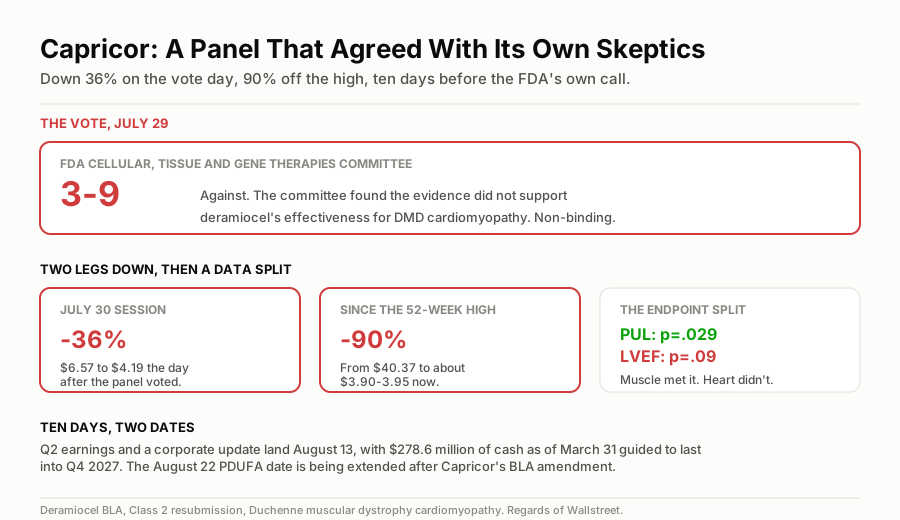
Down 36% on the vote day, 90% off the high, ten days before the FDA's own call.
The Panel Vote and the Two Legs Down
The stock did not fall on one piece of news. It fell on two, four days apart.
July 27: the FDA posted its briefing documents ahead of the advisory committee meeting, restating that "substantial evidence of effectiveness generally requires at least two adequate and well-controlled clinical investigations, each convincing on its own," and reiterating that the earlier HOPE-2 study had not cleared that bar. The stock sold off on the release.
July 29: the Cellular, Tissue and Gene Therapies Advisory Committee met and voted 3 for, 9 against, 0 abstaining on whether the evidence supported deramiocel's effectiveness for cardiomyopathy in the narrower indication the FDA had framed for the vote, not the full label Capricor originally proposed. CEO Linda Marbán said afterward the company "remain[s] focused on working with the FDA toward potential approval" ahead of the August 22 date. The market's answer came the next session: CAPR closed at $6.57 on July 29 and $4.19 on July 30, a 36% drop in a single day.
Shares have drifted lower since, trading around $3.90-3.95 as of this week, which puts the stock roughly 90% below its 52-week high of $40.37, a level reached earlier this year on optimism around the original HOPE-3 topline readout before any of this played out.
Worth naming the parallel on this site: Replimune fell 32% on similarly skeptical FDA briefing documents in July, then rallied 127% when its own advisory panel overruled the agency's staff and voted 10-3 in favor. Capricor's setup runs the other direction. Its panel did not overrule the staff's doubts, it agreed with them, 9 to 3. That distinction matters more than the headline "another biotech advisory vote" suggests, and it's the reason I don't read this as the same trade.
A Trial That Passed One Test and Missed Another
HOPE-3 did not simply fail. It split down the middle, and which half you weight decides where you land on August 22.
The primary endpoint, Performance of Upper Limb (PUL v2.0), met its target. Deramiocel showed a 54% slowing of progression in the intent-to-treat population at 12 months, statistically significant at p=.029. The committee's own discussion of this data was, per Capricor's account, "directionally supportive."
The key secondary endpoint is where the case gets weaker. Left ventricular ejection fraction, or LVEF, is the cardiac function measure most directly tied to the cardiomyopathy indication under review, and it is the one that matters most given the drug is a cardiac cell therapy. Capricor's original topline release described a 91% slowing of LVEF decline. But an updated statistical model, developed through dialogue with the FDA and in response to peer review at The Lancet, produced a different result when applied to the overall study population: a 1.8 percentage point treatment difference at p=.09, not statistically significant. That change was disclosed in an SEC filing on July 29, the same day as the panel vote.
None of this needs an accusation of wrongdoing. The muscle data is real and the panel said so. The heart data, which is the whole point of a drug indicated for cardiomyopathy, lost its statistical footing once the analysis was redone the way regulators and peer reviewers wanted it done. A company can walk into a hearing with a genuinely positive trial and still lose the vote on the measure that was supposed to prove the label.
What Wall Street Did With Its Price Targets
Sell-side reaction to the vote was uniformly negative, and it shows in the targets, not just the ratings:
- Oppenheimer cut to Perform from Outperform.
- Cantor Fitzgerald cut to Neutral from Overweight, price target $3.50, down from $62.
- Alliance Global Partners cut to Neutral from Buy, price target $7, down from $51.
- H.C. Wainwright cut to Neutral from Buy.
These are the analysts' own targets, set in the days immediately after the vote, not this site's. A $3.50 target from Cantor sits below where the stock trades now; a $7 target from Alliance Global implies close to a double from current levels. The spread between those two numbers, both published in the same week, is itself a fair measure of how unresolved this is nine days out.
The Money Question Before the Data Question
Capricor reports Q2 2026 results and a corporate update on August 13, with the call at 4:30pm ET, one day before this article publishes and nine days before the FDA's own decision. As of March 31, 2026, the company held $278.6 million in cash, cash equivalents and marketable securities, and posted a Q1 net loss of $33.9 million. Management's stated runway, excluding any product revenue or Priority Review Voucher sale, is into Q4 2027.
That runway matters regardless of which way August 22 goes. An approval likely means a commercial launch that needs funding well before deramiocel generates meaningful revenue. A second rejection means the company reworks its regulatory strategy from a considerably weaker cash and market-cap position than it had a month ago; the market cap when this was written was roughly $225-230 million against that $278.6 million cash balance (the update at the top of this page carries the June 30 cash figure and Thursday's market cap), which is itself a signal of how little residual value the market is assigning to the drug program. Multiple shareholder class-action suits have also been filed alleging securities-fraud claims tied to the clinical data disclosures, with a lead-plaintiff deadline of September 28, 2026; those are allegations, not findings, and Capricor has not been found liable of anything.
The Options Angle
CAPR has listed options, but this site could not source verified, same-session pricing for August strikes this week, and a binary regulatory catalyst is exactly the situation where a stale or estimated option price is worse than no price at all. Rather than publish a structure against numbers that cannot be checked, the call here is a pass, logged like any other.
Trade log
| # | Stance | Structure | Strikes and expiry | Cost or credit | Spot at writing | Implied move | Breakeven |
|---|---|---|---|---|---|---|---|
| 1 | Pass | Any directional options structure into Aug 22 | N/A | Pricing not sourced this session | ~$3.90-3.95 (Aug 11 close area) | Not sourced | N/A |
The reasoning, for the record: a stock already down 90% with a 9-3 advisory vote against it on the record is not a coin flip priced at even odds, it is a skewed bet the market has already partly repriced. Anyone trading this into the 22nd is choosing between "the FDA sides with a panel that agreed with its own staff's doubts" and "the muscle data and the unmet medical need in DMD carry a narrow or conditional approval anyway." Both are real cases. Neither is free money, and a long straddle on an illiquid microcap biotech into a single binary date carries execution risk (wide bid-ask spreads, thin open interest) that a clean implied-move number would understate anyway.
The One-Line Read
The setup into August 22 looks more like a second rejection than a Replimune-style reversal, because here the advisory panel agreed with the FDA staff's own doubts instead of overruling them, and the specific data that failed, LVEF, is the one that was supposed to justify a cardiomyopathy label in the first place; that doesn't make CAPR a short at $3.90 with 90% of the disappointment already in the tape, but it's not a stock I'd be adding into the decision on hope that the FDA sides with the minority of its own panel.
Next up:GDP, Wednesday at 8:30am ET →
More on $CAPR
Updated Every Saturday
The Week Ahead
Every earnings date, Fed event and setup for the current trading week, on one page.
Refreshed Weekly
Earnings Calendar
Who reports next, when, and what consensus and the whisper expect.
The Week-Ahead Brief
Don’t miss next week’s setups. Get the Saturday brief.
Latest issue, Aug 17“The consumer cracked on Friday. Six retailers answer for it this week.”
Every Saturday: next week’s earnings dates, Fed days and the trades worth watching, from the same desk that writes the week-ahead hub. Free, built for retail investors.